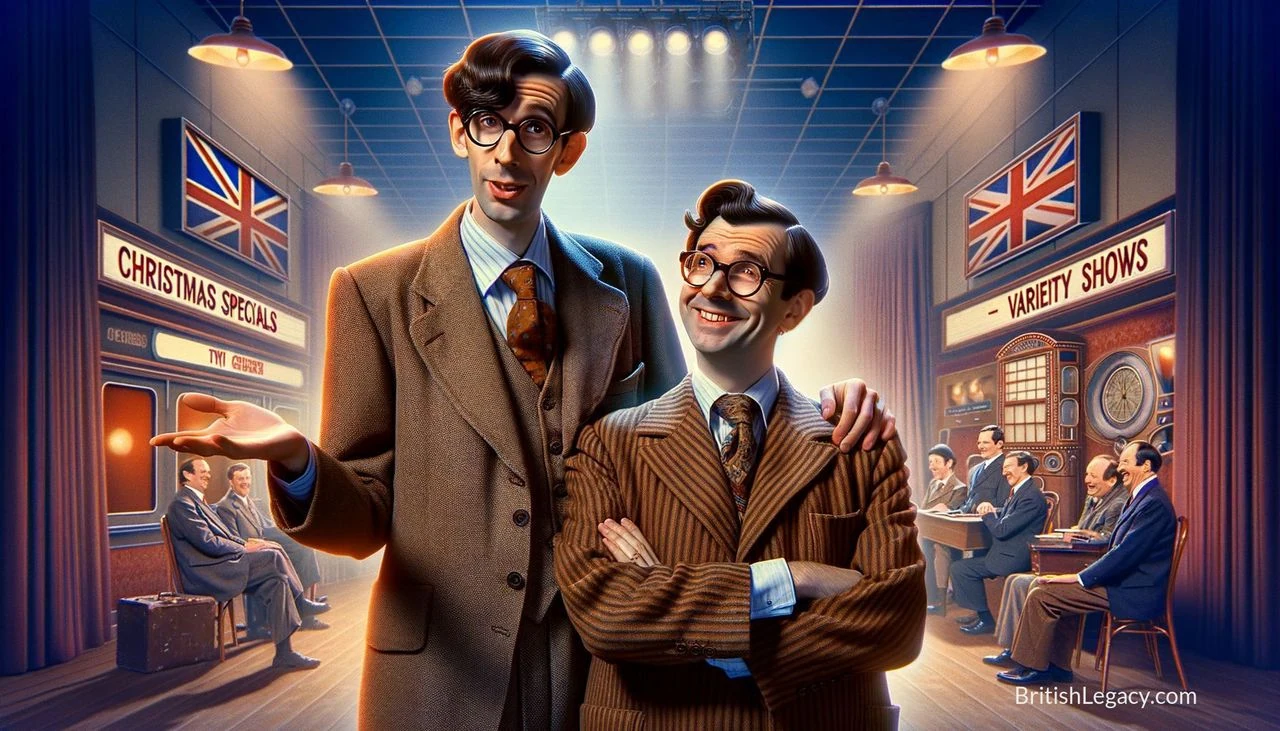
Eric Morecambe and Ernie Wise could turn a missed musical cue, a badly written play or a celebrity’s name into a comic event. Their double act began in variety, travelled through radio and television, and reached its widest audience in the BBC shows of the 1970s. The familiar partnership was more than a contrast between a mischievous comic and a straight man: over time, each performer became a distinctive character in a carefully constructed world of recurring jokes, musical routines and guest appearances.
A partnership takes shape
Eric Morecambe was born John Eric Bartholomew in Morecambe, Lancashire, on 14 May 1926. Ernie Wise was born Ernest Wiseman in Bramley, in the West Riding of Yorkshire, on 27 November 1925. Their friendship began in 1940, when they were booked separately for Jack Hylton’s revue Youth Takes a Bow at the Nottingham Empire Theatre. At the suggestion of Eric’s mother, Sadie, they worked on an act together. They made their double-act debut as Bartholomew and Wise at the Liverpool Empire in August 1941.
War service interrupted their partnership. They reunited by chance at the Swansea Empire Theatre in 1946 and returned to work in variety, performing at venues around Britain, including the Windmill Theatre and Glasgow Empire. The act did not arrive fully formed: its timing and characters developed through years of live performance and changes in writing. In 1950, Wise wrote to Morecambe proposing that they break up, believing the act would not work. Morecambe rejected the idea, and they went back to looking for work together.
From variety to television
Radio brought a wider audience. The duo appeared in the BBC’s Variety Fanfare, made in Manchester, before their own radio programme, You’re Only Young Once, was first broadcast on 9 November 1953. They moved into television in 1954 with Running Wild. Its reception was poor; one newspaper review mocked them, and the experience helped prompt them to take tighter control of their material. A 1956 appearance on the Winifred Atwell show, with material by Johnny Speight, proved more successful. In 1959 they topped the bill in the BBC’s Boxing Day edition of The Good Old Days.
They began their ITV series Two of a Kind in 1961; later series were billed as The Morecambe & Wise Show. Their television career was not an uninterrupted climb, but the move to the BBC in 1968 marked a decisive change. There they worked with writer Eddie Braben, whose scripts gave the duo a more layered relationship and shaped the humour for which the later shows are best remembered. Morecambe was not simply the chaotic one opposite a conventional straight man: Braben’s writing allowed both performers to set up jokes and land them, while Wise’s confident, faintly self-important character could be as funny as Morecambe’s reactions.
Producer John Ammonds helped define the BBC shows’ presentation and brought in celebrity guests. Ernest Maxin, who took over as producer in 1974, choreographed and staged musical comedy sequences, including “The Breakfast Sketch” and the duo’s recreation of Singin’ in the Rain. The work combined scripts, performance, production and choreography; its loose-seeming banter depended on a recognisable format that viewers could return to.
Sketches, songs and a comic world
Their shows moved between sketches, songs, guest appearances and scenes in a shared flat. A recurring feature was Wise’s claim to have written a play, introduced as “the play what I wrote”. These deliberately inept dramas put the duo alongside celebrated guests, who were drawn into the joke rather than treated as untouchable stars. The format let Morecambe and Wise parody theatrical grandeur while making the guest’s participation part of the comedy.
Catchphrases and visual gags gave the programmes a language of their own. Eric might offer Ernie “Tea, Ern?” or ask, “What do you think of it so far?”, then answer “Rubbish!” on behalf of an inanimate prop. Their routines also played on misnaming famous guests. In the best-known example, conductor André Previn was introduced as “Andrew Preview”. In the 1971 sketch built around Edvard Grieg’s Piano Concerto in A minor, Eric’s incompetent playing provoked Previn’s objection that he had got the notes wrong. “I’m playing all the right notes,” Morecambe replied, “but not necessarily in the right order.”
Music was not an ornament to the comedy but one of its central ingredients. Their distinctive skipping dance was based on a Groucho Marx routine and developed for the BBC shows by Ammonds. “Bring Me Sunshine” became their signature tune. Maxin’s 1976 Singin’ in the Rain sequence made a practical constraint comic: with water unsafe on a studio floor crowded with electrical cables, Ernie danced Gene Kelly’s routine without the rain, while Eric, playing a policeman, received the downpours. The “Breakfast Sketch”, also from 1976, turned kitchen utensils, toast and sausages into props for a dance to “The Stripper”.
Christmas audiences and work beyond the specials
The BBC years made Morecambe and Wise a regular presence in British homes. Their Christmas programmes became major television events, with specials across the period from 1969 onwards. The 1974 Christmas broadcast was a compilation rather than a new show, following Morecambe’s heart attack. The 1977 Christmas Show attracted more than 20 million viewers, although reported estimates vary. Their popularity was not confined to festive broadcasts: the pair made series and specials for the BBC and later Thames Television, and their radio work continued with The Eric Morecambe and Ernie Wise Show on BBC Radio 2 from 1975 to 1978.
They also made feature films, including The Intelligence Men (1965), That Riviera Touch (1966) and The Magnificent Two (1967). Their final film, Night Train to Murder, was made in 1983. They appeared on the American Ed Sullivan Show twelve times between 1963 and 1968, more often than any other British entertainers, according to the account of their career. In Britain, the BFI’s 2000 list of the 100 Greatest British Television Programmes placed The Morecambe and Wise Show at number 14.
Two careers after the partnership
Morecambe married Joan Bartlett in 1952; the couple had three children. His health was troubled by heart problems. After a heart attack in 1968 and another following bypass surgery in 1979, he stopped smoking and drinking and became a public advocate for heart research. On 28 May 1984, he suffered a fatal heart attack during the curtain call of a performance at the Roses Theatre in Tewkesbury. He died at Cheltenham General Hospital, aged 58.
Wise had married dancer Doreen Blythe in 1952. After Morecambe’s death, he returned to song-and-dance performance and pursued a solo career, then became a prominent elder statesman of British comedy, giving interviews and appearing at awards ceremonies. He died on 21 March 1999, aged 73, at Wexham, Buckinghamshire, after returning to England following heart surgery and a period of convalescence. Their joint honours included appointment as Officers of the Order of the British Empire in 1976. They received the BAFTA Fellowship posthumously in 1999, and a blue plaque was placed at Teddington Studios in 2013, where the last four series of their show had been recorded.
Why Morecambe and Wise deserve a place in British Legacy
Morecambe and Wise deserve a place in British Legacy because their work shows how a British entertainment partnership could evolve across variety, radio and television without losing its distinctive character. They built their act in front of live audiences, adapted it for broadcasting, and developed a television format that could bring together comic dialogue, music, physical performance and guest appearances. Their celebrated BBC years were a collective achievement: Braben’s writing deepened the characters, Ammonds and Maxin shaped the production and movement, and the duo made recurring routines feel fresh through timing and performance.
Their Christmas programmes became an unusually powerful part of the television year, while sketches such as the Previn concerto and the waterless Singin’ in the Rain routine show the precision behind their apparent disorder. The audience figures for the 1977 special and the BFI ranking of their show offer concrete measures of their reach; their repeated appearances on American television also carried the partnership beyond Britain. Their legacy is not simply a collection of catchphrases or a claim that they united everyone. It lies in the comic forms they made memorable: the celebrity guest treated as a participant, the pompous play that collapses in performance, and music and physical comedy woven into the same sketch. Those achievements give their work a specific and enduring place in British television history.
Sources
Morecambe and Wise (revision 1378546701)
Adapted in part from Morecambe and Wise by Wikipedia contributors, under CC BY-SA 4.0. Text has been edited and combined with the existing article; this adapted text is shared under the same licence. Contributor history.