
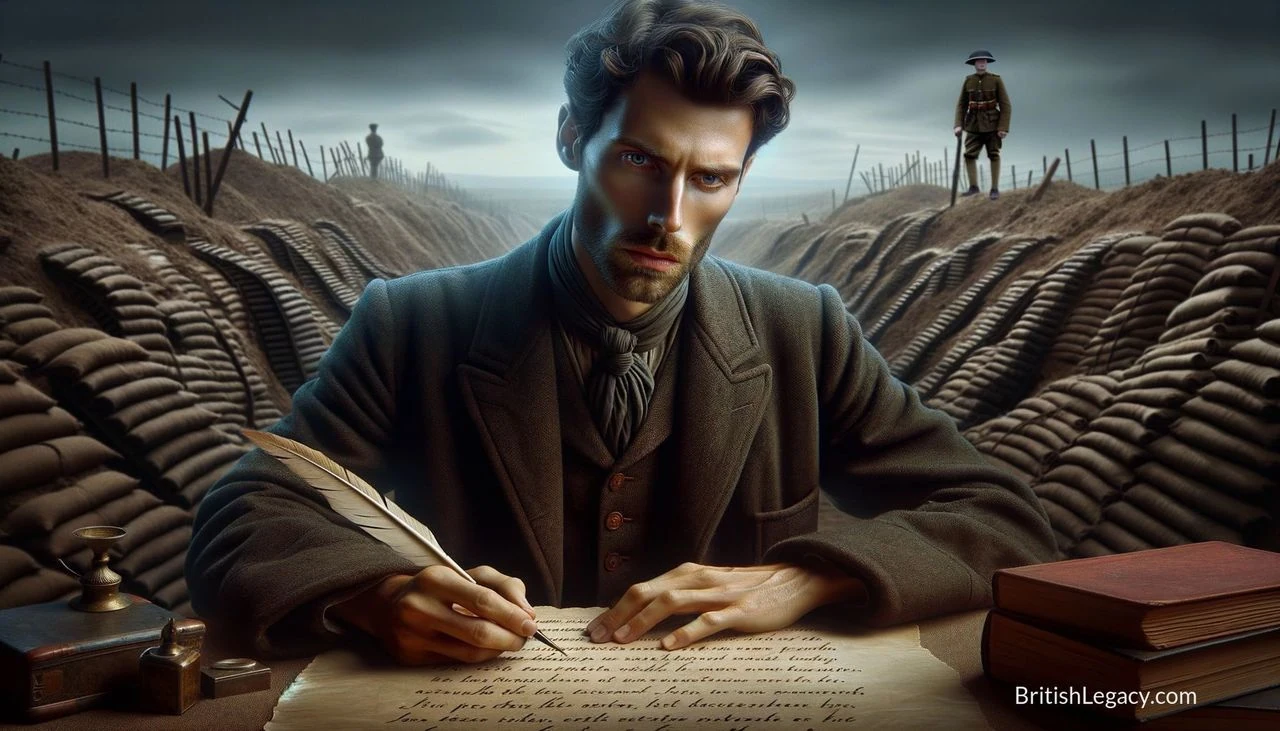
Siegfried Sassoon experienced the First World War both as a decorated officer on the Western Front and as a poet who refused to disguise its costs. His poems turned trench warfare into sharp, unsparing verse; his 1917 Soldier’s Declaration challenged the continuation of the conflict. The story did not end with protest or poetry: after the war, Sassoon became a literary editor, novelist and autobiographer whose work ranged from battlefield experience to the country pursuits of his youth.
From Matfield to the Western Front
Siegfried Loraine Sassoon was born on 8 September 1886 at Matfield in Kent. His father, Alfred Ezra Sassoon, belonged to the wealthy Baghdadi Jewish Sassoon family; his mother, Theresa, was Anglo-Catholic and came from the Thornycroft family of sculptors. The family lived at Weirleigh, a neo-Gothic house in Matfield. Sassoon attended New Beacon School in Sevenoaks, Marlborough College and Clare College, Cambridge, where he read history from 1905 to 1907. He left without a degree and spent the following years hunting, playing cricket and writing verse.
He joined the Sussex Yeomanry on 4 August 1914, the day Britain declared war on Germany. A riding accident broke his arm and delayed his departure from England. Commissioned into the Royal Welch Fusiliers in 1915, he went to France that November. The death of his younger brother Hamo at Gallipoli followed soon afterwards. On the Western Front, Sassoon’s experience of war transformed his writing: the romantic manner of some early poems gave way to verse that confronted death, injury, filth and fear.
Sassoon was also known for conspicuous courage. In July 1916 he received the Military Cross after a trench raid in which he remained under fire to bring in the wounded. His daring earned him the nickname “Mad Jack”. Bravery and anger at the war existed side by side: his service gave him direct knowledge of combat, while the suffering he witnessed sharpened his opposition to the way the conflict was being conducted.
Poetry that refused the heroic gloss
The Old Huntsman, published in 1917, was among Sassoon’s early war poetry collections. Counter-Attack and Other Poems followed in 1918. The title poem renders a battlefield of mud, bodies and exhausted men, a world far removed from abstract talk of honour. In “The General” and “Base Details”, Sassoon used satire to attack military leaders whom he saw as remote from the consequences borne by soldiers. His poems did not offer a detached account of battle: they made the human wreckage and the gap between front and command central to their effect.
His protest became public in July 1917, when he wrote “Finished with the War: A Soldier’s Declaration”. Sassoon argued that the war, which he had entered as a conflict of defence and liberation, had become one of aggression and conquest. The letter was forwarded to the press and read in the House of Commons. Rather than face a court-martial, he was judged unfit for service and sent to Craiglockhart War Hospital near Edinburgh, where he was officially treated for neurasthenia, then commonly called shell shock.
At Craiglockhart, Sassoon met Wilfred Owen, who was also receiving treatment. Sassoon encouraged Owen’s ambitions as a poet and amended a manuscript of “Anthem for Doomed Youth”; the marked-up copy survives. Their friendship connected two important voices in First World War poetry, although Owen was killed in 1918, a week before the Armistice. Sassoon returned to active service and was later wounded in the head near Arras, reportedly by a British soldier who mistook him for a German. The injury kept him in Britain for the remainder of the war. He relinquished his commission on health grounds in 1919, retaining the rank of captain.
After the armistice: editing, fiction and memory
Sassoon continued to write and took up a new role in public life. In 1919 he became literary editor of the socialist Daily Herald. He commissioned work from writers including Arnold Bennett and Osbert Sitwell and employed reviewers such as E. M. Forster and Charlotte Mew. His interests extended to music: he befriended the young William Walton and supported him financially and personally. Walton later dedicated his overture Portsmouth Point to Sassoon.
His reputation as a prose writer grew with Memoirs of a Fox-Hunting Man, published anonymously in 1928. Its fictionalised central character, George Sherston, recalls a country childhood shaped by hunting, cricket and country-house life, with a lighter comic touch than Sassoon’s war poetry. The book won the 1928 James Tait Black Award for fiction. He continued Sherston’s story in Memoirs of an Infantry Officer (1930) and Sherston’s Progress (1936), and later published autobiographical volumes including The Old Century, The Weald of Youth and Siegfried’s Journey.
In December 1933, Sassoon married Hester Gatty; their son, George, was born in 1936. The marriage broke down after the Second World War, and Sassoon lived in seclusion at Heytesbury in Wiltshire after their separation in 1945. In 1957 he converted to Catholicism. He died of stomach cancer on 1 September 1967, aged 80, and was buried at St Andrew’s Church, Mells, in Somerset. His honours included the Military Cross and appointment as a Commander of the Order of the British Empire in the 1951 New Year Honours.
Keeping the record: collections and commemoration
Sassoon’s words and records have continued to draw attention after his death. In 1985, he was among 16 First World War poets commemorated on a slate stone in Westminster Abbey’s Poets’ Corner. The inscription, taken from Owen’s preface to his poems, reads: “My subject is War, and the pity of War. The Poetry is in the pity.” The line places Sassoon’s work in a wider remembrance of the poets who wrote about the conflict, while the friendship between Sassoon and Owen remains part of the history of that literature.
Sassoon’s papers also preserve evidence of his life and service. In 2009, the University of Cambridge acquired a collection that included his war diaries, a draft of the Soldier’s Declaration, school notebooks and post-war journals. It also contained letters and photographs. The archive joined a university collection connected to Sassoon’s own time at Cambridge and his later status as an honorary fellow of Clare College. A 2010 exhibition at Cambridge drew on his life and archive.
His military decorations became part of that public record too. Sassoon’s Military Cross was rediscovered by his family in 2007 and acquired by the Royal Welch Fusiliers for display at its museum in Caernarfon. His service medals, CBE and warrant of appointment were also recorded in later sales. These objects sit alongside the poems and papers: they show the soldier’s formal recognition, while the writing records the cost and moral difficulty of the war he served in.
Why Siegfried Sassoon deserves a place in British Legacy
Sassoon’s place in British literary history rests on the force with which he joined experience to form. He served in the British Army, won the Military Cross for bringing in wounded men under fire, and wrote poems that rejected any easy separation between battlefield courage and battlefield suffering. In “The General”, “Base Details” and Counter-Attack, satire and stark physical detail challenged the language that made war seem clean or glorious. His Soldier’s Declaration carried that challenge beyond the page: it brought a serving officer’s dissent into public and parliamentary debate, and led to his removal from active service.
His contribution was not confined to his own poems. At Craiglockhart, Sassoon encouraged Wilfred Owen and helped shape a manuscript of “Anthem for Doomed Youth”; after the war, he helped bring Owen’s writing to a wider audience. His post-war work also widened the record he left behind. The Sherston books turned to memory, class and rural life, while his diaries and papers now offer material for the study of war and literature. The Cambridge archive and Westminster Abbey memorial keep those records accessible and connected to public remembrance. Sassoon’s British legacy is therefore not simply that of a famous war poet: it includes a decorated soldier’s dissent, a sustained literary career and a role in supporting another major voice of the war.
Sources
Adapted in part from Siegfried Sassoon by Wikipedia contributors, under CC BY-SA 4.0. Text has been edited and combined with the existing article; this adapted text is shared under the same licence. Contributor history.
.jpg)