
Wilfred Owen’s poems do not make the soldier’s death a clean emblem of glory. They bring readers close to the choking gas, the guns and the men who die far from the ceremonies that might have honoured them. Owen wrote from military experience, but his work was made through revision, literary friendship and hard-won changes in poetic voice. He was killed in France a week before the Armistice; most of the poems for which he is now remembered appeared after his death.
A poetic vocation before the war
Wilfred Edward Salter Owen was born on 18 March 1893 in Oswestry, Shropshire, the eldest of four children of Thomas and Susan Owen. His family moved several times during his childhood, living in Birkenhead and Shrewsbury. He attended the Birkenhead Institute and Shrewsbury Technical School. Owen later traced the beginnings of his poetic vocation to a holiday in Cheshire in about 1904. The Bible and Romantic poets, particularly Wordsworth and Keats, were among his early influences.
In 1911 Owen passed the University of London matriculation examination, but not at the level needed for the scholarship that was the only means by which he could afford to attend. He worked as a lay assistant to the vicar of Dunsden, near Reading, from 1911 to 1913, receiving lodging and some tuition in return. During that period he attended classes at University College, Reading, first in botany and later in Old English. His experience at Dunsden also contributed to disillusionment with the Church, including its ceremonies and its failure to help people in need.
In 1913 he moved to France, where he taught English and French at the Berlitz School of Languages in Bordeaux and later worked with a family. He met the French poet Laurent Tailhade and corresponded with him in French. When war began, Owen did not rush to enlist; he even considered joining the French army. He returned to England and enlisted in the Artists Rifles on 21 October 1915.
War service and a changed poetic voice
Owen trained at Hare Hall Camp in Essex and, in June 1916, received a commission as a second lieutenant in the Manchester Regiment. Front-line service brought experiences that altered his understanding of the war. He suffered concussion after falling into a shell hole and was caught in a trench-mortar explosion. After spending several days unconscious, he was diagnosed with neurasthenia, or shell shock, and sent to Craiglockhart War Hospital in Edinburgh.
At Craiglockhart, Owen met Siegfried Sassoon. Sassoon became a close literary influence and encouraged the younger poet’s turn towards realism and satire. Owen’s doctor, Arthur Brock, also encouraged him to translate the experiences he relived in dreams into poetry. These influences met Owen’s earlier romantic sensibility: the result was not simply a record of battle, but writing that joined direct physical detail to pity for the people caught in war.
After leaving Craiglockhart, Owen undertook light regimental duties. He spent time in Scarborough and was posted to Ripon in March 1918, where he composed or revised poems including Futility and Strange Meeting. He returned to active service in France in July. On 1 October 1918, he led men of the Second Manchesters in an attack near Joncourt. His conduct brought the Military Cross, although the award was not gazetted until February 1919.
Poems that refuse easy consolation
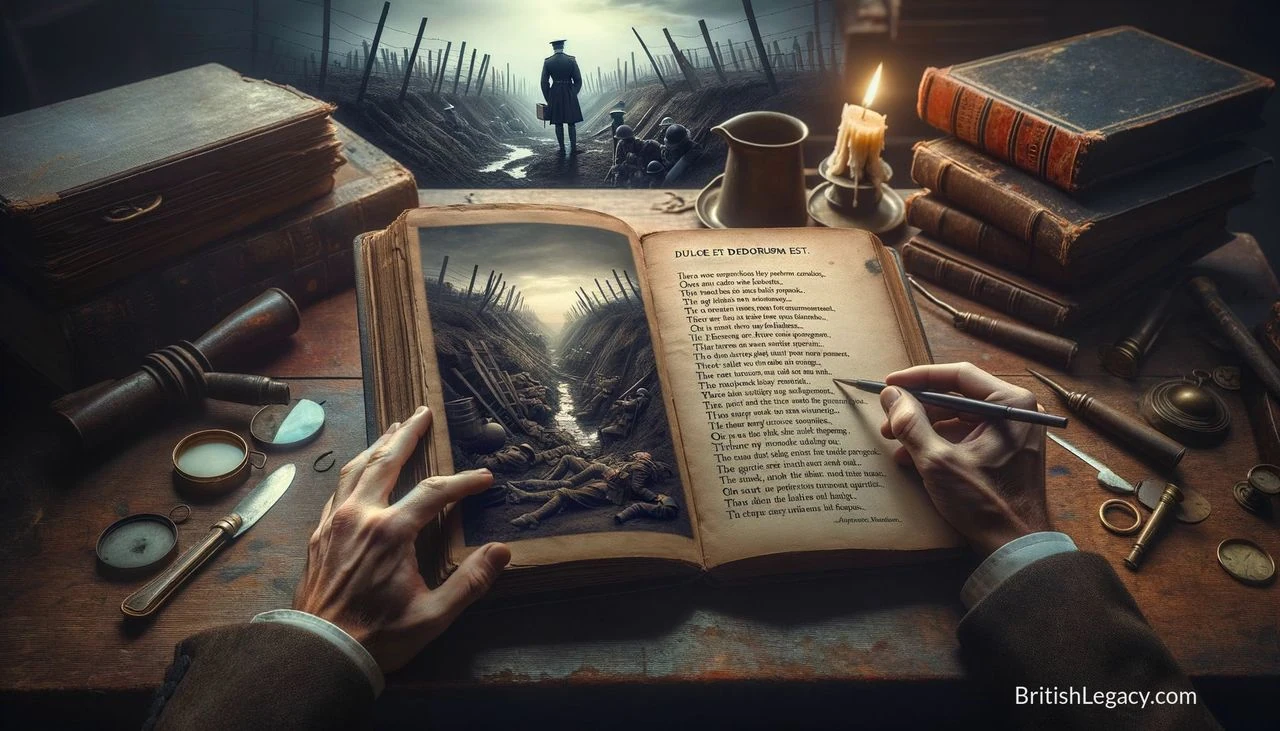
In Dulce et Decorum Est, a gas attack becomes an immediate human ordeal: the poem follows the men through exhaustion and panic, then fixes on a soldier choking to death. Its closing address condemns the claim that it is sweet and honourable to die for one’s country. Owen’s force comes not from an abstract argument against war, but from the contrast between an inherited patriotic formula and the suffering the poem makes visible.
Anthem for Doomed Youth asks what funeral rites can be offered to soldiers killed in battle. Its answer replaces bells, prayers and ceremony with the sounds of guns and shells, and with the grief of those left behind. The poem’s formal control sharpens rather than softens its subject: the battlefield’s violence and the home front’s mourning occupy the same elegy.
Owen had been writing poems for years, but only five were published before his death, one in fragmentary form. His planned volume and its preface remained unrealised. His poems circulated in The Hydra, the magazine he edited at Craiglockhart, and Miners appeared in The Nation. The first collection, Poems, was published in 1920. A fuller edition followed in 1931, and later collections and scholarship brought a larger body of work into view.
Sassoon helped promote Owen’s poems, while Edith Sitwell supported their publication and Edmund Blunden prepared the 1931 edition. Owen’s posthumous reputation therefore grew through the work of friends, editors and later readers as well as through the poems themselves. His influence did not erase his individuality: his extensive use of pararhyme and assonance helped give his verse its distinctive sound.
Death, remembrance and an afterlife in the arts
Owen was killed on 4 November 1918 while crossing the Sambre–Oise Canal in France, exactly a week before the Armistice. He was 25. His mother received news of his death on Armistice Day, as bells rang in Shrewsbury. He is buried at Ors Communal Cemetery. The words on his gravestone were adapted by his mother from one of his poems.
His work has been remembered in places connected with his life and service. Memorials stand in Oswestry, Birkenhead and Shrewsbury, as well as in France. In 1985, Owen was among 16 First World War poets commemorated at Westminster Abbey’s Poets’ Corner. The inscription on the memorial stone comes from his preface: “My subject is War, and the pity of War. The Poetry is in the pity.” Craiglockhart, where he met Sassoon and developed as a poet, houses a War Poets Collection.
Owen’s poems have also travelled through music, theatre and film. Benjamin Britten used them extensively in his War Requiem, first performed in 1962. Stephen MacDonald’s play Not About Heroes, first staged in 1982, centres on Owen’s friendship with Sassoon. A Wilfred Owen Association formed in 1989 to commemorate his life and poetry; its work includes readings, talks and the promotion of exhibitions and public memorials.
Why Wilfred Owen deserves a place in British Legacy
Owen deserves a place in British Legacy because his poetry changed the terms in which many readers encounter the First World War. Rather than treating military death as an uncomplicated proof of honour, poems such as Dulce et Decorum Est and Anthem for Doomed Youth set patriotic language against the bodily cost of combat and the grief of those who survive. Their achievement is artistic as well as historical: controlled form and memorable sound make the poems compelling, while their attention to individual suffering resists turning soldiers into abstractions.
His British connection is grounded in a life shaped by Shropshire, Birkenhead, Shrewsbury, Edinburgh and service in the British Army, and in a continuing public remembrance that reaches from local memorials to Westminster Abbey. The story also shows how literary legacies are made. Owen died before he could publish a collection of his work, but Sassoon, Sitwell, Blunden and later readers helped bring the poems to a wider audience. Their continued presence in editions, education, memorials and Britten’s War Requiem carries Owen’s carefully made witness into new settings. His legacy is not merely that he wrote about war, but that his poems give lasting form to the pity he identified as their subject.
Sources
Wilfred Owen — revision 1379807071
Adapted in part from Wilfred Owen by Wikipedia contributors, under CC BY-SA 4.0. Text has been edited and combined with the existing article; this adapted text is shared under the same licence. Contributor history.
.jpg)