
Kazuo Ishiguro’s novels often begin with a voice that seems measured and assured, then let uncertainty gather around what its narrator remembers, believes or has chosen not to confront. That quiet tension runs through stories set in very different worlds: an English country house before the Second World War, a parallel version of late twentieth-century Britain, or an unnamed city in post-war Japan. Ishiguro, who was born in Nagasaki and moved to Britain as a child, has built a career from shifting settings and forms while returning to questions of memory, responsibility and the stories people tell themselves.
From Nagasaki to Surrey
Ishiguro was born in Nagasaki on 8 November 1954, the son of physical oceanographer Shizuo Ishiguro and Shizuko Ishiguro. In 1960, when his father was invited to undertake research at the National Institute of Oceanography, the family moved to Guildford, Surrey. Ishiguro attended Stoughton Primary School and Woking County Grammar School. He grew up in a Japanese-speaking home in Britain, an experience he later described as giving him a perspective different from that of many of his English contemporaries.
As a teenager, he sang in church and school choirs, listened to musicians including Leonard Cohen, Joni Mitchell and Bob Dylan, and learnt guitar. After leaving school in 1973, he spent a year travelling in the United States and Canada, keeping a journal and sending song demos to record companies. He also worked as a grouse beater at Balmoral Castle. At that point, he hoped to become a professional songwriter; he later said that writing songs had taught him to value an intimate first-person voice and to let meaning emerge indirectly, qualities that also shaped his fiction.
In 1974 he began studying English and philosophy at the University of Kent, graduating in 1978. After a year writing fiction, he entered the creative writing course at the University of East Anglia, where he studied with Malcolm Bradbury and Angela Carter. He completed an MA in 1980. His thesis became his first novel, A Pale View of Hills, published in 1982. He became a British citizen in 1983.
Early novels and changing ground
Ishiguro’s first two novels look towards Japan, but their settings were not straightforward records of a country he knew from adult life. He later explained that the Japan of those books was, in part, an imagined place formed while he was growing up in England. A Pale View of Hills follows a Japanese woman reflecting on her past, while An Artist of the Floating World centres on an ageing artist reassessing his conduct and ideals after the war. The second book received the Whitbread Prize in 1986.
His fiction has since moved through historical settings, speculative premises and unfamiliar cities without abandoning the unsettled perspective of a narrator trying to make sense of the past. In The Unconsoled (1995), a pianist arrives in an unnamed Central European city. When We Were Orphans (2000) adopts the conventions of a detective story. Across these books, the reader is not simply given events in sequence: the narrator’s account, and the limits of what that narrator can see, become part of the story.
An English country house and a remembered school
The Remains of the Day, published in 1989, brought Ishiguro the Booker Prize. Its narrator, Stevens, is an English butler looking back on his service in a great house in the years surrounding the Second World War. A journey across post-war England prompts him to consider his ideas of professional dignity, loyalty and duty, along with the personal costs of having placed service above other attachments. The novel’s country-house setting makes class and inherited authority visible, while Stevens’s restrained account leaves readers to weigh what he cannot readily say.
Merchant Ivory adapted the novel as a 1993 film starring Anthony Hopkins and Emma Thompson. The screen version carried the story to a wider audience, but the book’s controlled first-person voice remains central to its effect: Stevens’s confidence in his own standards sits uneasily beside the evidence of the life he has described.
Never Let Me Go (2005) turns to a seemingly ordinary English school and the childhood memories of Kathy, Ruth and Tommy. Gradually, the characters’ circumstances reveal a disturbing purpose: they are clones intended to donate their organs. Ishiguro’s speculative premise develops through everyday recollections rather than dramatic explanation. The novel’s questions about human worth and mortality are inseparable from the relationships its characters form and the limits they accept. Time named it its best novel of 2005 and included it in its list of the 100 best English-language novels published since 1923. A film adaptation followed in 2010.
Beyond the novel
Ishiguro’s work has also crossed into screenwriting and music. He wrote screenplays including The White Countess (2005), and adapted the screenplay for Living (2022), Oliver Hermanus’s British film based on Akira Kurosawa’s Japanese film Ikiru. The screenplay was nominated for an Academy Award in 2023.
His longstanding interest in songs became a working collaboration with jazz singer Stacey Kent and her husband, saxophonist Jim Tomlinson. Ishiguro wrote lyrics for Kent, including the title song of her 2007 album Breakfast on the Morning Tram, which received a Grammy nomination. Their collaboration continued on later albums. In 2024, Faber & Faber published The Summer We Crossed Europe in the Rain: Lyrics for Stacey Kent, a collection of 16 of his lyrics, illustrated by Bianca Bagnarelli.
In Klara and the Sun (2021), the narrator is Klara, an Artificial Friend, and the novel considers technology, the future and what it means to be human. The book’s unusual viewpoint extends a career in which Ishiguro has repeatedly changed genre and setting while keeping close to the uncertain understanding of an individual consciousness.
Recognition and a British literary life
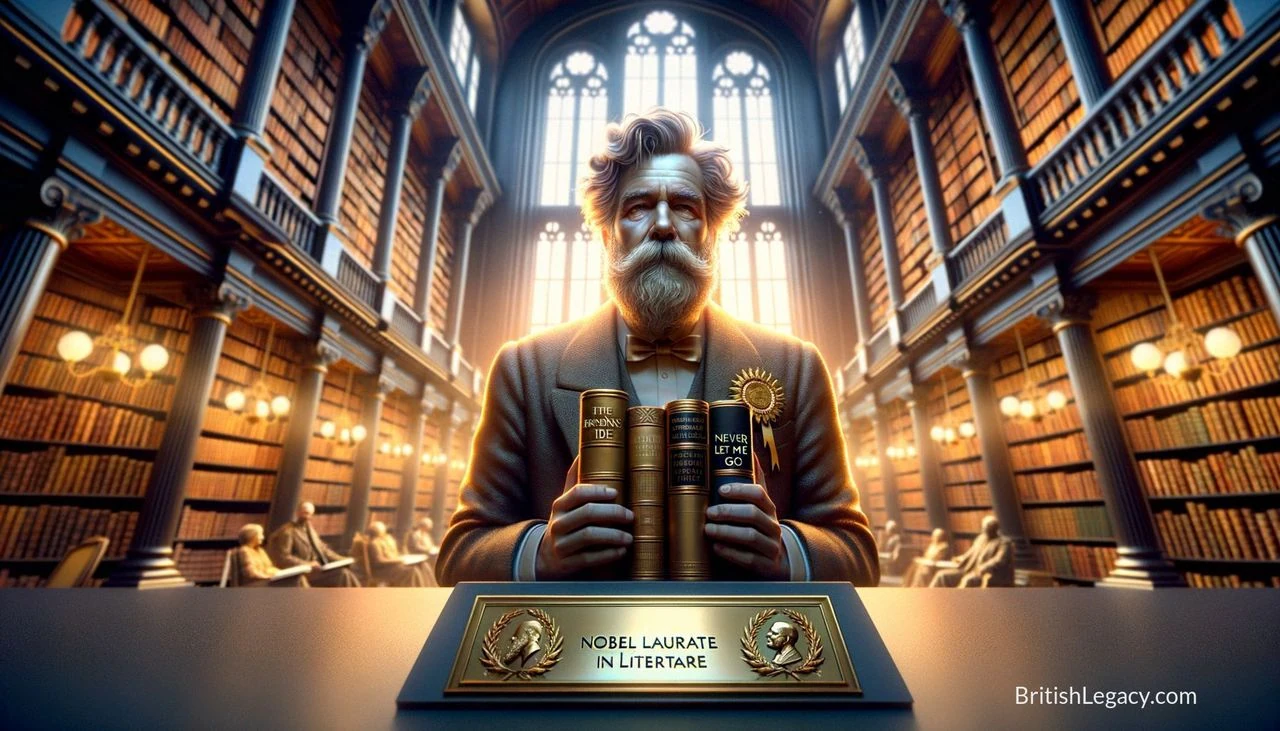
Ishiguro received the Nobel Prize in Literature in 2017. The Swedish Academy’s citation recognised novels of great emotional force that uncover “the abyss beneath our illusory sense of connection with the world”. The award acknowledged a body of work that includes Japanese settings and imagined futures as well as some of his most recognisable depictions of English life.
His other honours include the Booker Prize, election as a Fellow of the Royal Society of Literature, and appointment as an Officer of the Order of the British Empire in 1995 for services to literature. He was appointed Knight Bachelor in 2018 and a Member of the Order of the Companions of Honour in 2024, both for services to literature. His career has also encompassed short stories, screenplays, lyrics and novels shortlisted for major literary prizes.
Why Kazuo Ishiguro deserves a place in British Legacy
Ishiguro’s place in British literary life is rooted in more than the fact that several of his best-known stories are set in England. He moved to Surrey as a child, studied at the universities of Kent and East Anglia, became a British citizen, and has written novels that scrutinise English institutions and habits of thought. In The Remains of the Day, the country house is not merely a picturesque setting: Stevens’s service brings questions of class, loyalty and political judgement into the intimate space of one man’s recollections. In Never Let Me Go, a familiar English school becomes the setting for a quiet examination of how people live with limits imposed on their lives.
His wider contribution is equally significant. Ishiguro has moved among historical fiction, speculative fiction, screenwriting and songwriting without treating genre as a boundary. His narrators make readers attend to omissions and self-deception, and his changing settings show how those concerns can travel across cultures and periods. The Nobel Prize brought international recognition to a writer whose education and working life are closely connected with Britain; his British citizenship and literary honours add to that record. His achievement is not that his work speaks for a single national identity, but that it has enlarged the range of stories and perspectives within British literature.
Sources
Adapted in part from Kazuo Ishiguro by Wikipedia contributors, under CC BY-SA 4.0. Text has been edited and combined with the existing article; this adapted text is shared under the same licence. Contributor history.
.jpg)