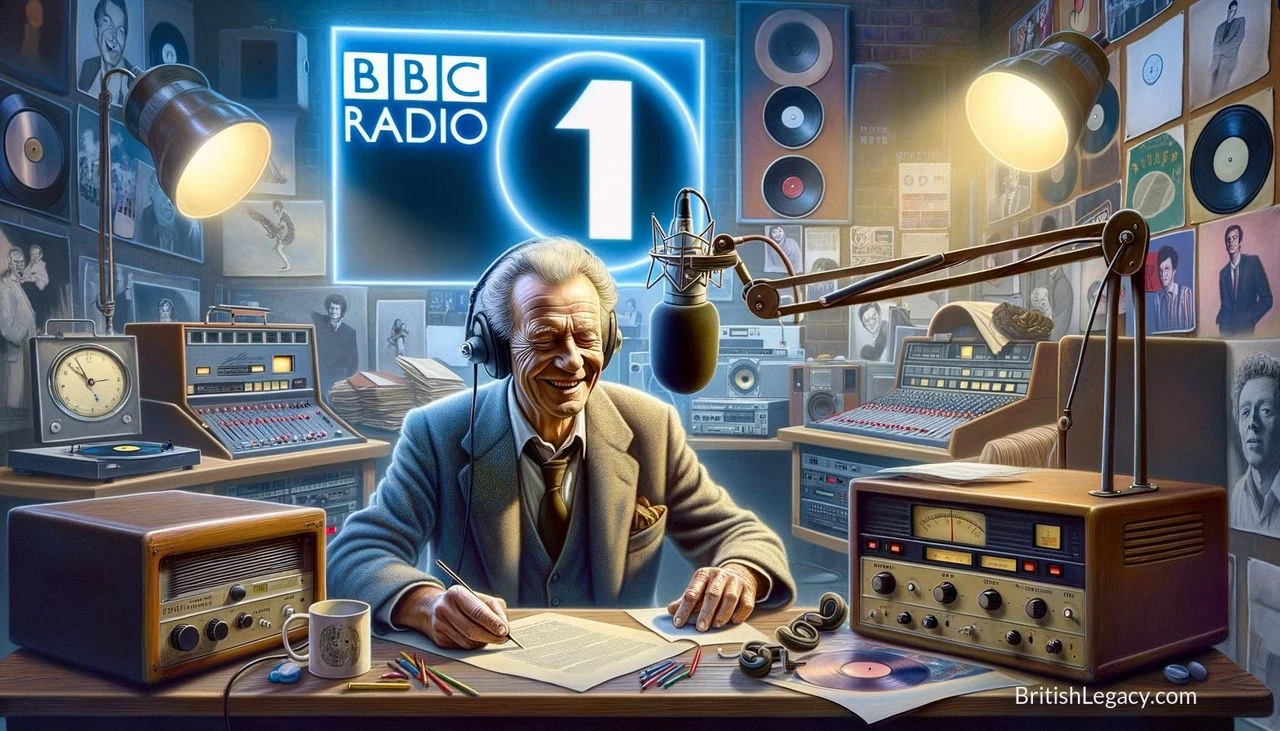
John Peel built a long career around a simple principle: play the records that interested him, even when they were unfamiliar or difficult to categorise. On BBC Radio 1, where he broadcast from 1967 until his death in 2004, that instinct brought new music to a national audience and helped make his programme a place where emerging artists could be heard. The Peel Sessions, recorded in BBC studios, gave performers a distinctive route on to the airwaves; his annual Festive Fifty let listeners shape another part of the programme. His influence grew from curiosity, persistence and a willingness to trust his own ears.
From Heswall to pirate radio
Born John Robert Parker Ravenscroft in Heswall on 30 August 1939, Peel grew up in nearby Burton and attended Shrewsbury School. He listened avidly to radio and collected records from an early age. After national service in the Royal Artillery, he worked at a cotton mill in Rochdale. In 1960, aged 21, he went to the United States, where he held several jobs, including work as an insurance salesman. He also found his way into broadcasting, first at Dallas station WRR and later at stations in Texas, Oklahoma and California.
Peel returned to England in early 1967 and joined the offshore station Radio London. His late-night programme, The Perfumed Garden, ranged across blues, folk and psychedelic rock, with a particular interest in music emerging from Los Angeles and San Francisco. The show’s tone mattered as much as its playlist: listeners wrote in with letters, poems and records of their own. When Radio London closed, Peel moved to the newly launched BBC Radio 1. He presented Top Gear, first sharing the programme and then taking sole charge in 1968; it continued until 1975.
A BBC programme that kept changing direction
Peel’s Radio 1 career lasted 37 years, from 1967 to 2004. The station did not confine him to one style. His programmes moved between pop, dub reggae, punk and post-punk, electronic and dance music, indie rock, extreme metal and UK rap. He was prepared to keep playing a sound when listeners objected. Recalling his first encounter with the Ramones’ debut album, he described the music’s intensity as startling. After some listeners demanded that he stop playing it, he went in the opposite direction and played more.
That readiness to change course helped make the programme a testing ground for unfamiliar music. Peel’s work was not limited to Radio 1: he also broadcast for the BBC World Service and the British Forces Broadcasting Service, as well as stations in several European countries. On television, he appeared as a presenter on Top of the Pops and took part in BBC coverage of music events, including Glastonbury. Later, he brought his relaxed style to BBC Radio 4. Home Truths, which began in 1998, centred on stories about everyday family life rather than celebrity guests.
The sessions and the listeners
Peel Sessions became one of the most enduring features of his Radio 1 programmes. Usually, a group recorded four tracks in a BBC studio, often within a single day. The sessions had a direct, sometimes rough-edged sound, between a live performance and a finished studio recording. BBC restrictions on playing records helped create the conditions for these studio performances: the broadcaster used bands to record music specially for its programmes. Across Peel’s 37 years on Radio 1, more than 4,000 sessions were recorded by more than 2,000 artists.
The sessions offered musicians a chance to be heard in a format that suited experimentation, while listeners could encounter acts before they became widely known. They also formed a lasting record of how artists sounded at a particular moment. In the 1980s, Peel and Clive Selwood established Strange Fruit Records to release material recorded for the BBC sessions.
Another regular feature was the Festive Fifty, a countdown of the year’s favourite records as voted for by listeners. Its results did not always fit the music Peel had championed during the year. In 1991, the chart was not broadcast as planned; a version dubbed the Phantom Fifty was eventually played one track at a time in 1993. A shortened Festive Thirty-One followed in 1997, after limited airtime threatened to cancel the countdown. The format made listeners part of the programme while giving the year’s music a record of its own.
Beyond the playlist
Peel also tried record-label work. In 1969, he founded Dandelion Records to release a debut album by Bridget St John, which he produced. The label issued 27 albums by 18 artists before folding in 1972. It was not a commercial success, but it gave Peel a way to put out music he valued without making likely sales the sole consideration. His later partnership in Strange Fruit focused on recordings made for the BBC.
His broadcasting extended to programmes beyond music. On Radio 4, Offspring explored children and family life before developing into Home Truths. Peel asked for the latter to avoid celebrities, preferring listeners’ accounts of ordinary domestic experience. It was another expression of the attention he gave to material that might otherwise be overlooked: in this case, not a new band or an unfamiliar record, but the details of everyday lives.
Peel died in Cusco, Peru, on 25 October 2004, aged 65, after suffering a heart attack during a working holiday. His funeral took place in Bury St Edmunds. More than 1,000 people attended, including artists whose music he had supported; the service ended with the Undertones’ “Teenage Kicks”, a song he had often named as a favourite. He was buried at St Andrew’s Church in Great Finborough.
Recognition and remembrance
Peel received an OBE in 1998 for services to British music and several broadcasting and music awards. After his death, the BBC held a John Peel Day in 2005, encouraging bands to stage gigs in his memory; more than 500 took place in Britain and elsewhere. A John Peel Centre for Creative Arts opened in Stowmarket in 2013 as a live venue and community meeting place. Blue plaques recognising his contribution were unveiled at two former recording studios in the Rochdale area in 2009 and in Great Finborough in 2017.
Glastonbury also named a stage after him, but the festival renamed it Woodsies in 2023. That later change is part of the record of how public commemorations evolve; it does not erase the role Peel played in music broadcasting. His continued presence is clearest in the sessions, programmes and records through which listeners can still encounter the music he brought to air.
Why John Peel deserves a place in British Legacy
John Peel deserves a place in British Legacy because his work changed what a national radio programme could make room for. From his arrival at Radio 1 in 1967 to his death in 2004, he repeatedly brought music beyond the mainstream into the BBC’s broadcasting schedules. His range extended across genres, and his willingness to follow a new sound rather than protect a fixed format gave listeners a way into music they might not otherwise have encountered. That contribution was not only a matter of personal taste: the BBC sessions created a substantial body of recordings, with more than 4,000 sessions involving over 2,000 artists.
Peel’s connection to British cultural life also lay in the ways he involved listeners. The Festive Fifty turned their votes into an annual musical record, while the conversational exchanges of his early programmes helped make radio feel open to response. His later work on Home Truths carried that attentiveness beyond music, giving ordinary experiences a place on Radio 4. The sessions, the countdown and the programmes together show a broadcaster who made discovery part of public service broadcasting. His legacy is therefore not a claim that he alone created the music or movements he played, but a specific achievement: he helped performers reach audiences and helped audiences listen beyond the familiar.
Sources
John Peel — Wikipedia revision 1379198645
Adapted in part from John Peel by Wikipedia contributors, under CC BY-SA 4.0. Text has been edited and combined with the existing article; this adapted text is shared under the same licence. Contributor history.