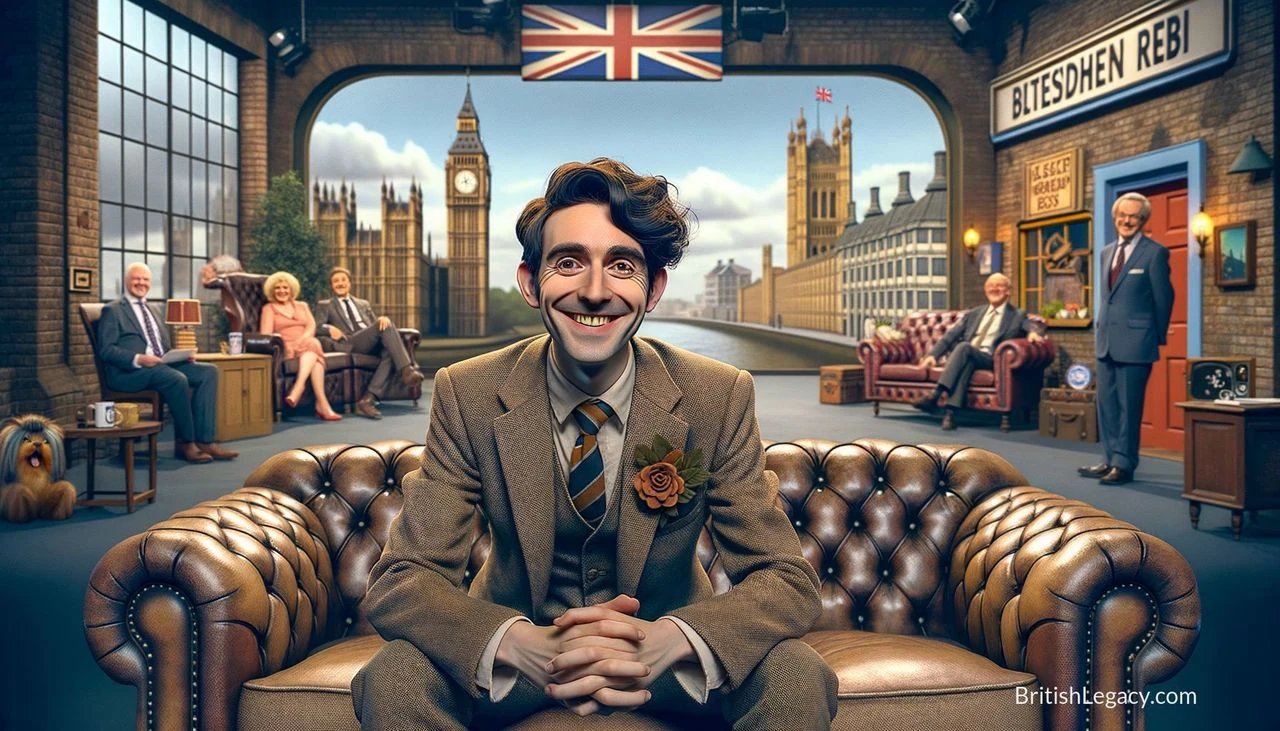
Graham Norton’s television career has moved between comic panel shows, prime-time entertainment and the close-up conversations of a celebrity sofa. Since 2007, The Graham Norton Show has made his relaxed, quick-witted interviewing style familiar to audiences in Britain and beyond. His work also includes years of Eurovision commentary, radio presenting, acting and fiction. Born in Ireland, Norton built the bulk of his television career in the United Kingdom, becoming one of its most recognisable broadcasters.
From Cork to London
Norton was born Graham William Walker on 4 April 1963 in Clondalkin, County Dublin. His father, William, worked as a sales representative for Guinness, and his mother was Rhoda Walker. The family moved around Ireland during his childhood, living in Tramore, Waterford and Kilkenny before settling in Bandon, County Cork, where Norton grew up. He attended Bandon Grammar School.
In 1981, he began studying English and French at University College Cork. He later left his studies and spent a year in San Francisco, where he worked as a waiter. In the late 1980s he moved to London to attend the Central School of Speech and Drama, also working as a waiter. When he joined the actors’ union Equity, he adopted Norton, his great-grandmother’s maiden name, because another actor called Graham Walker was already represented by the union.
His first steps in broadcasting included appearances on BBC Radio 4’s Loose Ends in the early 1990s. In 1992, a stand-up act at the Edinburgh Festival Fringe, in which he appeared as a tea-towel-clad Mother Teresa, attracted press attention after a television religious-affairs department mistook him for the real figure. On Channel 5, he became a stand-in host and then a comic panellist on Bring Me the Head of Light Entertainment. The programme was not well received, but helped establish Norton as a comic and presenter. He co-hosted ITV’s late-night quiz show Carnal Knowledge in 1996 and played Father Noel Furlong in three episodes of Channel 4’s Father Ted between 1996 and 1998.
Finding his television voice
Channel 4 gave Norton his own chat shows: the weekly So Graham Norton, which ran from 1998 to 2002, and the daily V Graham Norton, which followed from 2002 to 2003. Their comic, conversational approach established a format he would later develop on the BBC. In 2001, he also hosted Comic Relief on BBC One.
Norton moved to the BBC in 2005, presenting the Saturday-evening reality series Strictly Dance Fever and the comedy chat show Graham Norton’s Bigger Picture. He became a familiar host of television competitions, including How Do You Solve a Problem Like Maria? in 2006, followed by Any Dream Will Do, I’d Do Anything and Over the Rainbow. These shows asked audiences to follow performers competing for leading roles in West End productions. He presented other BBC programmes, hosted the BAFTA Television Awards on several occasions, and appeared at Live Earth in 2007.
The Graham Norton Show began on BBC Two on 22 February 2007, drawing on the conversational style of his earlier programmes. It moved to BBC One in 2009 with a one-hour format. Its central feature is a group interview: guests share the sofa, listen to one another and often join the same conversation rather than appearing in isolated interviews. Comic asides, audience contributions and stories prompted by the guests give the format its particular rhythm. The source article names Dame Judi Dench, Ian McKellen, Elton John, Taylor Swift and Jennifer Lawrence among the many guests who have appeared on the show.
Radio, Eurovision and other work
Radio has been another substantial part of Norton’s career. He appeared regularly on BBC Radio 4’s panel show Just a Minute from 1999. In 2010, he took over BBC Radio 2’s Saturday-morning slot, presenting it with Maria McErlane. Features included listener requests and discussions around music. After ten years, he presented his final programme in December 2020. He joined Virgin Radio UK in 2021 to host weekend shows and announced in 2024 that he would leave the role.
Norton also became closely associated with the Eurovision Song Contest. He began commenting for the BBC in 2009, taking over from Terry Wogan, and has provided commentary for the contest’s final. He co-hosted the 2023 final in Liverpool with Alesha Dixon, Hannah Waddingham and Julia Sanina, while also sharing the commentary role with Mel Giedroyc. Earlier, he and Claudia Winkleman hosted the Eurovision Dance Contest in 2007 and 2008. In 2015, he co-presented a concert celebrating the Eurovision Song Contest’s 60th anniversary with Petra Mede.
His work has ranged well beyond presenting. Norton wrote a newspaper advice column from 2006 to 2018 and published it as Ask Graham in 2010. His memoirs include So Me and The Life and Loves of a He-Devil; the latter won the non-fiction prize at the 2014 Irish Book Awards. His fiction includes Holding, a novel set in an Irish rural community, which won Popular Fiction Book of the Year at the 2016 Irish Book Awards, and A Keeper. He made his West End stage debut in a 2009 revival of La Cage Aux Folles, and has had film and voice-acting roles.
In 2013, Norton set a Guinness World Record for the most questions asked on a television chat show during Comic Relief’s Big Chat, which raised £1.02 million. In 2019, he became a judge on RuPaul’s Drag Race UK. His television work has been recognised with six BAFTA Television Awards for Best Entertainment Performance and a further BAFTA for producing, according to the supplied biographical account. He has also received a Royal Television Society award for Best Presenter and the National Television Awards’ Special Recognition Award.
An Irish broadcaster in British television
Norton’s story is not one of migration to Britain in pursuit of a career: he moved to London for drama training after growing up in Ireland, and established himself through work on British radio and television. The distinction matters. His career has connected Irish and British entertainment without requiring either identity to stand in for the other. His programmes have carried that connection into the mainstream, from the Irish setting of Father Ted to his presenting work on British television and his continuing involvement with Eurovision.
His public profile has also extended beyond entertainment. In 2014, he criticised RTÉ’s decision to settle out of court with opponents of same-sex marriage who had complained about an edition of the Saturday Night Show. At the 2022 Cheltenham Literature Festival, he argued that “accountability” was a more useful term than “cancel culture” and said discussion of transgender rights should involve trans people, parents and doctors rather than relying on celebrities. The resulting public dispute led him to deactivate his Twitter account. These episodes illustrate the visibility that comes with a prominent broadcasting platform, without reducing his varied career to a single political position.
Why Graham Norton deserves a place in British Legacy
Graham Norton deserves a place in British Legacy because his work has shaped several recognisable parts of modern British broadcasting. His chat-show career developed from the weekly and daily formats he made for Channel 4 into a long-running BBC programme built around guests sharing a conversation. That format has given British television a distinctive way to bring together performers from different fields and countries, with comedy arising from the exchanges between them as much as from the host’s questions. His years presenting BBC Radio 2 and his regular Eurovision commentary extended that presence into radio and one of the UK’s best-known annual broadcasts.
His career also shows how an Irish-born entertainer became a central figure in British popular culture without losing the distinction between birthplace and professional home. Norton has worked across comedy, television, radio, stage performance and writing; his fiction has been recognised by Irish literary awards, while his broadcasting has earned repeated BAFTA recognition. His Eurovision work, including co-hosting the 2023 Liverpool final, links British television presentation with an international event. These achievements offer a specific, substantial legacy: a broadcaster who has helped make celebrity conversation, live entertainment and the shared pleasure of commentary part of the UK’s television landscape.
Sources
Graham Norton — Wikipedia, revision 1379661945 · Graham Norton — Wikipedia
Adapted in part from Graham Norton by Wikipedia contributors, under CC BY-SA 4.0. Text has been edited and combined with the existing article; this adapted text is shared under the same licence. Contributor history.