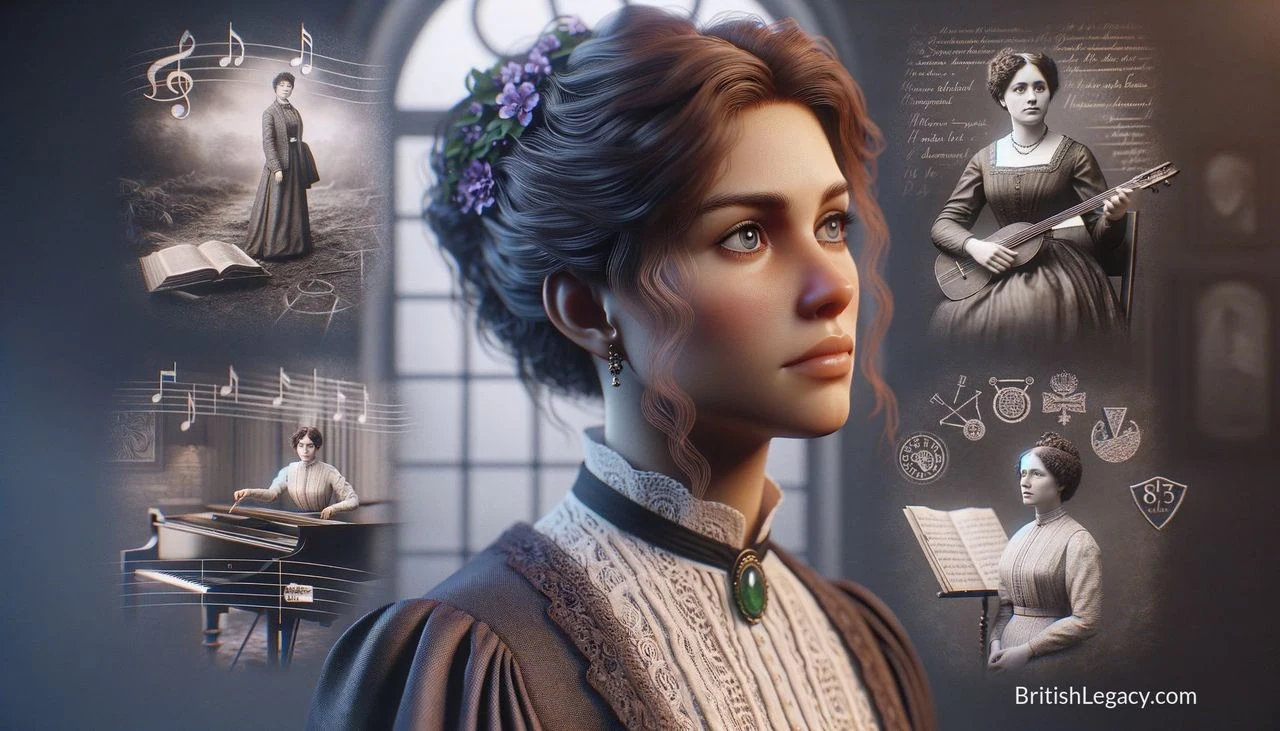
Ethel Smyth’s work ranged from chamber music and orchestral pieces to opera and a large-scale Mass. Her music made a claim to serious artistic standing in a profession where critics often judged women by different standards. She also joined the women’s suffrage movement, set aside her composing for its cause and wrote “The March of the Women”, which became an anthem of the movement. Smyth’s story is one of musical ambition and political commitment, pursued in public despite the limits placed on women in both fields.
A Symphony of Talent and Tenacity
Smyth was born in London on 22 April 1858, the fourth of eight children. Her family celebrated her birthday on 23 April, a date she habitually gave. Her father, John Hall Smyth, was a major general in the Royal Artillery and opposed her plan to pursue music as a career. Sidcup, then in Kent, was the family’s early home; they later lived near Frimley and, from 1910, at Hook Heath on the outskirts of Woking.
She decided at 12 that she wanted to study music. At 17 she studied with Alexander Ewing, who introduced her to the music of Wagner and Berlioz. After overcoming her father’s opposition, she went to the Leipzig Conservatory to study composition with Carl Reinecke. She left after a year, dissatisfied with the standard of teaching, and continued her studies privately with Heinrich von Herzogenberg. In Leipzig she met Dvořák, Grieg and Tchaikovsky; through Herzogenberg she also met Clara Schumann and Brahms. Back in England, she formed a supportive friendship with Arthur Sullivan, who encouraged her work.
Works that challenged the limits set for women
Smyth composed songs, piano music, chamber and orchestral works, choral music and operas. The performance of her Mass in D at the Royal Albert Hall in 1893 helped establish her as a serious composer. Her opera The Wreckers, written to a French libretto by Henry Bennet Brewster, premiered in 1906. Some critics have described it as the most important English opera composed between Purcell and Britten. Der Wald, another opera, was staged at New York’s Metropolitan Opera in 1903; for more than a century, it was the only opera by a woman composer performed there.
Her achievements did not shield her from unequal criticism. Smyth’s music could be praised or dismissed according to ideas about how a woman’s compositions should sound. Powerful, rhythmically vigorous writing might be called insufficiently feminine; delicate music might be judged against the standards of her male peers and found wanting. This double standard helped keep her on the margins of the profession. Smyth resisted being confined to the label “lady composer”: her ambition was to be recognised as a composer among composers.
As her hearing deteriorated, her composing and conducting career diminished before the 1920s. She turned increasingly to literature, publishing ten books between 1919 and 1940, many of them autobiographical. The BBC marked her musical jubilee with two concerts in 1928; Smyth conducted the second, which featured her choral works. A festival celebrating her music followed for her 75th birthday in 1934, under Thomas Beecham’s direction. By then, she was completely deaf.
Championing Women’s Rights
In 1910 Smyth joined the Women’s Social and Political Union (WSPU), setting music aside for two years to devote herself to the cause. In her memoirs, she argued that women’s disadvantages in music were connected to their lack of a political vote and voice. She became a close associate of WSPU leader Emmeline Pankhurst. For the union, Smyth composed “The March of the Women” in 1911, setting words by Cicely Hamilton. The song became an anthem of the WSPU and the suffragette movement, taking her music beyond the concert hall and into political campaigning.
In 1912, Pankhurst called on WSPU members to break windows at the homes of politicians opposed to women’s suffrage. Smyth was among those who answered the call and was arrested. She served two months in Holloway Prison. When Thomas Beecham visited, he saw suffragettes marching and singing in the quadrangle while Smyth, leaning from a window, conducted them with a toothbrush. The episode captures the joining of music and activism in her life: she took part in the protest and made music part of the imprisoned campaigners’ shared experience.
Smyth’s political relationships were not without disagreement. She opposed Pankhurst and her daughter Christabel’s support for the war effort in 1914, though she trained as a radiographer in Paris. Her correspondence with Pankhurst continued, and in 1930 Smyth conducted the Metropolitan Police Band at the unveiling of Pankhurst’s statue in London. Her involvement therefore extended beyond the anthem and the prison episode, spanning years of personal and political engagement.
Advocate for Music Education and Women’s Rights
Smyth’s writings offer another account of the obstacles women faced in musical life. In Impressions That Remained and Female Pipings in Eden, she wrote about her experiences and women’s position in a male-dominated culture. Her memoirs challenged the idea that women composers should be treated as a separate category rather than as composers among composers. Her case for equality is well documented in her music, her political activism and her writing; claims that she mentored younger musicians or campaigned specifically for wider access to music education are not established by the available account.
Her last major composition was the hour-long vocal symphony The Prison, setting a text by Brewster. It was first performed in 1931. The work came after her release from Holloway and after hearing loss had curtailed her composing and conducting. Her later books, including Female Pipings in Eden, kept her writing in public circulation even as deafness changed her relationship with music.
An Enduring Legacy
In 1922 Smyth became a Dame Commander of the Order of the British Empire, the first female composer to receive a damehood. She also received honorary doctorates in music from the universities of Durham and Oxford. These honours recognised a career that had been shaped by both significant compositions and a long struggle against assumptions about women’s artistic capacity.
Smyth died in Woking on 8 May 1944, aged 86. At her request, her ashes were scattered in the woods near Woking Golf Club by her brother Bob. Her music and political work have also been remembered in later cultural tributes: she was portrayed in the BBC television film Shoulder to Shoulder, and a statue of her conducting was unveiled in Woking in 2022. In 2021, a recording of The Prison received a posthumous Grammy Award for Best Classical Vocal Solo.
Why Ethel Smyth deserves a place in British Legacy
Ethel Smyth deserves a place in British Legacy because she made a substantial contribution to British musical life while challenging the restrictions imposed on women composers. The Mass in D helped establish her reputation, while The Wreckers and Der Wald demonstrate the breadth of her achievement in opera. Her work also encompassed chamber, orchestral and choral music. Critics did not consistently assess these compositions on equal terms: the same musical qualities could be condemned as too masculine or dismissed as inadequate beside the work of men. Smyth’s determination to be judged as a composer among composers gives her career a lasting historical significance, as well as an artistic one.
Her political contribution was equally concrete. Smyth gave the WSPU “The March of the Women”, a song that campaigners could sing together, and she joined the protests that led to her imprisonment in Holloway. Music served both as serious composition and as part of collective political action. Her writings returned to the barriers women faced, while her honours and later tributes marked the wider recognition of her work. Remembering Smyth brings together a distinctive body of British music and an account of a woman who used her abilities in the campaign for political rights. That combination, rather than a general claim to inspiration, is the foundation of her place in British Legacy.
Sources
Ethel Smyth (revision 1374785952)
Adapted in part from Ethel Smyth by Wikipedia contributors, under CC BY-SA 4.0. Text has been edited and combined with the existing article; this adapted text is shared under the same licence. Contributor history.