
Daphne Guinness has treated fashion as more than a matter of dress. A designer, model, curator, writer and musician, she has used clothes to make images, tell stories and collaborate with artists. Her striking public style is part of that work, but so are the collections she has assembled, the designers she has supported and the creative projects she has pursued beyond the wardrobe.
A childhood between England, Ireland and Spain
Daphne Diana Joan Susanna Guinness was born in London on 9 November 1967. Her father was Jonathan Guinness, later 3rd Baron Moyne, and her mother was Suzanne Lisney. As a child, she moved between family country houses in England and Ireland and a villa in Spain. The artist Salvador Dalí was a family friend. She later lived in New York with her half-sister Catherine, who worked as an assistant to Andy Warhol.
Her family history includes her paternal grandmother, Diana Mitford, who divorced Bryan Guinness and later married British Union of Fascists leader Oswald Mosley. Guinness has said she did not know of Mosley’s political affiliations until she heard of his death on the BBC News in 1980. The detail is part of her family background, not a description of her own political views.
In 1987, Guinness married Spyros Niarchos; they had three children. The marriage ended in divorce in 1999. After the separation, she became more involved in avant-garde fashion and built relationships across the industry. The change marked a period in which fashion became both a public language and a working practice for her.
Clothes as image and collaboration
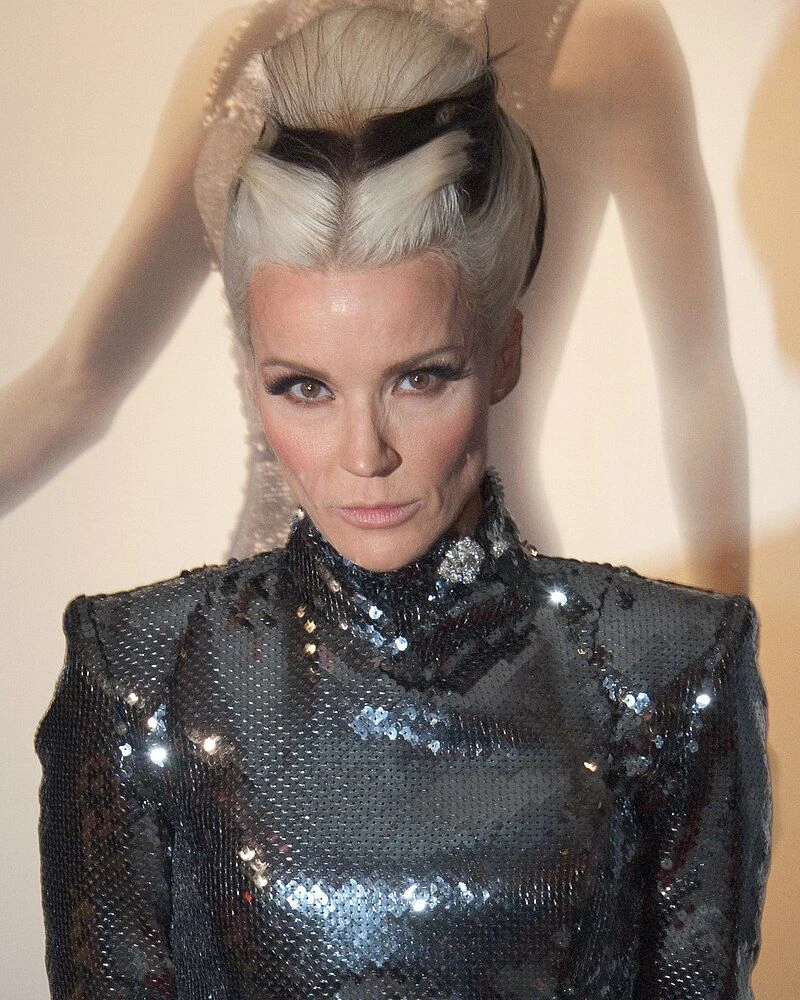
Guinness is known for dramatic silhouettes, elaborate footwear and a platinum-blonde hairstyle. Her clothes draw on historical references and experimental design, but her contribution is not confined to wearing other people’s work. She has designed shirts with Comme des Garçons for Dover Street Market and, in 2010, created around 100 pieces for herself without intending to sell them. With British jeweller Shaun Leane and Alexander McQueen, she designed Contra Mundum, a diamond-encrusted, 18-carat white-gold glove. McQueen used it in his shows; it was later sold at Sotheby’s in 2017.
Her relationship with McQueen was one of friendship as well as creative exchange. Vogue described her as having nurtured his career. She has also worked with designers including Philip Treacy, and in 2004 became a fashion consultant for Gucci. Her fashion work has included writing: she has contributed pieces on fashion to Vogue, the Financial Times, The Times and Harper’s Bazaar, and written or contributed to books on McQueen, Jazz Age dress and the relationship between art and fashion.
In 1994, Guinness was named to the International Best Dressed List Hall of Fame. The distinction recognised a public image that was already unusually individual; her later work made that image part of a broader creative practice. She has also styled photo shoots for photographers Steven Klein and David LaChapelle, and appeared on the covers of international fashion magazines.
Collecting, curating and preserving fashion
Guinness’s interest in fashion history became particularly visible through her work with Isabella Blow’s collection. After Blow’s death in 2007, Guinness bought her friend’s wardrobe in 2010, before it could be sold at auction. The collection was later shown as Isabella Blow: Fashion Galore at Somerset House in London in 2013. The exhibition gave the clothes a public life and brought attention to the distinctive fashion world Blow had helped shape.
Guinness also curated an exhibition at the Fashion Institute of Technology in New York in 2011, featuring more than 100 pieces from her own couture collection. The garments included work by Alexander McQueen, Chanel and Valentino. The exhibition included The Phenomenology of Body, a short film she directed about costumes through the ages. These projects connect her collecting to presentation and interpretation: the clothes are not simply possessions, but objects placed in conversation with design history and the body.
Her public appearances have sometimes made that curatorial sensibility part of the event itself. At the 2011 Met Gala, she dressed in a Barneys window in a feathered McQueen dress and pieces from Blow’s collection, a tribute to both Blow and McQueen. In 2013, she and other donors contributed shoes to the Fashion Institute of Technology’s Shoe Obsession exhibition.
From short films to recorded music
Film has offered Guinness another way to work with costume and image. She produced the short film Cashback, which received an Academy Award nomination in 2004 and was later made into a feature. In 2011 she starred in The Murder of Jean Seberg. At the end of that year she played the central role in The Legend of Lady White Snake, a film based on a Chinese legend, made with photographers Markus Klinko and Indrani and stylist GK Reid. Bernard-Henri Lévy wrote her dialogue. She also starred in Julien Landais’s science-fiction short Shakki in 2012.
Music became another substantial strand of her career. Encouraged by David Bowie, she worked with producer Tony Visconti, who produced her first three albums. Her debut, Optimist in Black, was released in 2016, followed by Daphne & the Golden Chord in 2018 and Revelations in 2020. The first began with an intention to record Bob Dylan’s “Desolation Row”; original songs written and recorded in the studio became the album instead.
Her fourth album, Sleep, appeared in 2024. Recorded at British Grove and Abbey Road studios, it brought together Visconti, a 34-piece string section and other musicians. Singles from the album also appeared in remixed form. Alongside the records, Guinness has made music videos with photographers and directors including Nick Knight, David LaChapelle and Paul Fryer. The work extends her interest in fashion-led imagery into a different medium, without leaving behind the visual drama that marks her clothes and exhibitions.
Charity and public collections
Guinness has taken part in Naomi Campbell’s Fashion for Relief shows, which raised funds for disaster victims. In 2008, she auctioned part of her wardrobe for Womankind Worldwide, a British charity working on issues including domestic violence. Her charitable work and her collecting are distinct activities, but both have placed fashion in a public context: garments can raise money, support an institution or help preserve the work of designers and editors.
She has also worked with fashion and beauty businesses. In 2009, she created a fragrance named Daphne for Comme des Garçons. She modelled for NARS Cosmetics’ autumn 2010 campaign, which included an eyeshadow named after her, and released a 21-product make-up line with MAC Cosmetics in 2011. These collaborations brought her visual identity into products, while her design, writing, film and music projects show a wider range of creative roles.
Why Daphne Guinness deserves a place in British Legacy
Daphne Guinness deserves a place in British Legacy because her career shows how fashion can operate as design, performance, scholarship and public culture. Her collaboration with Alexander McQueen produced work such as the Contra Mundum glove, while her own designs and writing demonstrate that she is not simply a wearer of couture. Her exhibitions have made significant collections visible to wider audiences: the Fashion Institute of Technology show presented more than 100 pieces from her personal collection, and the Somerset House exhibition brought Isabella Blow’s wardrobe into public view. These are specific contributions to fashion’s record, not merely expressions of personal taste.
Her British connection is grounded in her birth in London, her life and work within British fashion, her collaborations with British designers and jeweller Shaun Leane, and the use of London institutions and studios in her projects. Guinness has carried that creative network onto an international stage, from New York exhibitions to music and film, while remaining engaged with British charities and cultural venues. Her albums and screen work further demonstrate a career that crosses disciplines without abandoning fashion’s visual language. The result is a distinctive British contribution to contemporary style: not a claim to represent everyone, but a sustained example of how an individual can connect design, collecting, image-making and performance.
Sources
Adapted in part from Daphne Guinness by Wikipedia contributors, under CC BY-SA 4.0. Text has been edited and combined with the existing article; this adapted text is shared under the same licence. Contributor history.
.jpg)