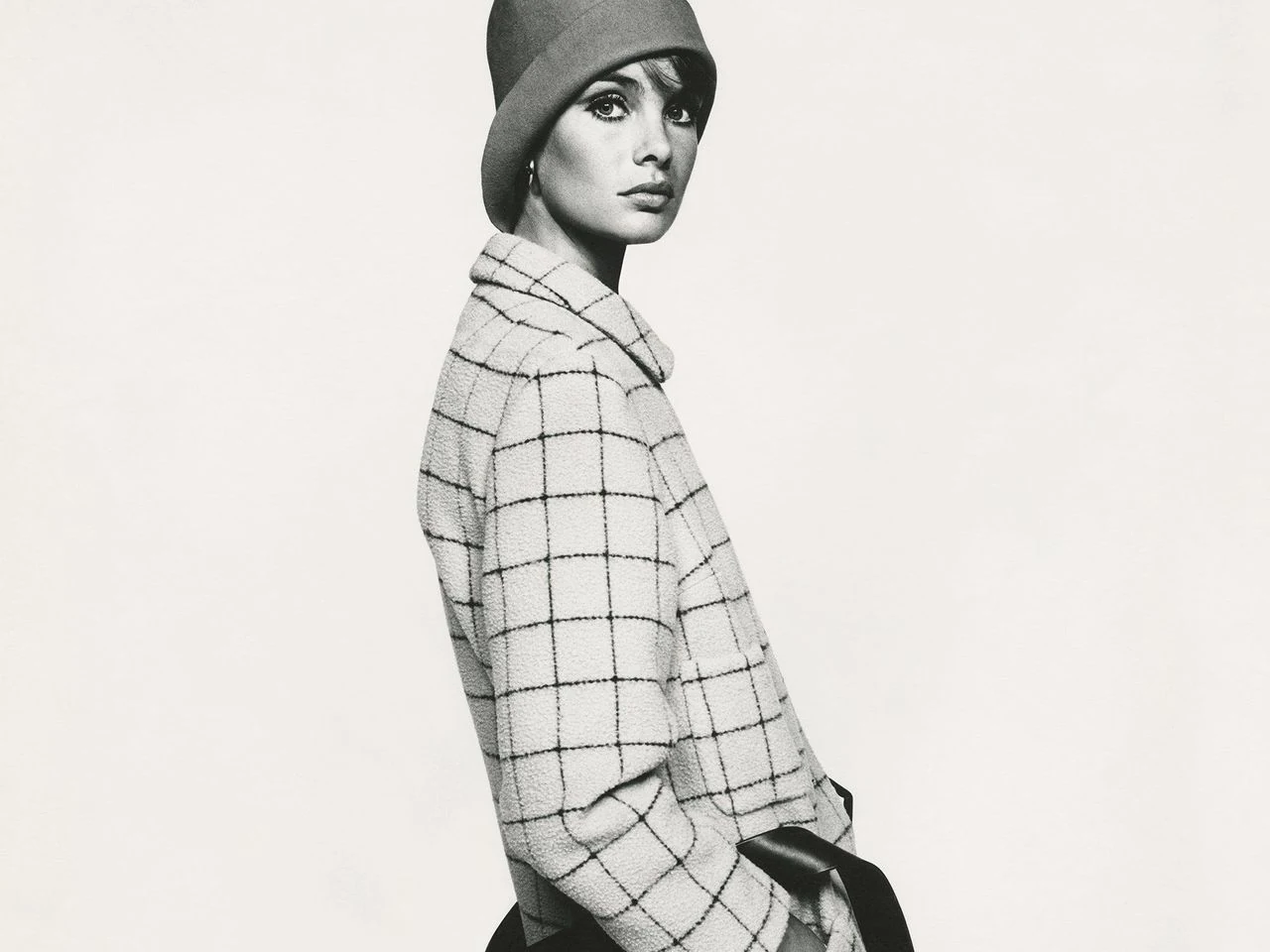
David Bailey’s photographs did more than show clothes and famous faces: they helped make the photographer a celebrity and gave Swinging London a distinctive visual record. Working for British Vogue from 1960, he brought an energetic approach to fashion and portraiture, while projects such as Box of Pin-Ups made images of musicians, actors, models and other public figures available beyond the pages of a magazine. His career also encompassed films, documentaries, books, advertising and exhibitions.
From East Ham to the camera
David Royston Bailey was born on 2 January 1938 at Whipps Cross Hospital in Leytonstone, then in Essex. His father, Herbert Bailey, was a tailor’s cutter; his mother, Gladys, was a machinist. From the age of three, Bailey lived in East Ham. He developed an interest in natural history, which led him towards photography, and later described difficulties at school associated with undiagnosed dyslexia. He also has dyspraxia.
Bailey left school on his fifteenth birthday and became a copy boy at the Yorkshire Post’s Fleet Street offices. After a succession of jobs, he was called up for National Service in 1956 and served with the Royal Air Force in Singapore in 1957. When his trumpet was appropriated, he turned towards other creative interests and bought a Rolleiflex camera. After demobilisation in 1958, he bought a Canon rangefinder and sought work in photography. Unable to secure a place at the London College of Printing because of his school record, he became an assistant to photographer David Ollins before joining John French’s studio in 1959.
Vogue, celebrity and a new kind of picture
Bailey worked for John Cole’s Studio Five in May 1960 and was contracted as a fashion photographer for British Vogue later that year. The original account describes his appointment as a junior photographer; the more detailed chronology records his work first as an assistant, then at Studio Five, before the Vogue contract. Within months, he was shooting covers. At the height of his productivity, he made 800 pages of Vogue editorial in a year.
Bailey, Terence Donovan and Brian Duffy helped create the image of “Swinging London”: a culture in which fashion and celebrity were closely linked. They worked among actors, musicians and members of royalty, and became celebrities themselves. Norman Parkinson called the trio “the Black Trinity”. Bailey’s photographs of figures including The Beatles, Mick Jagger and Jean Shrimpton belong to this period, alongside portraits of Terence Stamp, P. J. Proby, Cecil Beaton, Rudolf Nureyev and the Kray twins.
His 1964 Box of Pin-Ups brought together poster-prints of celebrities and other notable figures in an unusual commercial format. The project reflected the changing status of the photographer: Bailey’s images were being presented as a collection that people could buy, rather than appearing only as part of a magazine or publicity campaign. Objections to the inclusion of the Krays by fellow photographer Lord Snowdon were a major reason that a second British edition and an American edition did not follow.
Bailey’s fashion work continued beyond the first years of his Vogue career. He began working with Jaeger in the late 1950s, and his first New York shoot featured Jean Shrimpton in clothes by Jaeger and Susan Small. In 2015, after 53 years, he returned to photograph a Jaeger autumn-winter campaign. His pictures also served music: in 1970 he photographed Cat Stevens for publicity connected with Tea for the Tillerman, and he made album-sleeve images for musicians including the Rolling Stones and Marianne Faithfull.
Films, photographs and books beyond the fashion pages
Bailey’s work was not confined to fashion photography. In 1966 he directed the short film G.G. Passion. His involvement in film and television included documentaries on Cecil Beaton, Luchino Visconti and Andy Warhol, as well as the BBC drama Who Dealt?, which he directed in 1992. He also directed and wrote the 1995 South Bank Film The Lady is a Tramp, featuring his wife Catherine Bailey, and directed the Channel 4-commissioned Models Close Up in 1998.
His photographs ranged from everyday life in the East End to work made during travels in Papua New Guinea. His books included Goodbye Baby & Amen (1969), Papua New Guinea (1975), Bailey NW1 (1982), Rock & Roll Heroes (1997) and the three-volume Bailey’s East End (2014). The subject matter, formats and settings changed, but the camera remained central to a career that moved between magazines, commissioned work and books.
In 1976, Bailey published Ritz Newspaper with David Litchfield. He also worked in advertising, appearing in British television commercials for Olympus cameras after replacing equipment lost in a robbery with the company’s smaller OM system. In 1985, he photographed performers at the Live Aid concert at Wembley Stadium. His later projects included Look Again, a memoir written with James Fox and published in 2020, and Eighties Bailey, published in 2024.
Exhibitions and recognition
Bailey’s work was shown at the National Portrait Gallery in 1971 and at the Victoria and Albert Museum in 1983. His exhibitions also reached audiences outside London: a retrospective was presented at the International Center of Photography in New York in 1984, while a touring presentation of Birth of the Cool included the Barbican Art Gallery and the National Museum of Film, Photography and Television in Bradford in 1999–2000. In 2001, the exhibition was shown at the Dean Gallery in Edinburgh. The National Portrait Gallery later presented Bailey’s Stardust in 2014; it travelled to Edinburgh and Milan in 2015.
His honours included appointment as a Commander of the Order of the British Empire in the 2001 Queen’s Birthday Honours. The Royal Photographic Society awarded him its Centenary Medal and an Honorary Fellowship in 2005. In 2016, the International Center of Photography in New York gave him its Lifetime Achievement award. Bailey paints and sculpts as well as taking photographs; some of his sculptures were shown in London in 2010, followed by paintings and mixed-media work in 2011.
Why David Bailey deserves a place in British Legacy
David Bailey deserves a place in British Legacy because his work helped shape how Britain’s fashion and celebrity culture was seen, both at home and abroad. His appointment by British Vogue in 1960 placed him at the centre of a British magazine with an international reach. Through his photographs, and through the work he made alongside Terence Donovan and Brian Duffy, he helped define the visual image of Swinging London. That legacy is concrete: covers and editorials, portraits of musicians and models, and the distinctive format of Box of Pin-Ups, which helped establish that a photographer’s images could themselves be the product.
His contribution also lies in the breadth of his practice. Bailey moved between fashion, portraiture, documentary photography, film, publishing, advertising and exhibition-making. Projects ranging from Bailey’s East End to photographs made in Papua New Guinea show a career extending beyond the fashionable London world with which he is most closely associated. His work was exhibited at major British institutions including the Victoria and Albert Museum, the Barbican and the National Portrait Gallery, and his honours included a CBE and recognition from the Royal Photographic Society. Together, these achievements make his story part of Britain’s cultural history: a record of how photographers helped connect fashion, public figures and the visual identity of an era.
Sources
David Bailey — Wikipedia, revision 1368651046
Adapted in part from David Bailey by Wikipedia contributors, under CC BY-SA 4.0. Text has been edited and combined with the existing article; this adapted text is shared under the same licence. Contributor history.