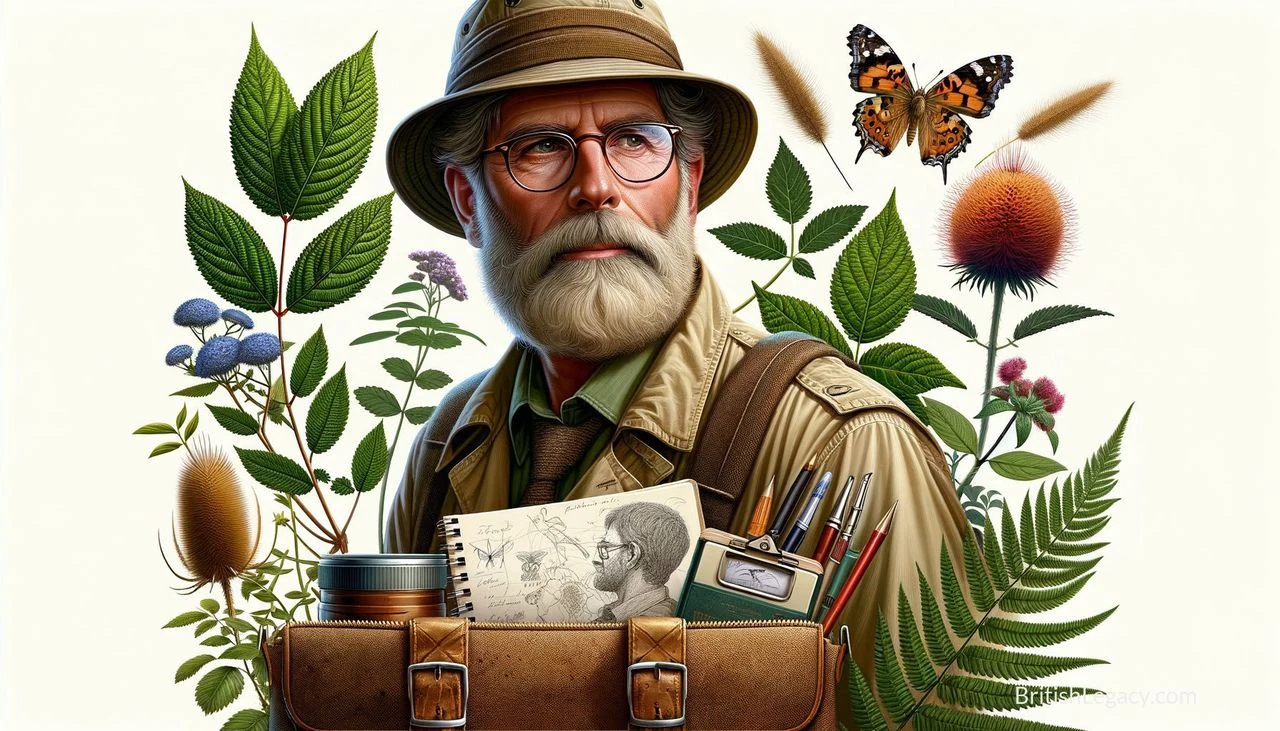
David Bellamy brought botany to television with an energy that was hard to mistake. Audiences knew him for exuberant explanations of plants and wildlife, but his public profile grew from academic work and a practical involvement in conservation. He advised on the environmental effects of the Torrey Canyon oil spill, helped establish Durham Wildlife Trust, and campaigned on environmental issues in Britain and overseas. His later statements on climate science became contentious; they are part of his record, alongside the science, broadcasting and conservation work that first made him a familiar figure.
A botanist before a broadcaster
Bellamy was born in London on 18 January 1933 and grew up in south London. He attended schools in Cheam and Sutton, including Sutton County Grammar School. As a young man he had hoped to become a ballet dancer, but turned towards science. After working as a laboratory assistant at Ewell Technical College, he studied botany at Chelsea College of Science and Technology, graduating in 1957. He completed a PhD at Bedford College in 1960.
That year he became a lecturer in Durham University's botany department. His scientific work and public communication soon began to overlap. In 1967, after the Torrey Canyon oil spill, Bellamy worked as an environmental consultant and wrote a paper about the disaster in Nature. Television appearances on the subject helped introduce him to a much wider audience. The episode linked his scientific expertise to a public debate about pollution and the consequences of industrial activity.
Bellamy wrote scientific papers and books as well as teaching. His books included Bellamy on Botany and Bellamy's Britain, and he contributed to publications associated with his television work. In the 1980s, he also became the public figurehead of the I-Spy children's books, to which readers sent completed books to receive a reward. The role connected his popular profile with a format that invited young readers to observe and identify the world around them.
Making natural history television
Bellamy's first television appearances relating to Torrey Canyon led to a long broadcasting career. His programmes included Life in Our Sea, broadcast in 1970–71, and Bellamy on Botany. He went on to present series such as Bellamy's Britain, Bellamy's Europe and Bellamy's Backyard Safari, and appeared on programmes including Don't Ask Me. Across hundreds of broadcasts, he explained botany, ecology and environmental questions in an animated, demonstrative style.
His manner made him a distinctive television personality as well as a science communicator. Comedians, including Lenny Henry on Tiswas, parodied him; his voice was also used in advertising. The jokes depended on a recognisable public character, but the work behind it was sustained: Bellamy used television to present scientific subjects to audiences well beyond the lecture hall. He also wrote for children and adults, with titles ranging from botanical guides to books about Britain's landscapes.
Conservation in Britain and beyond
Bellamy's conservation work was not confined to broadcasting. In the early 1970s, he helped establish Durham Wildlife Trust and remained involved in conservation in the Durham area for decades. The Conservation Foundation, which he founded, supported conservation work; with David Shreeve and the Foundation, he originated the Ford European Conservation Awards. He also held leadership and patronage roles across a broad range of wildlife and environmental organisations, including the Wildlife Trusts partnership, which he led as president from 1995 to 2005.
Some of his activism took him beyond Britain. In 1983, he was imprisoned after taking part in a blockade of Australia's Franklin River in protest against a proposed dam. The following year, he leapt from the pier at St Abbs Harbour to open Britain's first voluntary marine reserve, at St Abbs and Eyemouth. In Jersey, he campaigned unsuccessfully to prevent Queens Valley from being turned into a reservoir, arguing that the site was important for a rare snail.
Bellamy's conservation activity also included projects that brought people into contact with local landscapes. In 2016 he opened the Hedleyhope Fell Boardwalk in County Durham, a feature of Durham Wildlife Trust's reserve. The scheme included a path from Tow Law to the reserve and a boardwalk made from recycled plastic bottles. He also supported environmental education through roles such as president of the British Institute of Cleaning Science and patron of the recycling charity Recoup. His work ranged from public campaigning to initiatives intended to encourage practical attention to nature and the environment.
Disputed views and later years
Bellamy's later public record included scepticism about climate science, a position that brought him into conflict with some environmental organisations. In 2005 he published a claim about the number of monitored glaciers advancing, based on figures that were subsequently traced to discredited information. He accepted that his figures were wrong and said he would withdraw from the global-warming debate. He later signed the 2008 Manhattan Declaration, which called for an end to tax-funded attempts to counter climate change, and continued to describe climate change as part of a natural cycle.
The Wildlife Trusts, of which he had been president, publicly distanced the organisation from his climate-change position in 2005; he was succeeded as president that November. Bellamy said that his views had led the BBC to reject programme ideas. These disagreements complicate any simple account of his environmental record. His earlier conservation activity and later climate statements should both be recognised, without treating his conservation credentials as proof of his climate claims or allowing controversy to erase his work in botany and wildlife protection.
Bellamy stood for the Referendum Party in Huntingdon in 1997, against the sitting prime minister, John Major. He later called the decision one of the stupidest things he had done and speculated that it might have affected his television opportunities. He died aged 86 on 11 December 2019 at a care home in Barnard Castle, County Durham. His honours included the United Nations Environment Programme's Global 500 Award, the Royal Geographical Society's Busk Medal in 2001 and a BAFTA Richard Dimbleby Award.
Why David Bellamy deserves a place in British Legacy
Bellamy's place in British Legacy rests on a substantial and specific contribution: he helped make botany and ecology visible to a mass British audience. His television work did not stand apart from his scientific career. The Torrey Canyon consultancy and paper in Nature preceded programmes that carried environmental subjects into homes, while his books and I-Spy role extended that invitation to readers, including children. This combination of academic work, broadcasting and accessible publishing gave natural history a recognisable public voice in Britain.
His conservation record also had local and practical dimensions. He helped establish Durham Wildlife Trust, remained active in the region's conservation movement, and took part in campaigns over the Franklin River and the St Abbs and Eyemouth marine reserve. The Hedleyhope Fell boardwalk connected access to a County Durham reserve with a project using recycled plastic bottles. These examples show how his public advocacy could be attached to particular places and organisations, rather than remaining general enthusiasm for nature. His legacy is not without dispute: his later climate claims were challenged, and he acknowledged that one widely publicised set of glacier figures was wrong. Remembering both the achievements and the controversy gives a fuller account of a British botanist whose work brought environmental questions into public life.
Sources
David Bellamy — Wikipedia revision
Adapted in part from David Bellamy by Wikipedia contributors, under CC BY-SA 4.0. Text has been edited and combined with the existing article; this adapted text is shared under the same licence. Contributor history.