Dawn French’s best-known television roles have made her familiar across generations: as one half of French and Saunders, and as Geraldine Granger, the vicar at the centre of The Vicar of Dibley. But her career has never been confined to a single partnership or character. Since her television debut in the early 1980s, she has moved between sketch comedy, sitcom, drama, film, theatre, stand-up and writing, often bringing the same interest in heightened characters to very different settings.
From Holyhead to comedy partnership
French was born in Holyhead, Wales, on 11 October 1957. Her father, Denys, served in the Royal Air Force, and his postings took the family between stations. French began studying drama at the Royal Central School of Speech and Drama in 1977. There she met Jennifer Saunders, who became her comedy partner. They shared a flat while at college and, after graduating, formed a double act.
Their early work grew out of performance rather than an immediate television breakthrough. In 1981, sketches by French and Saunders appeared on a comedy record compiled by producer Martin Lewis. The following year, French made her television debut in The Comic Strip Presents… episode “Five Go Mad in Dorset”. The Comic Strip’s self-contained stories gave her an early platform among a group of performers that included Peter Richardson, Rik Mayall, Nigel Planer, Robbie Coltrane and Adrian Edmondson. French acted in 27 of the series’ 37 episodes and wrote two. In 1985, she appeared with Saunders, Tracey Ullman, Ruby Wax and Joan Greenwood in Girls on Top.
French and Saunders on television
The BBC sketch series French and Saunders began in 1987. French and Saunders wrote and starred in the show, using sketches to parody performers, popular culture and films. Their targets included Madonna, Cher and the Spice Girls, as well as films such as Star Wars, The Lord of the Rings and Harry Potter and the Chamber of Secrets. A later collection, A Bucket o’ French & Saunders, began airing in 2007, twenty years after the original series started.
Their partnership was one strand of a broader television career. French played a different character in each episode of Murder Most Horrid, the anthology comedy series that ran from 1991 to 1999. She also worked with Saunders in Let Them Eat Cake, set at the Palace of Versailles, and took roles in series ranging from Wild West to Jam & Jerusalem. These contrasting parts show how often her work depended on a particular comic persona rather than one fixed screen identity.
Geraldine Granger and Dibley
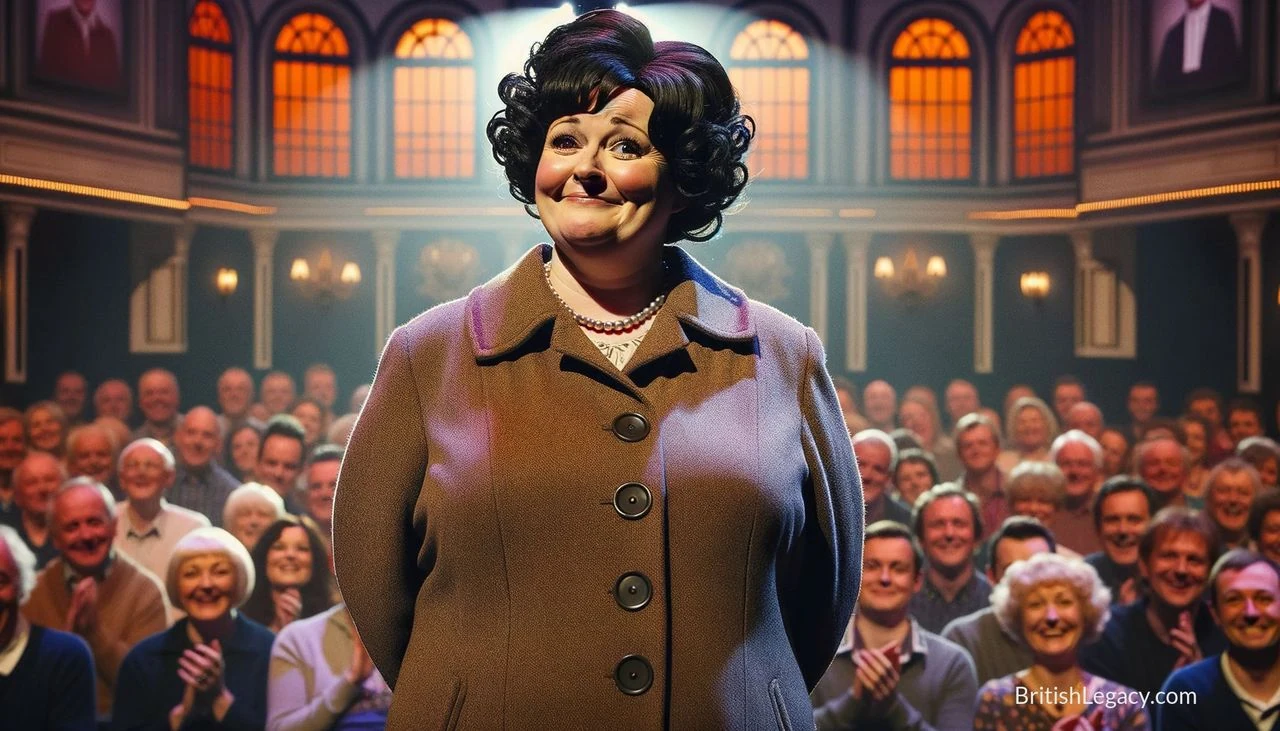
French’s most prominent solo role was the title character in The Vicar of Dibley, created for her by Richard Curtis. The BBC sitcom began in 1994 and placed Geraldine Granger, a vicar, in a small fictional village. The character’s arrival unsettles the village’s established routines, giving the series its central source of comedy. The role made French the face of a long-running programme whose main run ended in 2007, though she returned for shorter special episodes, including a series of four in 2020.
The scale of the audience was evident when 12.3 million people watched the final full-length episode, which included Geraldine’s marriage ceremony. French was nominated for a BAFTA for her performance in that episode. She also received several BAFTA television nominations for the series and won the British Comedy Award for Best TV Comedy Actress in 1997. In 2009, she and Saunders received the BAFTA Fellowship together.
French’s work beyond these two defining series has included roles in the BBC drama Lark Rise to Candleford, the sitcom Roger & Val Have Just Got In and the Sky series Delicious. Her film credits include The Adventures of Pinocchio, Harry Potter and the Prisoner of Azkaban, in which she played the Fat Lady, and the voice role of Mrs Beaver in The Chronicles of Narnia: The Lion, the Witch and the Wardrobe. She has also worked on stage, including at the Royal Opera House in La fille du régiment and in the London Palladium pantomime Jack and the Beanstalk.
Writing, performance and public life
French has written both fiction and non-fiction. Dear Fatty, her book of letters to people in her life, was published in 2008. Her novels include A Tiny Bit Marvellous, Oh Dear Silvia, According to Yes and Because of You; the last was longlisted for the 2021 Women’s Prize for Fiction. She later published Me. You. A Diary and The Twat Files. The books extend her work beyond performance, using a direct, conversational form alongside the character comedy for which she is known.
Her live work has also drawn on autobiography. In 2014, she toured Thirty Million Minutes, a one-woman show whose title refers to the number of minutes she had been alive when she made it. In 2022, she toured Dawn French is a Huge Twat, returning to the show in the UK and Australia in subsequent years. French has also appeared in charity-linked comedy performances: in 1989, she joined Saunders and Kathy Burke as Lananeeneenoonoo for a Comic Relief single, a cover of The Beatles’ “Help!” that reached number three in the UK singles chart.
In 2014, French was named Chancellor of Falmouth University. Her career has also brought recognition beyond individual roles, including the BAFTA Fellowship shared with Saunders and the honorary Golden Rose of Montreux received by the pair in 2002. These acknowledgements sit alongside a body of work that has crossed television, stage, film, books and live performance.
Why Dawn French deserves a place in British Legacy
Dawn French deserves a place in British Legacy because her career helps tell the story of British comedy as a craft made for television and shared through popular culture. French and Saunders took a long-running creative partnership from college performance to a BBC sketch series that repeatedly turned familiar films and celebrities into material for parody. Their work gave two women the space to write and perform comic characters on their own terms. The BAFTA Fellowship they received together recognises that partnership, while the series itself remains a record of how sketch comedy could respond to changing entertainment and celebrity culture.
French’s wider achievement is visible in the variety and reach of her work. The Vicar of Dibley gave her a defining solo role, and its final full-length episode drew an audience of 12.3 million. She has also acted in drama, film and theatre, toured with autobiographical shows, and written books across fiction and memoir. Those achievements connect her to British television and theatre while showing how a performer can move between forms without losing a distinctive comic voice. Her legacy is not simply a list of popular programmes: it is the lasting contribution of a writer and performer whose characters, collaborations and performances have become part of the country’s shared entertainment history.
Sources
Dawn French — Wikipedia revision 1377380246 · Dawn French — Wikipedia
Adapted in part from Dawn French by Wikipedia contributors, under CC BY-SA 4.0. Text has been edited and combined with the existing article; this adapted text is shared under the same licence. Contributor history.