
Rosie Huntington-Whiteley’s career has taken her from a farm near Tavistock to international fashion campaigns, two major film roles and a long-running collaboration with Marks & Spencer. Born in Plymouth in 1987, she began working with a London modelling agency as a schoolgirl. Her rise was not a single leap from Devon to fame, but a progression through editorial shoots, catwalk appearances and commercial work that made her one of the most recognisable English models of her generation.
From Devon to the modelling industry
Huntington-Whiteley was born in Plymouth and raised on a farm near Tavistock, Devon. She attended Tavistock College. At 14, before taking her GCSEs, she began working with Profile, a model agency based in London’s West End. In the summer of 2003, aged 16, she left school for her first modelling job, a Levi’s jeans commercial.
A trip to New York for a Teen Vogue shoot in January 2004 brought her wider attention. That spring she made her catwalk debut in New York, appearing alongside Naomi Campbell, and was photographed by Bruce Weber for Abercrombie & Fitch. These early assignments established the pattern of a career that moved between fashion editorials, runway shows and advertising campaigns.
In 2006, she signed with American lingerie brand Victoria’s Secret and made her debut at its fashion show in Los Angeles. She became an official Victoria’s Secret Angel in 2010. The label helped introduce her to a larger audience, but her work during these years also included campaigns for fashion houses and other commercial brands. In 2008, Burberry chief creative director Christopher Bailey cast her in the label’s autumn/winter campaign, alongside actor Sam Riley. That year she appeared on her first British Vogue cover, in a feature celebrating British models.
Fashion campaigns and a recognisable profile
Huntington-Whiteley’s work with Burberry developed beyond the 2008 campaign. In July 2011 she became the face of its fragrance Burberry Body. She also modelled for the brand’s first beauty line and appeared in campaigns for labels including Karen Millen, Godiva, Miss Sixty and Monsoon. Her runway work included shows for Prada in Milan and Giles Deacon in Paris. In 2010, she posed for the Pirelli Calendar, photographed by Terry Richardson.
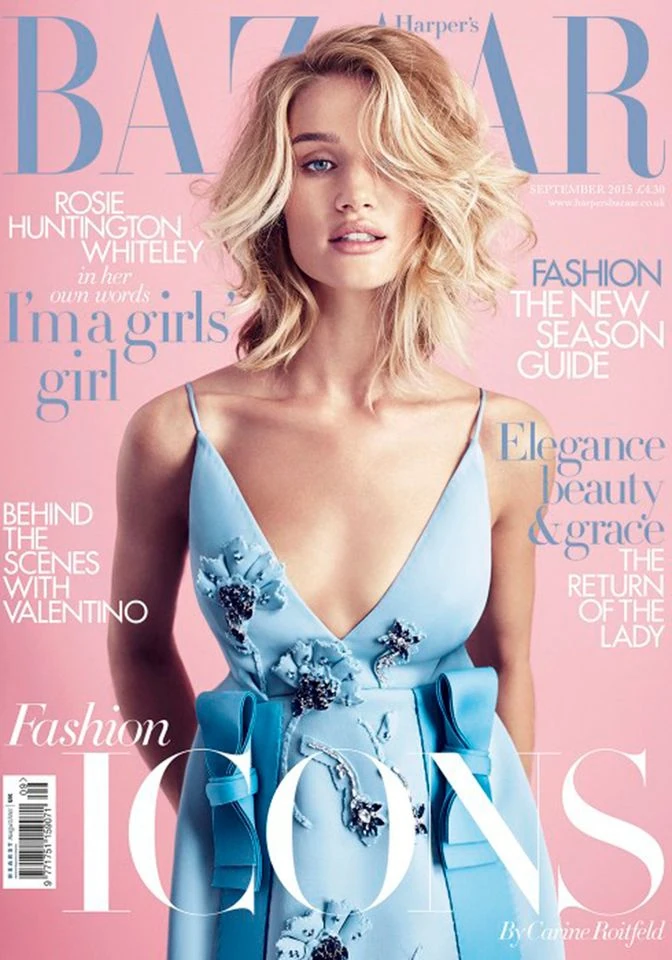
Her visibility grew across magazines as well as advertising. She appeared on the covers of British Vogue, Elle and GQ, and in 2011 took her first solo British Vogue cover. Fashion photographer Rankin devoted a book to her, Ten Times Rosie, published in 2010. Rather than describing her influence in sweeping terms, the record of these commissions shows how broadly she worked: from luxury fashion and beauty campaigns to denim, lingerie and editorial photography.
Marks & Spencer became a significant British business connection. Huntington-Whiteley collaborated with the retailer on its Rosie for Autograph lingerie range, launched in 2012. She also appeared with Helena Bonham Carter and David Gandy in the retailer’s 2013 Christmas advert. In 2014, denim brand PAIGE named her an ambassador; in 2017, it released a 17-piece capsule collection designed in collaboration with her, followed by a 20-piece autumn collection.
Two film roles and a new beauty venture
In 2011, Huntington-Whiteley made her feature-film debut as Carly Spencer in Transformers: Dark of the Moon, replacing Megan Fox in the film’s female lead role. The response was mixed: several reviewers criticised her acting, while one positive review described her performance as natural and suited to the film. The role brought her a CinemaCon award for Female Star of Tomorrow and a Teen Choice Award, as well as a Golden Raspberry Award nomination.
Her second film role was in George Miller’s Mad Max: Fury Road, released in 2015. She played The Splendid Angharad, one of the Five Wives held by the warlord Immortan Joe. To portray the pregnant character, Huntington-Whiteley wore a prosthetic abdomen during filming. The part placed her in an ensemble cast, a different screen context from the central role she had taken in Transformers.
After the birth of her first child, she launched Rose Inc. as a beauty publication, working alongside Instagram and YouTube accounts. In 2021, the brand expanded into its own make-up and skincare products. Huntington-Whiteley announced her departure in 2024, after the brand’s acquisition by AA Investments and the bankruptcy of joint-venture partner Amyris. Rose Inc. therefore marked both an expansion of her work beyond modelling and a later change in her relationship with the business.
Recognition and continuing work
Industry awards chart her standing across different parts of her career. She won Elle Style Awards’ Model of the Year in 2009 and 2015, and the same awards’ Top Style Icon title in 2012. The 2011 Glamour Awards gave her an Editor’s Special Award. Harper’s Bazaar named her Model of the Year in 2014 and Businesswoman of the Year in 2016. These distinctions reflect a career that has included modelling, brand partnerships and product development, rather than a single role or medium.
Huntington-Whiteley has been in a relationship with actor Jason Statham since 2010; they became engaged in 2016 and have two children. After living in California for several years, the family moved back to London in 2020. The move has renewed her direct connection with Britain, while her professional work continues to span international fashion and beauty markets.
Why Rosie Huntington-Whiteley deserves a place in British Legacy
Huntington-Whiteley’s place in British Legacy rests on a substantial, evidenced career rather than on claims that she represents a fixed national ideal. She grew up in Devon, entered modelling through a London agency and became a familiar face in British fashion through work for Burberry, British Vogue and Marks & Spencer. Her campaigns and magazine appearances took her into international markets, while her collaboration with Marks & Spencer brought her name to a major British retailer’s lingerie range. That partnership connected a global modelling career with a product developed for a familiar British high-street brand.
Her story also shows how a model’s work can cross industries. Huntington-Whiteley moved from catwalks and advertising into film, appearing in Transformers: Dark of the Moon and Mad Max: Fury Road, then extended her work into beauty publishing and products with Rose Inc. Not every venture lasted unchanged: her departure from the brand followed its acquisition and its partner’s bankruptcy. Including that turn makes the account more complete than a simple success narrative. Taken together, her career reflects the reach of British fashion talent and the varied commercial routes—from campaigns and design collaborations to screen roles—through which that talent can find an audience.
Sources
Adapted in part from Rosie Huntington-Whiteley by Wikipedia contributors, under CC BY-SA 4.0. Text has been edited and combined with the existing article; this adapted text is shared under the same licence. Contributor history.
.jpg)