
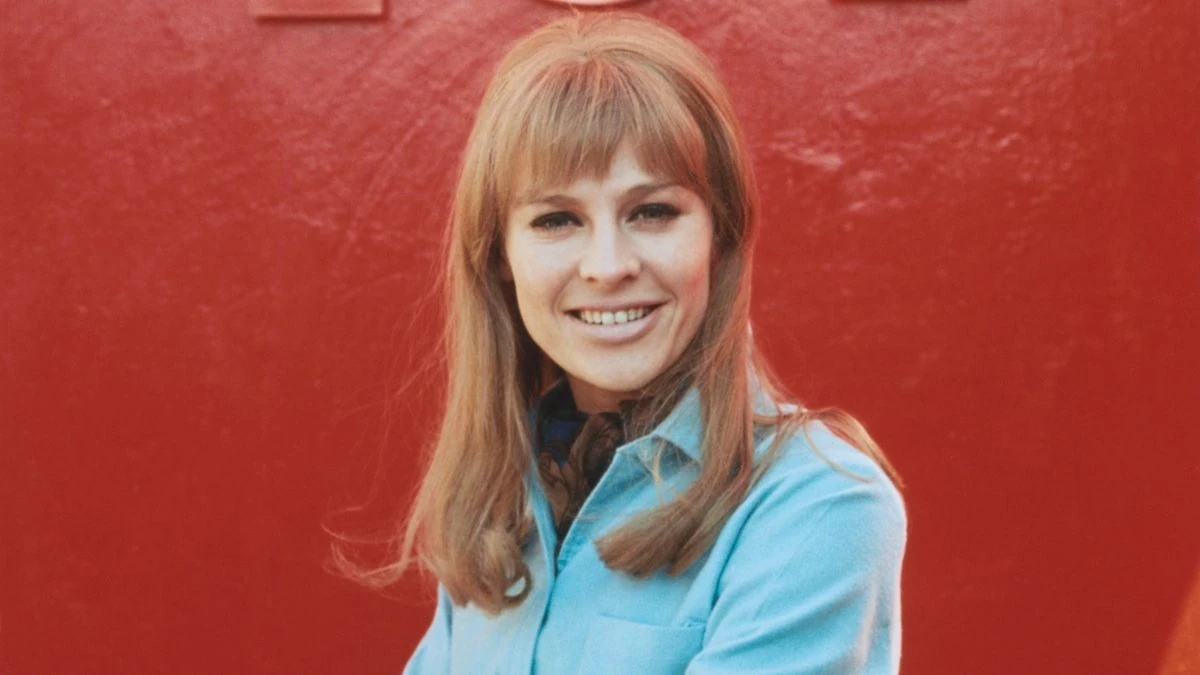
Julie Christie’s breakthrough came with two films released in 1965. In John Schlesinger’s Darling, she played Diana Scott, an ambitious model whose choices place her at the centre of changing social expectations. In David Lean’s Doctor Zhivago, she was Lara Antipova, a role that carried her to international audiences. Christie won the Academy Award for Best Actress for Darling, and her cool, modern screen image became closely associated with the British culture of the 1960s.
Early life and first roles
Christie was born Julie Frances Christie on 14 April 1940 at Chabua, Assam, in British India. Her mother, Rosemary Ramsden, was a Welsh-born painter; her father, Frank St John Christie, ran the tea plantation where she grew up. At six, Christie was sent to England to live with a foster mother and attend school. Her parents later separated, and after their divorce she spent time with her mother in rural Wales. She studied at the Central School of Speech and Drama in London.
Her professional stage debut came in 1957, followed by early appearances on British television. A larger audience noticed her in the BBC serial A for Andromeda in 1961. She appeared in two comedies in 1962, Crooks Anonymous and The Fast Lady, before John Schlesinger cast her as Liz in Billy Liar (1963). Liz is the friend and would-be lover of the title character, played by Tom Courtenay. The role brought Christie a BAFTA nomination and marked a turning point in her screen career.
The films that made her a star
Christie’s performance as Diana Scott in Darling made her an international name. Schlesinger insisted on casting her in the lead, despite the studio’s preference for Shirley MacLaine. Christie won both the Academy Award and the BAFTA Award for Best Actress for the performance. The film’s portrait of a socially ambitious model was far removed from a conventional romantic heroine, and Christie’s assured, unsentimental presence suited its sharp view of contemporary life.
In the same year, she played Lara in Doctor Zhivago. Lean’s adaptation of Boris Pasternak’s novel became a major box-office success, and the part remains among Christie’s best-known roles. She followed it with a pair of contrasting films: François Truffaut’s adaptation of Fahrenheit 451 (1966), in which she played two roles, and Schlesinger’s Far from the Madding Crowd (1967), as Bathsheba Everdene. Richard Lester’s Petulia (1968) took her into a different register again. Her appearance in the documentary Tonite Let's All Make Love in London further fixed her public image as a distinctly modern British woman of the period.
The 1970s brought performances that reached beyond the familiar image of the 1960s star. Christie appeared in Joseph Losey’s The Go-Between (1971), which won the Grand Prix at Cannes, and Robert Altman’s McCabe & Mrs. Miller (1971), earning another Academy Award nomination for the latter. She later worked with Altman again in Shampoo (1975), and appeared in Nicolas Roeg’s unsettling Don't Look Now (1973), opposite Donald Sutherland. In 1977 she returned to the United Kingdom and lived on a farm in Wales. She continued to take selective film roles, including Heat and Dust (1983) and Power (1986).
A career renewed
After a lengthy absence from the screen, Christie returned in the 1990s with roles in Dragonheart and Kenneth Branagh’s Hamlet (both 1996). Her performance in Alan Rudolph’s Afterglow (1997) earned a third Academy Award nomination. She received the BAFTA Fellowship for lifetime achievement in 1997, an honour recognising her contribution to British cinema. The British Film Institute’s list of the 100 greatest British films of the twentieth century included six films in which she appeared.
Christie continued working in the 2000s. She played Madam Rosmerta in Harry Potter and the Prisoner of Azkaban and appeared in Troy and Finding Neverland in 2004. Her leading performance in Away from Her (2006), directed by Sarah Polley, was widely acclaimed. It brought Christie a fourth Academy Award nomination and wins including the Golden Globe and Screen Actors Guild awards for leading actress. She also narrated the 2008 short film Uncontacted Tribes for Survival International, a charity of which she was a long-standing supporter and, from that year, an ambassador. Her later screen roles included Red Riding Hood (2011) and The Company You Keep (2012).
Style and screen presence
Christie’s fame in the 1960s rested on more than the success of individual films. Her work in Billy Liar and Darling helped define an image of a British woman who was self-possessed, mobile and unwilling to fit a familiar mould. That image travelled beyond the cinema. In 1967, Time magazine observed that what Christie wore had more impact on fashion than the clothes of the ten best-dressed women combined. The line captures the reach of her public style, though the evidence for her influence is clearest in the period’s attention to her clothes and screen persona.
Her career also resisted a simple story of steady stardom. Christie avoided becoming a prolific performer, turned down a number of prominent parts and spent periods away from the screen. Yet she returned to demanding roles across different decades, from Bathsheba Everdene to the wife facing dementia in Away from Her. That combination of selective work and lasting visibility helps explain why her career is remembered through both a handful of defining performances and a wider range of character parts.
Why Julie Christie deserves a place in British Legacy
Julie Christie deserves a place in British Legacy because her career connects a distinct period of British filmmaking with performances that continued to matter long after the 1960s. Billy Liar introduced a new screen presence; Darling brought her the Academy and BAFTA awards for Best Actress; and Doctor Zhivago made her familiar to audiences around the world. The BFI’s inclusion of six Christie films in its list of the twentieth century’s greatest British films provides a concrete measure of how often her work intersects with the national film record. Her BAFTA Fellowship recognised that contribution across a career, rather than for one celebrated performance alone.
Her legacy is not limited to awards or a period-specific fashion image. Christie moved between British productions and international films, took on sharply different roles, and returned to the screen with acclaimed work such as Afterglow and Away from Her. Her later recognition shows that her achievement was not confined to a brief moment of 1960s celebrity. The British connection is also grounded in her work: films such as Billy Liar, Far from the Madding Crowd and Don't Look Now have a place in British cinema, while her performances helped give that cinema an internationally recognisable face. Remembering Christie means recognising both the cultural force of her early stardom and the craft and range that sustained her reputation.
Sources
Julie Christie · Julie Christie
Adapted in part from Julie Christie by Wikipedia contributors, under CC BY-SA 4.0. Text has been edited and combined with the existing article; this adapted text is shared under the same licence. Contributor history.
.jpg)