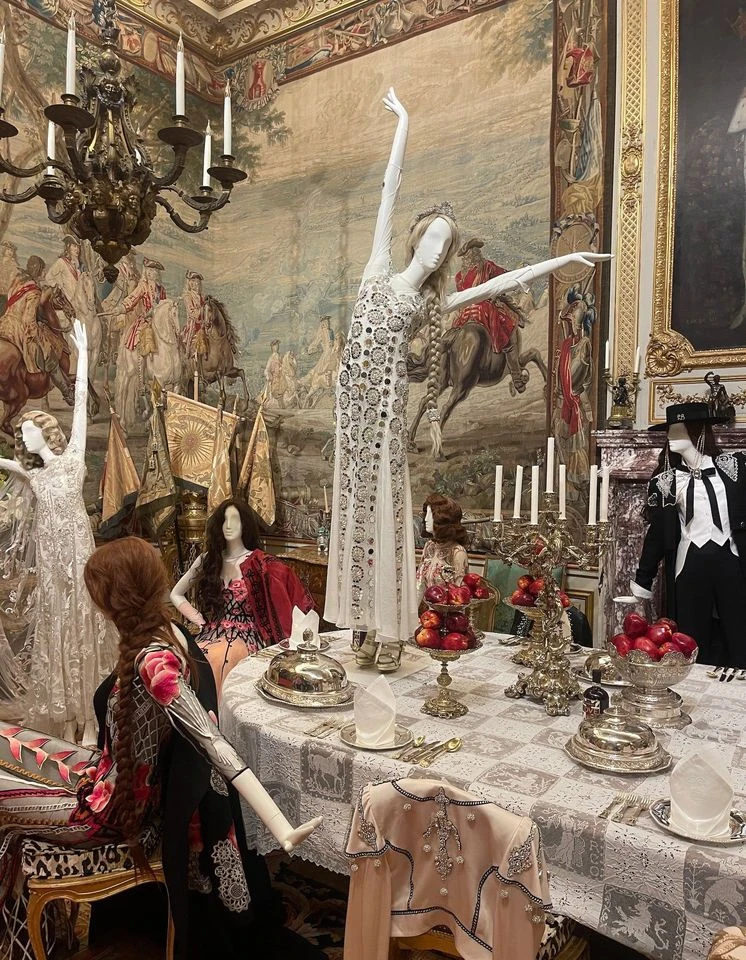
Alice Temperley’s work brings together flowing silhouettes, intricate decoration and references to earlier styles. She launched her label, Temperley London, in 2000, taking a romantic and feminine approach to contemporary fashion. The designs have attracted an international following, while their recurring interest in vintage imagery, embroidery and hand-finished detail gives the label a recognisable identity.
A label built around a distinctive style
Temperley studied at the London College of Fashion and Central Saint Martins before establishing Temperley London. The launch marked the start of her career as a designer working under her own name. Her collections are described through a combination of luxurious materials, flowing shapes and detailed ornament. Rather than treating historical references as reproductions, the designs bring vintage-inspired elements into a contemporary setting.
That balance between old and new is central to the label’s character. The clothes draw on romantic imagery and classic sartorial references, but are presented as modern collections. Hand-finished work and intricate embroidery are among the details associated with the designs. Together, these features give the clothes a more decorative quality than a purely functional wardrobe, while the flowing silhouettes carry the romantic mood through the overall shape.
The style has been associated with a wide range of inspirations, including bohemian life, historical sources and mythology. Temperley’s Somerset upbringing is also linked with an interest in nature and English pastoral imagery. These influences provide a varied vocabulary for the collections: references to the past and to the natural world can sit alongside contemporary forms, without depending on a single historical period or motif.
From Somerset to an international audience
Temperley’s British connection begins with her Somerset upbringing and continues in the label’s use of pastoral and vintage-inspired references. Its romantic approach draws on familiar ideas of English landscape and dress, but the designs are not limited to a domestic audience. The label has developed an international following, and its clothes have been worn by public figures including the Duchess of Cambridge, Pippa Middleton, Keira Knightley and Penélope Cruz.
The label has also been associated with London boutiques and a presence in high-end department stores abroad. That reach has helped place a British fashion business in front of customers beyond the UK. Its significance lies not simply in presenting a recognisably English mood, but in carrying a particular design language—ornament, flowing shapes and historical reference—into an international fashion context.
Temperley’s work is frequently linked with craftsmanship, especially through its embroidery and hand-finished details. Those features offer a concrete basis for considering the label’s approach to making: detail and finish are part of the design, not incidental decoration. Claims about the wider effects of this approach should be kept in proportion, but the visible emphasis on intricate work distinguishes the collections described here from mass-produced simplicity.
Why Alice Temperley deserves a place in British Legacy
Alice Temperley deserves a place in British Legacy for building a fashion label with a clear and sustained design identity. Since launching Temperley London in 2000, she has brought together romantic silhouettes, vintage-inspired elements and detailed decoration. Her Somerset background is reflected in the label’s pastoral associations, while its historical and mythological references give the collections a broader imaginative range. These are specific features of the work, rather than a claim that one designer represents all British fashion.
The label’s international following, including its wearers among public figures, shows how a British designer’s distinct visual language can travel beyond its place of origin. Its interest in embroidery and hand-finished detail also keeps attention on the work involved in making clothes, alongside the finished appearance. Temperley’s contribution is therefore both creative and cultural: she has established a recognisable approach rooted in British settings and references, and brought it to an international audience. That combination of local influence and wider reach makes her career relevant to a record of British fashion.