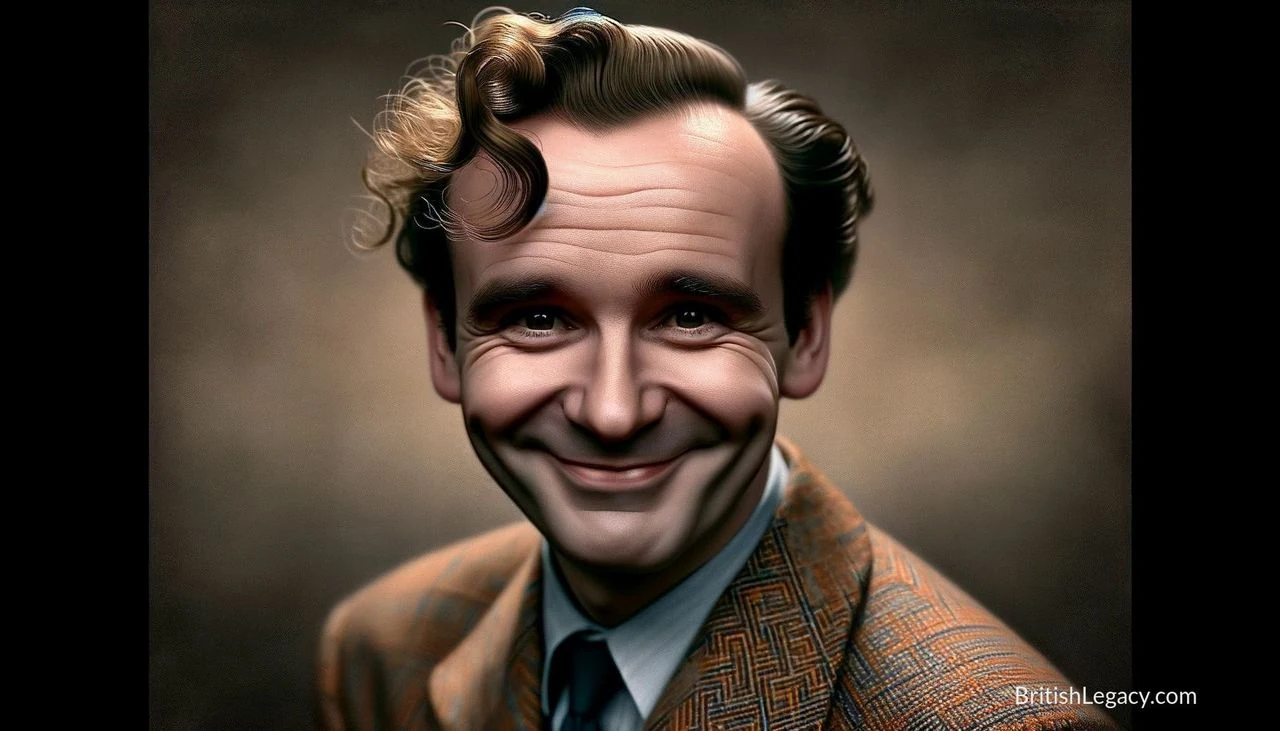
Kenneth Williams could turn a voice into a character. On radio, his quick shifts in accent and tone helped bring to life a gallery of eccentrics; in the Carry On films, his delivery sharpened the innuendo and punctured the pretensions of authority. His career crossed repertory theatre, radio, film and television, making him one of the most familiar comic performers in post-war British entertainment.
Growing up in London
Williams was born in King’s Cross, London, on 22 February 1926. His parents, Charles and Louisa, managed a hairdresser’s shop, and the family lived above it in Bloomsbury. He attended Lyulph Stanley Boys’ Central Council School and was apprenticed as a draughtsman to a mapmaker. During the Second World War he was evacuated to Bicester, Oxfordshire. In 1944, aged 18, he joined the British Army and served as a sapper in the Royal Engineers Survey Section. By the end of the war he was in Ceylon, where he transferred to the Combined Services Entertainment Unit and took part in revue shows.
That experience helped turn an interest in performance into a profession. Williams began working in repertory theatre in 1948, initially hoping to establish himself as a serious actor. A breakthrough came in 1954, when radio producer Dennis Main Wilson saw him playing the Dauphin in Bernard Shaw’s Saint Joan. Wilson cast him in Hancock’s Half Hour, the radio series starring Tony Hancock. Williams’s distinctive, nasal and camp-cockney delivery made him a popular voice in the programme, although he later had less to do as Hancock moved away from comic voices and what he regarded as gimmicks.
Williams’s early stage work also included Moby Dick—Rehearsed, directed by Orson Welles in 1955, and the revue Share My Lettuce, with Maggie Smith. In Pieces of Eight, Peter Cook contributed material that included “One Leg Too Few” and “Interesting Facts”, routines Cook later performed himself. These engagements show Williams moving between the stage and the emerging opportunities of radio comedy rather than following a single route to fame.
Radio: characters made from words
After his work with Hancock, Williams joined Kenneth Horne in Beyond Our Ken (1958–64) and its successor, Round the Horne (1965–68). The latter gave him several of his best-known parts, including Rambling Syd Rumpo, an absurd folk singer whose rustic songs were built from nonsense words and double entendres. Williams also played J. Peasemold Gruntfuttock, a telephone heavy-breather, and Dr Chou En Ginsberg, a comic criminal mastermind.
As Julian, one half of the camp couple Julian and Sandy, he performed alongside Hugh Paddick. Their exchanges used innuendo and Polari, a language associated with gay subcultures, as the basis for a radio comedy routine. Williams’s skill lay not simply in changing his voice but in controlling timing, emphasis and wordplay. A phrase could suggest one meaning and then turn sharply towards another.
From 1968 until his death, he was a regular panellist on BBC Radio’s Just a Minute, joining the show in its second series. The format’s demand for quick, sustained speech suited his fluency and appetite for performance. His on-air arguments with host Nicholas Parsons and other panellists became part of the programme’s entertainment. Across these series, radio offered Williams a durable platform for invention: characters could be built through language alone, then carried into the memories of listeners.
The Carry On years and television work
Williams appeared in 26 of the 31 Carry On films, from Carry On Sergeant (1958) to Carry On Emmannuelle (1978). The films made comic targets of institutions, social manners and authority, using slapstick and double entendre. Williams’s parts ranged from James Bailey in the first film to the Khasi of Khalabar in Carry On Up the Khyber and Thomas Cromwell in Carry On Henry. His precise, often splenetic delivery gave the series a recurring comic presence.
His relationship with the films was not uncomplicated. In his diaries he criticised many of the productions and his own work, and he complained that the cast were poorly paid. Producer Peter Rogers later said Williams cost little in relation to the money he made for the franchise. Williams continued to appear in the series and also spoke fondly of the films in interviews. The contrast between private criticism and public affection is part of the record of a performer who could be exacting about his work while remaining closely identified with it.
His television career extended well beyond the film series. He hosted or appeared in entertainment programmes, including International Cabaret and the BBC2 variety series Meanwhile, On BBC2. He read 69 episodes of the children’s programme Jackanory and supplied all the voices for the animated series Willo the Wisp (1981). The range of these appearances reflects how readily his voice and comic persona travelled between formats.
Diaries, private life and remembrance
Williams kept diaries throughout his life, and their posthumous publication brought another dimension to his public image. He wrote about his work, his disappointments and his private thoughts; the diaries reveal recurring unhappiness and struggles with depression. He also spoke openly about loneliness and a sense of underachievement in two BBC Radio London documentaries broadcast in 1977. His public fluency and capacity to entertain did not mean that his private life was free from difficulty.
Williams died in his London flat on 15 April 1988, aged 62. An inquest recorded an open verdict: it could not establish whether his death, caused by an overdose of barbiturates, was suicide or an accident. His authorised biographer later argued that it was an accidental overdose. Williams was cremated at East Finchley Cemetery, and his ashes were scattered in the memorial gardens.
His life and work have continued to be revisited in biographies and performances. A blue plaque at 57 Marchmont Street, where he lived above his father’s shop from 1935 to 1956, was unveiled in 2009. Another English Heritage blue plaque, unveiled in 2014, marks his former home at Farley Court. These commemorations place a performer known through radio and cinema within the London streets where his life began.
Why Kenneth Williams deserves a place in British Legacy
Williams’s place in British Legacy rests on the range and recognisability of his work. He helped make post-war radio comedy a meeting place for verbal invention and character performance, from the eccentric voices of Hancock’s Half Hour to the wordplay of Round the Horne. Rambling Syd Rumpo and Julian and Sandy were not merely funny voices: they depended on carefully controlled language, timing and innuendo. His regular appearances on Just a Minute extended that relationship with radio audiences across two decades.
On screen, his 26 appearances in the Carry On series connected him with a comic tradition that teased British institutions and social conventions. His television work, including Jackanory and Willo the Wisp, brought his voice to audiences beyond those who knew him from adult comedy. The diaries and later biographies add a more complicated account of the person behind that public performance, without diminishing the craft that made it memorable. Remembering Williams means recognising both the entertainment he gave and the distinctive way he used voice and language across British broadcasting, film and theatre.
Sources
Kenneth Williams — revision 1379422179
Adapted in part from Kenneth Williams by Wikipedia contributors, under CC BY-SA 4.0. Text has been edited and combined with the existing article; this adapted text is shared under the same licence. Contributor history.