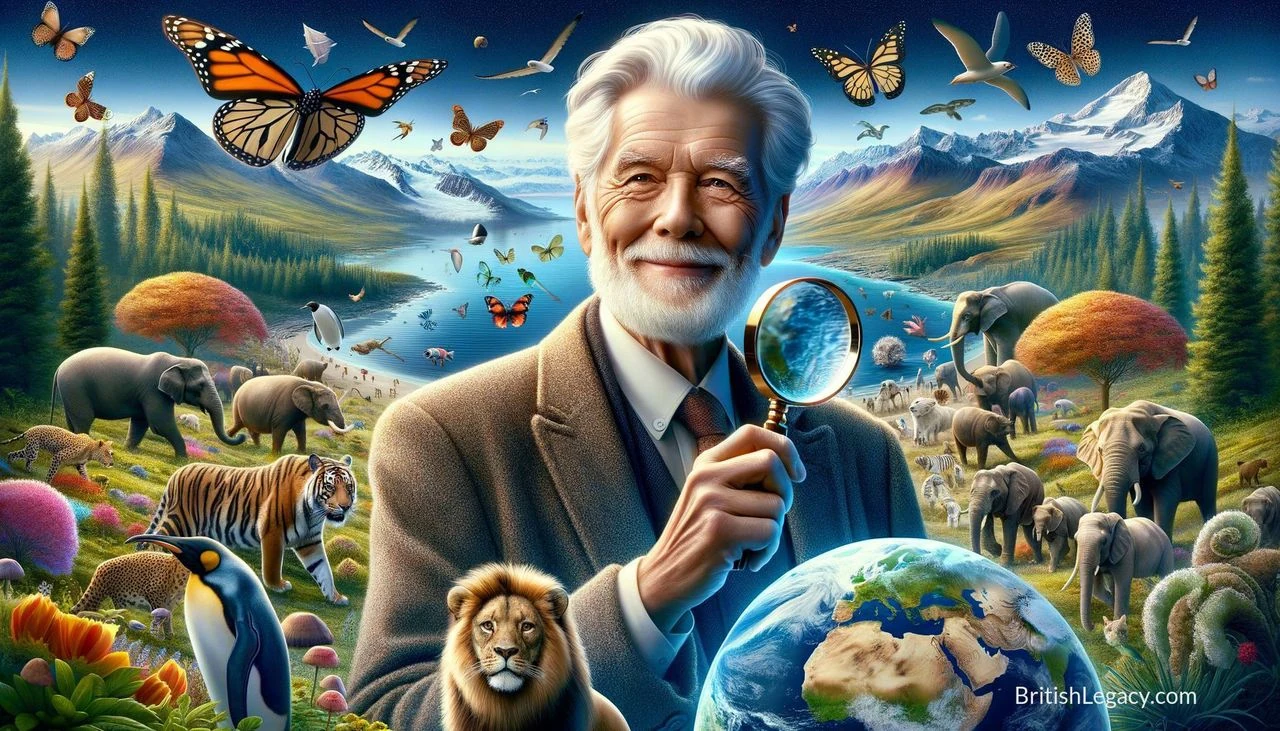
David Attenborough’s broadcasting career began behind the scenes, in factual television, before a last-minute change put him in front of the camera. From Zoo Quest in 1954 to Life on Earth, The Blue Planet and Planet Earth, he helped make the study of animals and their habitats a central subject of British television. His work has combined field observation with the reach of the BBC, while his later films have spoken with increasing urgency about humanity’s effects on the natural world.
A childhood collection, then Cambridge
David Frederick Attenborough was born in Isleworth, Middlesex, on 8 May 1926. He grew up in Leicester, where his father, Frederick, was principal of University College. As a boy, he collected fossils, stones and other natural specimens. A visit to a lecture by the conservationist Grey Owl in 1936, attended with his brother Richard, also made a lasting impression: the lecture connected wildlife with the consequences of human destruction of the environment.
Attenborough went to Wyggeston Grammar School for Boys in Leicester. In 1945 he won a scholarship to Clare College, Cambridge, where he studied geology and zoology and graduated in natural sciences. After being called up for national service in 1947, he spent two years in the Royal Navy, stationed in North Wales and the Firth of Forth. The order matters: his university studies came before, not after, his naval service.
His first civilian work was editing children’s science textbooks. In 1950 he applied unsuccessfully for a BBC radio production job. His curriculum vitae nevertheless caught the attention of Mary Adams, who offered him a training course with the BBC’s television service. Attenborough joined the corporation full-time in 1952, initially as a producer in its factual Talks department. He worked on programmes including the quiz show Animal, Vegetable, Mineral? and Song Hunter, about folk music.
From the studio to the field
Natural history entered his work through Animal Patterns, a studio series featuring animals from London Zoo and discussion of their behaviour. Attenborough met the zoo’s reptile-house curator, Jack Lester, and together they developed the idea for an animal-collecting expedition series. When Lester became ill, Attenborough took over as presenter. Zoo Quest first aired in 1954, beginning his long on-screen career.
In 1957, the BBC established its Natural History Unit in Bristol and invited Attenborough to join. He declined, as he and his young family were settled in London, and formed the corporation’s Travel and Exploration Unit instead. He continued to present Zoo Quest and to work on other factual programmes. In the early 1960s, he left the BBC staff to study social anthropology at the London School of Economics, but returned before completing the degree when invited to become controller of BBC Two.
Attenborough took up that post in 1965. He was responsible for shaping a channel that needed a distinctive identity, and assembled a broad schedule spanning arts, science, archaeology, travel, sport and entertainment. Programmes commissioned during his tenure included Call My Bluff, The Old Grey Whistle Test, Monty Python’s Flying Circus and The Money Programme. He also backed major documentary work, including Kenneth Clark’s Civilisation, which demonstrated the possibilities of colour television. In 1969 he became director of programmes, overseeing both BBC channels. The management role took him away from programme-making, and he left in 1973 to return to making and presenting television.
The long view of life on Earth
Life on Earth, broadcast in 1979, began the best-known sequence of authored natural-history series associated with Attenborough and the BBC Natural History Unit. Its thirteen episodes traced the evolution of life, moving between locations around the world. The programme’s scale depended on international co-production and on film-making techniques developed to capture animals and events that had rarely been filmed. Attenborough’s restrained presence on screen left room for the wildlife itself, while his narration connected individual encounters to a larger account of evolution.
The Living Planet followed in 1984, organising its story around ecology and the ways living things adapt to their surroundings. The Trials of Life completed the original trilogy in 1990, turning to animal behaviour. Further series widened the scope: Life in the Freezer explored Antarctica; The Private Life of Plants used time-lapse photography to show plant growth; and The Life of Birds, The Life of Mammals and Life in the Undergrowth examined other major groups of living things. With Life in Cold Blood in 2008, Attenborough brought the collection’s coverage of the major groups together. He later included First Life, which explored evolutionary history before the events of Life on Earth.
His work extended beyond that sequence. He narrated the long-running BBC series Wildlife on One and contributed to Natural World. The BBC’s The Blue Planet (2001), a comprehensive series on marine life, and Planet Earth (2006), the corporation’s first wildlife series filmed in high definition, brought the natural-history format to new technical and visual scales. Attenborough returned for later productions including Frozen Planet, Planet Earth II and Blue Planet II. Across these programmes, the continuing method was to make scientific subjects accessible without reducing them to spectacle alone.
From observation to environmental warning
Environmental concerns became more explicit in Attenborough’s later work. State of the Planet (2000) assessed the effects of human activity using scientific evidence and interviews with researchers and conservationists. He went on to address climate change in The Truth about Climate Change and population growth in How Many People Can Live on Planet Earth?. In 2019, Climate Change – The Facts and Extinction: The Facts focused on climate change and biodiversity loss.
David Attenborough: A Life on Our Planet (2020) framed those themes through changes he had witnessed over his lifetime, presenting a personal account alongside a call for a different future. His work around the 2021 United Nations climate conference included an address at its opening ceremony. The United Nations Environment Programme named him a Champion of the Earth in 2022, recognising his work documenting and advocating for the protection and restoration of nature.
His environmental advocacy has included support for conservation organisations and campaigns. He has backed efforts to protect albatross from longline fishing and to preserve rainforest in Borneo, and helped launch ARKive, a digital library of natural-history media. His public arguments have also drawn criticism, including over his views on population growth. That debate is part of the record of an environmental voice whose work has moved beyond describing wildlife to discussing the pressures placed upon it.
Honours, influence and public service
Attenborough’s standing rests not only on presenting, but also on the institutions and programmes through which he worked. His years directing BBC Two helped establish a varied schedule for the channel; his later natural-history films showed how sustained collaboration between presenters, scientists and production teams could bring research to a mass audience. He has received numerous broadcasting and science-communication honours. Among them are the BAFTA Fellowship in 1980, a knighthood in 1985, the Order of Merit in 2005 and a 2024 Stephen Hawking Medal for Science Communication.
His connection to British places is visible in both his career and public recognition. He grew up in Leicester, studied at Cambridge and worked for the BBC, while serving as president of the Leicestershire and Rutland Wildlife Trust. He was made an honorary Freeman of Leicester and of Bristol. The polar research ship RRS Sir David Attenborough also bears his name. These links sit alongside an international career: the films travel widely, but a substantial part of their production history belongs to British public-service broadcasting.
Why David Attenborough deserves a place in British Legacy
David Attenborough deserves a place in British Legacy because he helped build a distinctive tradition of natural-history broadcasting within the BBC. His contribution was not limited to appearing in front of a camera. As controller of BBC Two, he supported a channel with room for science, arts, documentary and entertainment; later, as a maker and presenter, he helped develop a sustained sequence of ambitious wildlife programmes. Life on Earth and the series that followed joined field filming, scientific research and clear narration, allowing viewers to encounter subjects that were difficult to observe directly. That work influenced the form and reach of wildlife film-making and made natural history part of everyday television culture.
His legacy also lies in the changing purpose of that broadcasting. The programmes began by bringing the diversity of life into view; later films increasingly examined the human pressures that threaten it. Attenborough’s conservation campaigning, support for organisations and contribution to projects such as ARKive extend that work beyond the screen. His British connection is concrete: a career shaped by the BBC, education and public institutions in Britain, with films made for audiences around the world. Together, those achievements show how British broadcasting can combine public education, technical ambition and international reach—and how a familiar television voice can help make environmental change a subject of public concern.
Sources
David Attenborough (Wikipedia revision)
Adapted in part from David Attenborough by Wikipedia contributors, under CC BY-SA 4.0. Text has been edited and combined with the existing article; this adapted text is shared under the same licence. Contributor history.