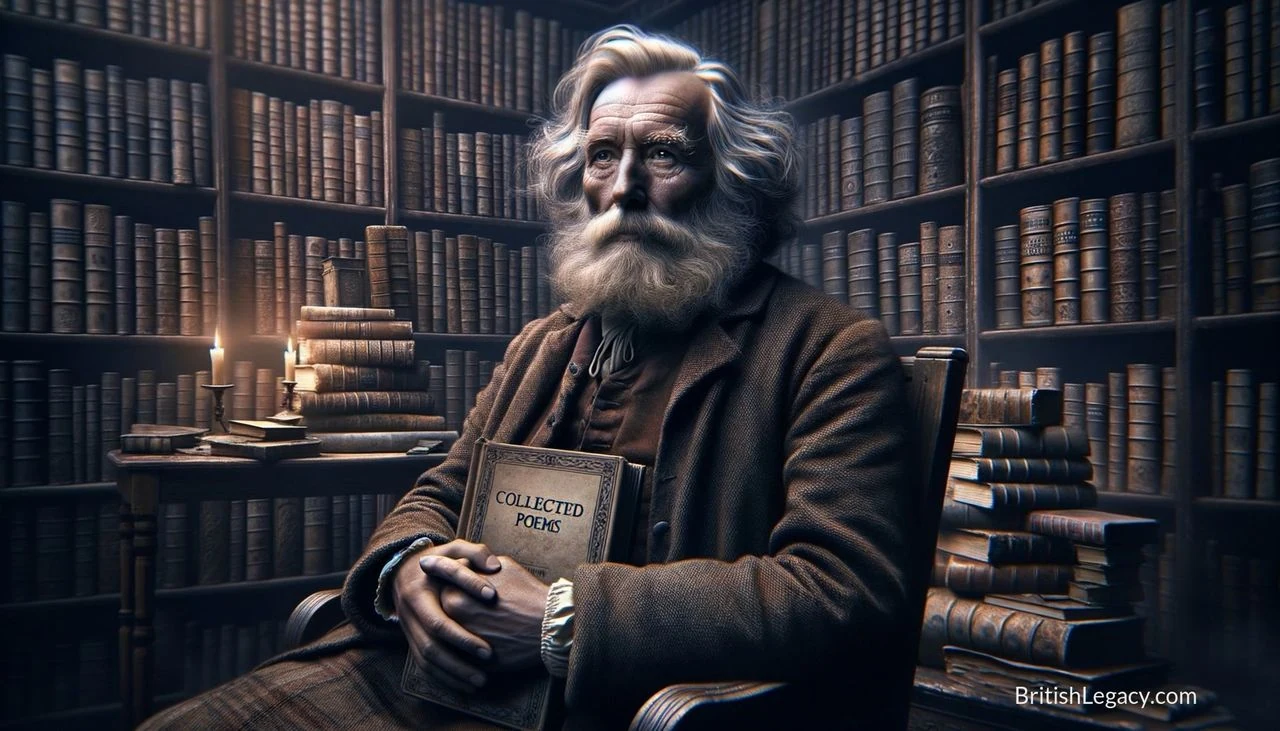
Edwin Morgan moved between the sonnet, concrete poetry, science-fiction verse and translation without treating any one form as a boundary. His writing could confront poverty in Glasgow, turn towards love or friendship, or play with imagined journeys through space. That range made him one of the most distinctive Scottish poets of the twentieth century, and carried his work from the page into public life as Glasgow’s first Poet Laureate and Scotland’s first Makar.
Glasgow, study and interruption
Born in Glasgow on 27 April 1920, Morgan grew up in nearby Rutherglen. His parents were Presbyterian, and as a young reader he persuaded them to pay for memberships in several Glasgow book clubs. He later described The Faber Book of Modern Verse as a revelation. That early encounter with modern poetry would sit alongside a wide-ranging education: he entered the University of Glasgow in 1937 and studied French and Russian, while teaching himself some Italian and German.
His university years were interrupted by the Second World War. As a conscientious objector, Morgan served in the Royal Army Medical Corps in a non-combatant role. He graduated in 1947 and became a lecturer at Glasgow, remaining at the university until retiring as a full professor in 1980. Teaching and writing were not separate careers so much as parallel parts of a life shaped by language, reading and the exchange of ideas.
Experiment across forms
Morgan’s poetry ranges from traditional sonnets and blank verse to concrete poems in which the arrangement of words on the page contributes to their effect. His subjects are just as various: urban life, love, politics, popular culture, science and imagined futures all find a place. He could move from serious reflection to camp or playful nonsense, and from poems attentive to contemporary technology to space fantasies. Rather than settle into a recognisable formula, he made change itself a defining feature of his work.
The Glasgow Sonnets, published in 1972, connect formal skill with the city’s social realities. “Glasgow Sonnet (I)” has been described as a Petrarchan sonnet about poverty. Other poems take a more intimate or everyday encounter as their starting point. “Strawberries” is a love poem; “Trio” finds friendship in an ordinary city scene; and “In the Snackbar” observes an encounter with a disabled pensioner in a Glasgow café. Together, such poems show how Morgan could make a small moment carry emotional or social weight without losing the particularity of its setting.
His work also reached beyond the boundaries of poetry written in English. Morgan translated from languages including Russian, Hungarian, French, Italian, Latin, Spanish, Portuguese, German and Old English. His 1952 verse translation of Beowulf became a standard translation in America. Translations collected in Rites of Passage and later in Collected Translations sit alongside his original writing as evidence of a career spent listening to, and remaking, different poetic voices.
Books, songs and public poetry
Collected Poems appeared in 1990, gathering work from a career that had moved through many forms. Morgan’s books include the concrete poetry collection The Horseman’s Word, the science-fiction poems of Star Gate, and Glasgow Sonnets. His later publications continued to resist a single mode: Dreams and Other Nightmares appeared in April 2010, the year he turned 90.
His poems also found listeners beyond the readership of books. In 1999, Morgan became Glasgow’s first Poet Laureate. He was named Scotland’s first Makar, or National Poet, in 2004; the appointment lasted until his death in 2010. For the opening of the Scottish Parliament building in October 2004, he wrote a poem that Liz Lochhead read because he was too ill to attend. The occasion placed poetry within a significant public ceremony, while keeping the poet’s words at its centre.
Music offered another route to an audience. Morgan collaborated with the Scottish band Idlewild on “In Remote Part/Scottish Fiction”, the closing track of their album The Remote Part, reciting a poem written for the song. He also contributed to Ballads of the Book, a project pairing poems by Scottish writers with music by Scottish performers. Karine Polwart and Idlewild performed songs based on his contributions. These collaborations did not require him to abandon the written poem; they let its language travel in another form.
Recognition and remembrance
Morgan received the OBE in the 1982 Birthday Honours. Among later distinctions were the Queen’s Gold Medal for Poetry in 2000, the Saltire Society’s Andrew Fletcher of Saltoun award in 2002, and a lifetime achievement award for literature from the Saltire Society and Scottish Arts Council in 2003. His work continued to attract attention near the end of his life, including a 2008 Scottish Arts Council Book of the Year Award.
On 19 August 2010, Morgan died of pneumonia in Glasgow, aged 90. His will left funds for the creation of the Edwin Morgan Poetry Award, an annual scheme for young poets in Scotland; the Edwin Morgan Trust was established in 2012 to administer it. The award extended his name into a practical form of support for a new generation of writers.
Why Edwin Morgan deserves a place in British Legacy
Morgan’s place in British literary history rests on more than a title or a single celebrated collection. He widened the possibilities of Scottish poetry by moving confidently between established forms and experiments with the visual page, science fiction, song and translation. In poems such as “Glasgow Sonnet (I)” and “In the Snackbar”, formal invention stays connected to recognisable human lives and urban settings. His writing gives Glasgow and Scotland a vivid presence without limiting its reach: his translations brought other literary traditions into English, while his own poems were carried into music and public ceremony.
His public appointments made that contribution visible. As Glasgow’s first Poet Laureate and Scotland’s first Makar, Morgan helped place poetry in civic and national life, including at the opening of the Scottish Parliament. His legacy also has a continuing, practical dimension: the poetry award established from funds he left in his will supports young poets in Scotland. Taken together, these achievements show a writer who treated poetry not as a fixed inheritance but as a living practice—open to new forms, other languages, contemporary experience and future voices. That combination of Scottish rootedness and formal openness is a specific and lasting contribution to Britain’s literary culture.
Sources
Edwin Morgan (poet), revision 1379440502 · Edwin Morgan (poet)
Adapted in part from Edwin Morgan (poet) by Wikipedia contributors, under CC BY-SA 4.0. Text has been edited and combined with the existing article; this adapted text is shared under the same licence. Contributor history.