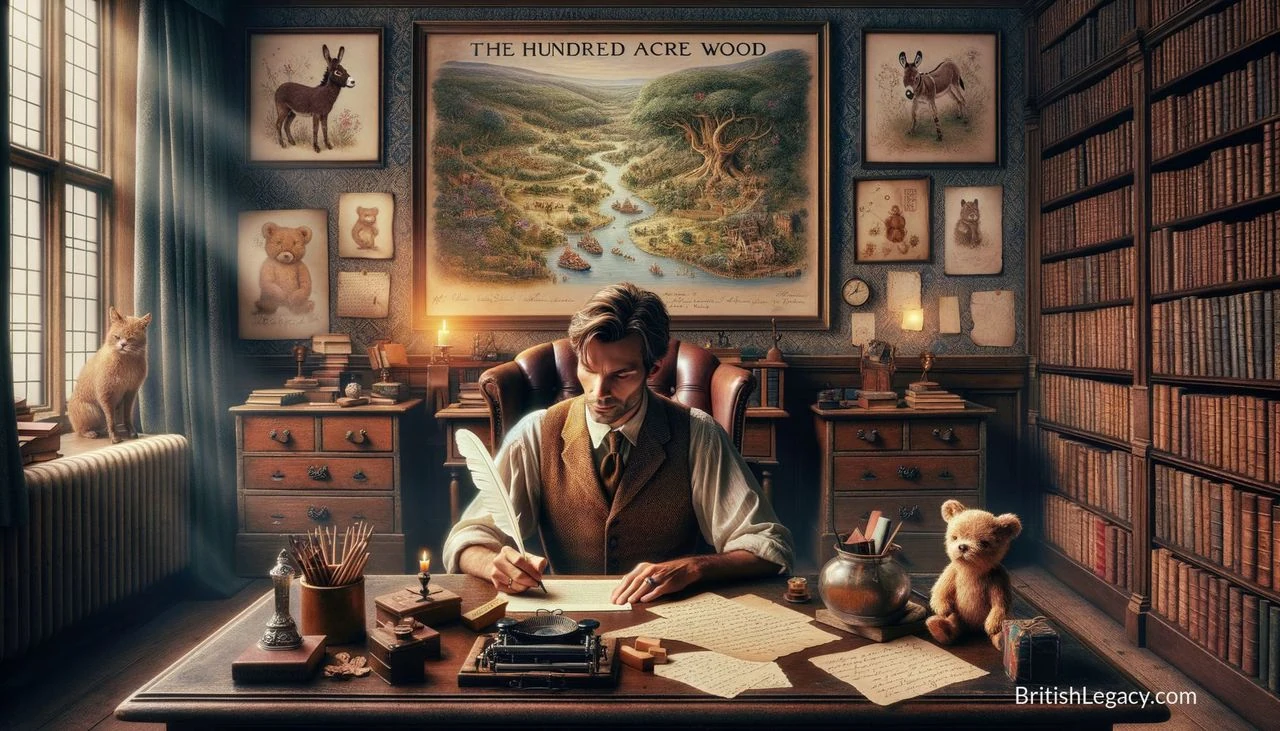
For many readers, A. A. Milne’s name belongs to the Hundred Acre Wood. But the writer who created Winnie-the-Pooh had already built a varied literary career: he contributed humour to Punch, wrote plays and novels, and served as an officer in two world wars. The success of his children’s books brought a lasting public identity that was both his greatest achievement and, at times, a source of frustration.
From Kilburn to Punch
Alan Alexander Milne was born in Kilburn, London, on 18 January 1882. His father, John Vine Milne, was born in Jamaica; his mother was Sarah Marie Milne, née Heginbotham. Milne grew up at Henley House School, a small independent school run by his father. He later attended Westminster School and Trinity College, Cambridge, where he studied mathematics on a scholarship and graduated with a BA in 1903.
At Cambridge, Milne wrote for and edited Granta, the student magazine, sometimes collaborating with his brother Kenneth. After university he contributed humorous verse and essays to Punch, joining its staff in 1906 and later becoming an assistant editor. The magazine gave him an early audience for the wit and observational humour that would remain part of his writing. He also played cricket for amateur teams made up largely of writers, including the Allahakbarries and the Authors XI.
Milne’s work before Pooh was substantial. He wrote 18 plays and three novels during the earlier part of his career, among them the detective story The Red House Mystery (1922). He also wrote for the emerging British film industry: four stories were filmed in 1920 for Minerva Films, a company founded by actor Leslie Howard and story editor Adrian Brunel. His career was not a straight path towards children’s literature; he moved among journalism, theatre, fiction and film.
War, writing and changing convictions
Milne joined the British Army during the First World War and served as an officer in the Royal Warwickshire Regiment. He went to the Somme as a signals officer in 1916, caught trench fever and was invalided back to England. After recovering, he worked as a signals instructor and was recruited to write propaganda articles for military intelligence. He left the Army in 1919, retaining the rank of lieutenant.
In 1934 he published Peace with Honour, a denunciation of war. By 1940, as the Second World War was under way, he had partly retracted that position in War with Honour. He served in the Home Guard in Hartfield and Forest Row, where he held the rank of captain and asked members of his platoon to call him “Mr Milne”. These experiences sat alongside his writing rather than replacing it: he continued to publish books and work for the stage.
The making of the Hundred Acre Wood
Milne married Dorothy “Daphne” de Sélincourt in 1913. Their son, Christopher Robin, was born in 1920. The boy’s toys inspired several characters in the Pooh stories, while Christopher himself became the model for the child at their centre. Pooh’s name and origins drew on more than one source: Christopher’s stuffed bear, originally called Edward, was renamed Winnie after Winnipeg, a Canadian black bear at London Zoo; “the Pooh” came from a swan the child had named Pooh. E. H. Shepard illustrated the books, using his own son’s teddy bear as a model for Pooh.
The landscape mattered too. Milne lived at Cotchford Farm in Hartfield, on the northern edge of Ashdown Forest, and took Christopher on walks there. The fictional Hundred Acre Wood was based on the forest’s Five Hundred Acre Wood; Shepard also drew on Ashdown’s scenery for his illustrations. Pooh first appeared in the poem “Teddy Bear” in 1924, then in a story published in the London Evening News on Christmas Eve 1925. Winnie-the-Pooh followed in 1926 and The House at Pooh Corner in 1928. The same period brought the poetry collections When We Were Very Young and Now We Are Six, also illustrated by Shepard.
The stories’ gentle comedy and attention to friendship made them inviting to children and adults alike. Yet their success narrowed public attention to one part of Milne’s work. He did not intend to keep producing Pooh stories, and the intense attention directed at his son troubled him. Christopher later resented what he saw as the use of his childhood and name, and became estranged from his parents. The books’ affection for childhood therefore belongs beside a more complicated family history.
Beyond the bear
Milne continued writing after the Pooh books, though not more stories about the bear. In 1929 he adapted Kenneth Grahame’s The Wind in the Willows for the stage as Toad of Toad Hall. It opened in Liverpool before reaching London’s West End in 1930, and the play was revived there in later years. Milne also published novels, essays, poetry and plays, including the autobiographical It’s Too Late Now (1939). His range is easy to overlook when the best-known books dominate the story.
A stroke and brain surgery in 1952 left Milne an invalid. He died at his home in Hartfield, Sussex, on 31 January 1956, aged 74. The original manuscripts of Winnie-the-Pooh and The House at Pooh Corner are held at Trinity College Library, Cambridge. The rights to the Pooh books were divided among four beneficiaries after his death; later sales brought the characters into the Walt Disney company’s ownership. Those commercial afterlives helped extend Pooh’s reach, while the manuscripts preserve the work in the place where Milne had studied.
Why A. A. Milne deserves a place in British Legacy
Milne’s place in British literary history rests on more than the continuing popularity of Winnie-the-Pooh. His path from Punch contributor to playwright, novelist and children’s poet shows the breadth of a working writer whose career crossed several forms. The Pooh books themselves joined Milne’s words to E. H. Shepard’s illustrations and to a recognisable landscape in East Sussex. Ashdown Forest was not simply a distant inspiration: walks there with his son helped shape the fictional wood, and the books carried an identifiable part of the English countryside into readers’ imaginations around the world.
That achievement has had a lasting cultural benefit. The stories and their characters have travelled far beyond their original setting, while the manuscripts remain in the Cambridge college where Milne studied. Their continuing life in publishing, performance and adaptation has made a particular strand of British writing familiar to successive generations. A balanced legacy also remembers that Pooh’s fame overshadowed Milne’s other work and complicated his son’s relationship with the books. Recognising both the imaginative achievement and that human cost makes his story more complete: Milne was not only the author of a much-loved bear, but a writer whose varied career and lasting creations remain part of Britain’s literary inheritance.
Sources
A. A. Milne (revision 1374617113)
Adapted in part from A. A. Milne by Wikipedia contributors, under CC BY-SA 4.0. Text has been edited and combined with the existing article; this adapted text is shared under the same licence. Contributor history.