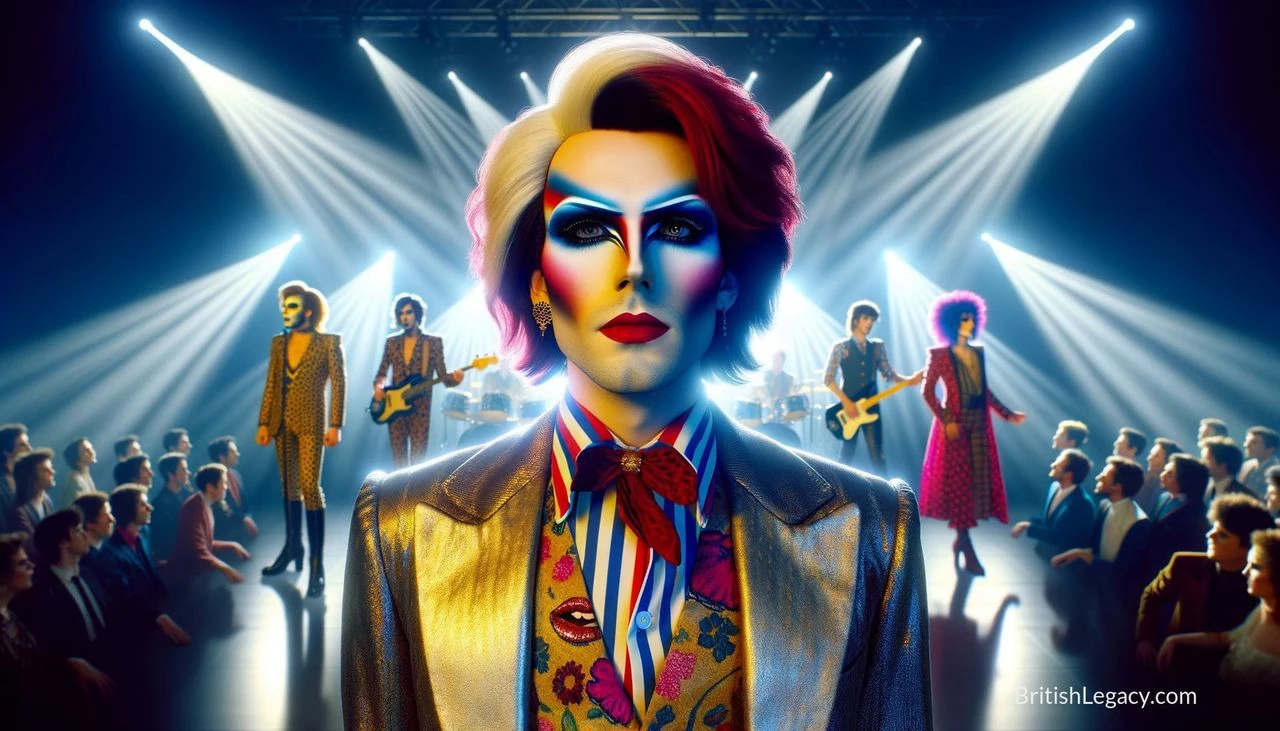
Boy George’s rise from London’s New Romantic scene to international success with Culture Club made him one of the most recognisable British pop performers of the early 1980s. His voice carried songs such as “Do You Really Want to Hurt Me” and “Karma Chameleon”; his make-up, hairstyles and clothes gave the band a striking visual identity. George’s career did not end with the group’s first run of hits: it went on through solo records, DJ work, theatre, television and repeated Culture Club reunions.
Eltham and the New Romantics
George Alan O’Dowd was born at Barnehurst Hospital, Kent, on 14 June 1961, and grew up in Eltham, south-east London. The second of five children in a working-class Irish Catholic family, he attended Middle Park Infant School and Eltham Green Secondary School. He later said that he left school without qualifications. Before music became his career, he worked as a fruit picker, printer, make-up artist and model.
In the late 1970s and early 1980s, O’Dowd became part of the New Romantic movement, which took shape around London clubs and a highly theatrical approach to dress. He lived in squats around Warren Street and was a regular at Blitz, the club run by Steve Strange and Rusty Egan. His influences included Siouxsie and the Banshees, Roxy Music, Patti Smith, David Bowie and Marc Bolan. He later identified Siouxsie Sioux as an early inspiration, and described fashion as an important part of his artistic identity.
Music entrepreneur Malcolm McLaren arranged for him to perform with Bow Wow Wow, using the name Lieutenant Lush. After leaving the group, O’Dowd formed a band with bassist Mikey Craig. Drummer Jon Moss and guitarist Roy Hay joined; the group settled on the name Culture Club.
Culture Club’s breakthrough
Formed in 1981, Culture Club combined pop and new wave with soul and reggae influences. The group’s debut album, Kissing to Be Clever, was released in 1982. Its single “Do You Really Want to Hurt Me” became an international hit, reaching number one in several countries and number two in the United States. “Time (Clock of the Heart)” and “I’ll Tumble 4 Ya” followed; the latter reached the US top ten. Culture Club became the first group since the Beatles to score three US top-ten hits from a debut album.
Their second album, Colour by Numbers (1983), topped the UK album chart and reached number two in the United States. “Karma Chameleon” reached number one in 16 countries. In the UK it was the best-selling single of 1983 and spent six weeks at number one. Other hits from the album included “Church of the Poison Mind”, “Victims” and “It’s a Miracle”. The group’s success connected a distinctive performance style to a run of widely heard pop records.
Waking Up with the House on Fire, the band’s third album, was less successful internationally than its predecessors but reached number two in the UK. Its first single, “The War Song”, peaked at number two on the UK singles chart. On 25 November 1984, George also provided a joint lead vocal on Band Aid’s “Do They Know It’s Christmas?”, recorded to raise funds for people affected by famine in Ethiopia. The song became the UK Christmas number one and the country’s best-selling single of 1984.
In 1986, George appeared in an episode of The A-Team, and Culture Club released its fourth album, From Luxury to Heartache. The band ultimately disbanded that year. George began his solo career with Sold (1987), which produced the UK number-one single “Everything I Own”. His later work included the song “The Crying Game”, recorded for the film of the same name, and releases as part of Jesus Loves You. In 1989, he formed the record label More Protein and wrote under the pseudonym Angela Dust.
A career beyond Culture Club
George built a parallel career as a DJ, playing clubs and compiling dance-music collections. His recording projects ranged from the rock-influenced Cheapness and Beauty (1995) to dance collaborations and solo albums. In 2013, This Is What I Do became his first album of original material in 18 years. These projects show a career that continued to develop beyond Culture Club’s early chart successes.
Theatre offered another way to revisit the world that had shaped his beginnings. George’s musical Taboo, based on the early-1980s New Romantic scene, opened in London’s West End in 2002. He played Australian performance artist Leigh Bowery rather than himself. The production ran for two years and received four Laurence Olivier Award nominations; its score earned George a Tony Award nomination. A substantially altered New York production had a shorter run.
Culture Club reunited for performances in 1998 and released Don’t Mind If I Do in 1999. Later attempts to reunite and tour did not always proceed as planned, but the band returned to performing together in 2014. George also appeared on television as a coach on The Voice UK in 2016 and later on The Voice Australia. In 2022 he took part in the UK series of I’m a Celebrity...Get Me Out of Here!, finishing in eighth place.
Image, recovery and recognition
George’s public image joined sound to appearance. His make-up, hairstyles and androgynous clothing distinguished him from more conventional pop presentation, while the New Romantic club scene provided a context for that theatrical style. As Culture Club reached audiences well beyond London, his appearance became an integral part of how many listeners recognised the group, alongside his voice and the songs’ mixture of pop hooks and emotional directness.
George has spoken publicly about addiction and recovery. After struggling with heroin addiction during the 1980s, he entered treatment. He later said he had been sober since 2 March 2008. In 2014, a haemorrhaged polyp on his vocal cords led to the cancellation of Culture Club reunion-tour dates. After resting his voice and doing vocal exercises, he recovered without surgery.
His career also includes serious legal consequences. In 2008, George was convicted at Snaresbrook Crown Court of assault and false imprisonment in connection with an incident involving Norwegian model Audun Carlsen. In January 2009 he was sentenced to 15 months’ imprisonment. He was released after four months and served the remainder of his sentence under conditions that included a curfew.
Among George’s later recognitions, he received the Ivor Novello Award for Outstanding Services to British Music in 2015. In 2018, he and Culture Club were named Music Icon at the Attitude Awards. The honours recognise a career that encompasses the group’s hit records as well as George’s work in other musical forms.
Why Boy George deserves a place in British Legacy
Boy George deserves a place in British Legacy because his work with Culture Club shows how a distinctive British pop group could carry experimentation from a local scene to an international audience. “Do You Really Want to Hurt Me” established the band’s reach, while “Karma Chameleon” became a chart-topping British single and the UK’s best-selling single of 1983. George was central to that achievement: his voice gave the songs their emotional character, and his visual presence made the group readily identifiable. Their music connected pop with soul, reggae and new wave, turning a particular mix of influences into records that travelled far beyond the London clubs of the New Romantic era.
His contribution is not confined to that breakthrough. George continued to record solo music, work as a DJ and write for the stage, while returning to perform with Culture Club. His role in Band Aid also placed him among the performers on a major British charity recording of the 1980s. The public visibility of his androgynous style formed part of the band’s identity and brought an individual, theatrical image into mainstream pop. Remembering George in British Legacy means acknowledging the records and performances that gave audiences lasting songs, as well as the range of creative work that followed his first success. His career links British popular music, nightlife, theatre and television through one performer’s continuing work.
Sources
Boy George — Wikipedia revision 1379646495 · Boy George — Wikipedia
Adapted in part from Boy George by Wikipedia contributors, under CC BY-SA 4.0. Text has been edited and combined with the existing article; this adapted text is shared under the same licence. Contributor history.