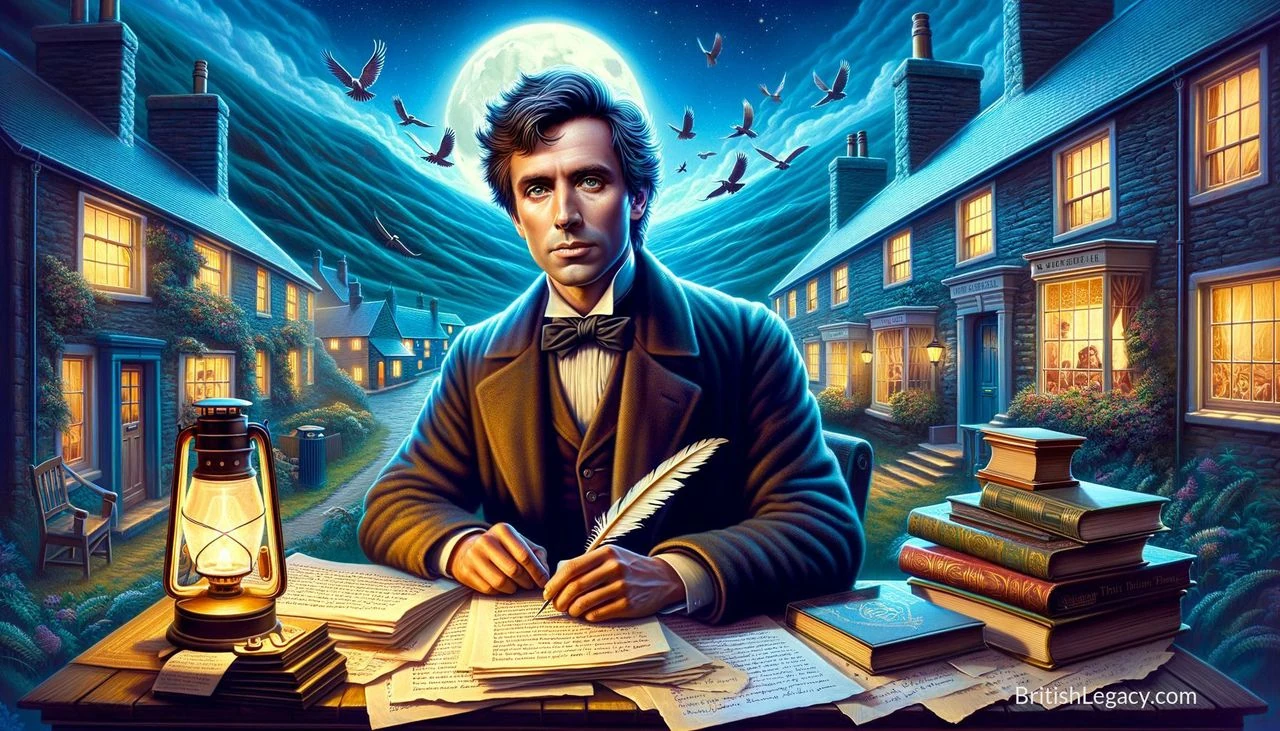
Dylan Thomas’s poetry can be heard as much as read. Dense with rhythm, rhyme and striking images, it made a distinctive voice of a young writer from Swansea. He was already publishing poems as a teenager; later, BBC broadcasts and readings brought his writing to a far wider audience. His work ranged from the formal intensity of “Do not go gentle into that good night” to the comic, tender chorus of Under Milk Wood. Thomas died in New York in 1953, aged 39, but the landscapes and language of Wales remained at the heart of his writing.
Swansea beginnings and a writer in formation
Thomas was born in Swansea on 27 October 1914, the son of Florence Hannah Williams and David John “Jack” Thomas, an English teacher. His father taught English literature at the local grammar school and had studied the subject at University College, Aberystwyth. Both parents spoke Welsh and English, as did many of the relatives who helped bring up Dylan and his older sister, Nancy. Thomas’s childhood included regular visits to the Llansteffan peninsula, where his mother’s family lived and worked on farms. These Welsh-speaking places and their people would stay with him, even though he later resisted being labelled a provincial or nationalist poet.
He attended Swansea Grammar School, where his father taught. Thomas preferred his own reading and writing to the school curriculum, edited the school magazine and began keeping notebooks of poems. He left school at 16 in 1931 to work as a reporter for the South Wales Daily Post. After about 18 months he left the newspaper, but continued freelance journalism while writing. A number of his poems appeared in print while he was still a teenager; “And death shall have no dominion”, published in 1933, was his first poem in a national journal. His notebooks, eventually containing more than 200 poems, record the rapid development of a writer still in his teens and early twenties.
His early career was not confined to the page. From 1929 to 1934, he acted, wrote, produced and painted sets for amateur theatre in Swansea, including the Little Theatre in the Mumbles. In 1934 he first visited Laugharne, the Carmarthenshire town that would later become his home. His debut collection, 18 Poems, appeared in 1934 after a poem won a prize in the Sunday Referee’s “Poet’s Corner”. Twenty-five Poems followed in 1936, bringing further critical attention. The books were praised, but sales were poor, and earning a living as a writer remained difficult.
Welsh roots and a restless working life
Thomas married Caitlin Macnamara in 1937. The family lived in a succession of homes in Wales and England before settling at the Boat House in Laugharne in 1949. The town gave him a lasting base: he wrote in a garage converted into a shed on the cliff, and the people and surroundings of the area helped shape the imaginative world of his later work. His life was not, however, a steady retreat into poetry. During the Second World War, chronic lung problems kept him from military service. He worked for the Strand Film Company, writing scripts for documentary films, including productions for the Ministry of Information and the British Council.
Broadcasting became another important part of his working life. Thomas had contributed occasionally to the BBC before the war, but from 1945 he made more than a hundred broadcasts over three years. He read poetry, took part in discussions and performed in radio drama. His resonant delivery made him a familiar voice, while the broadcasts provided income at a time when his books did not reliably do so. His work for radio also developed alongside the writing of Under Milk Wood: what began as an idea for a drama about a Welsh town gradually became a “play for voices”, built from the dreams, conversations and routines of its inhabitants.
The play’s development was prolonged. Thomas read an early version in the United States in 1953, and was still revising the script shortly before his final journey there. He died before the BBC could record it. Under Milk Wood was broadcast in 1954, with Richard Burton in the cast, and won the Prix Italia for literary or dramatic programmes that year. Its fictional village of Llareggub brings together humour and sadness, ordinary work and private longing. Rather than presenting a single hero, Thomas gives the community its own layered voice.
Poems carried by sound and image
Thomas’s poetry is often recognised by its verbal energy: alliteration, internal rhyme, rhythmic shifts and images that can seem at once vivid and difficult to pin down. He treated words as material to be shaped, and his poems draw on varied sources, including the Bible, science, Welsh folklore and literary tradition. Critics have debated the density of his writing, but its sound is not decoration added to a message. Rhythm and word choice are part of how the poems think and feel.
His connection to Wales was complex. Thomas objected to being described as a provincial poet and denied that Welsh bardic poetry directly influenced his work. Yet his writing was rooted in Welsh geography and experience. Swansea, the countryside around Llansteffan and the estuary at Laugharne belong to the imaginative world of his poems and prose. He returned to Wales when he found writing difficult, and the settings and voices of the country informed the work without reducing it to a simple statement of national identity.
“Do not go gentle into that good night”, written in 1951 in the form of a villanelle, addresses his father, who died the following year. Its repeated appeal to “Rage, rage against the dying of the light” gives the poem its insistent movement. That musical force also runs through works such as “Fern Hill” and “In the white giant’s thigh”. Thomas’s writing extended beyond lyric poetry: he published short stories, prose works such as A Child’s Christmas in Wales, radio pieces and film scripts. The range reflects a writer who worked across forms and audiences, not just the page.
Fame, final journey and remembrance
Thomas’s reputation grew through publication, broadcasting and readings. Deaths and Entrances, published in 1946, marked a turning point in critical recognition. His poetry readings in the United States brought further attention, and his work became widely popular during his lifetime. He also faced financial insecurity: writing did not always provide a dependable income, and film and broadcast work helped support him. The contrast between public acclaim and the practical difficulty of making a living remained part of his career.
In October 1953, Thomas travelled to New York for another series of performances and work on Under Milk Wood. He became gravely ill and died on 9 November, aged 39. His body was returned to Wales, and he was buried at St Martin’s churchyard in Laugharne. Accounts of his life have often been overshadowed by a “doomed poet” image centred on drinking and his death. That reputation can obscure the disciplined writing, performance and range of work that made him a significant literary figure.
His memory remains part of the cultural life of Swansea and Laugharne. Swansea’s Dylan Thomas Centre hosts exhibitions and lectures and is associated with the annual Dylan Thomas Festival; a statue of the poet stands outside. In Laugharne, the Boat House and his writing shed have been preserved, and the house became a museum. His name also lives on in the Dylan Thomas Prize, established in 2004 for a published writer in English under 30. These memorials connect his work to the places that shaped it, while giving new readers ways to encounter the writing itself.
Why Dylan Thomas deserves a place in British Legacy
Thomas deserves a place in British Legacy not because his writing can be reduced to a national label, but because his work shows how a distinctive local inheritance can speak beyond its place of origin. Born and raised in Swansea, with family and creative ties across Wales, he made Welsh settings and communities part of a body of work written largely in English. His poetry does not simply describe landscape: its rhythms and imagery make language itself feel alive. The tension between his resistance to being categorised as a “Welsh poet” and the deep Welsh grounding of his work is part of what makes his literary identity compelling.
His contribution also reaches beyond the printed poem. Thomas’s BBC broadcasts made poetry a public sound, while his readings brought that sound to audiences in Britain and the United States. Under Milk Wood demonstrates how radio could give a whole community a dramatic presence, and its later performances have carried that work into new settings. The preserved Boat House and writing shed, Swansea’s Dylan Thomas Centre and the prize bearing his name connect literary remembrance with places, education and opportunities for other writers. Thomas’s legacy is therefore both artistic and cultural: a body of formally inventive work, a powerful performance voice and an enduring link between Welsh literary life and wider audiences.
Sources
Adapted in part from Dylan Thomas by Wikipedia contributors, under CC BY-SA 4.0. Text has been edited and combined with the existing article; this adapted text is shared under the same licence. Contributor history.