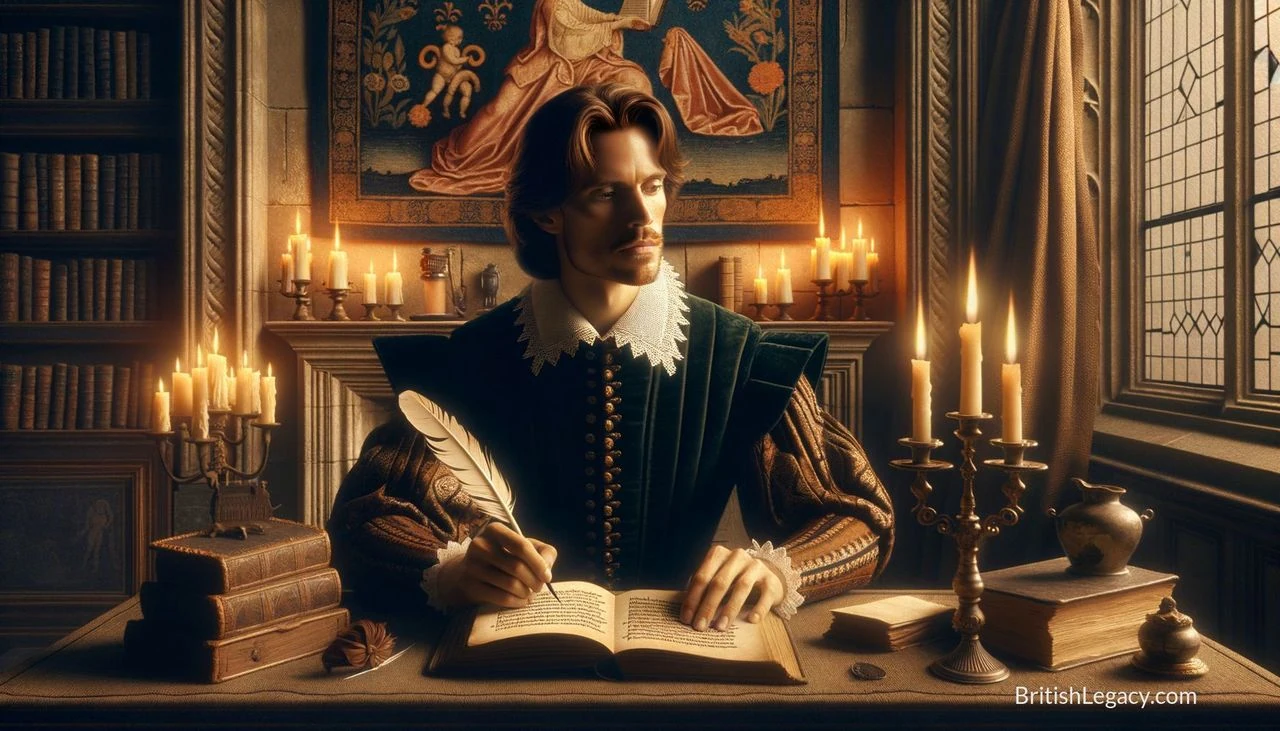
Edmund Spenser made a career of holding several kinds of writing together: pastoral poems and courtly praise, formal experiment and political argument, fantastical adventure and moral instruction. His best-known work, The Faerie Queene, follows knights through an imagined world of trials, but its allegory also engages with the Tudor monarchy and the ideals of Elizabethan rule. Spenser’s life in Ireland gives that literary achievement a difficult context: his prose there argued for the destruction of Irish language and customs, and he was driven from his home during a rebellion.
London, Cambridge and a first book
Spenser was born in East Smithfield, London, around 1552. The exact date is uncertain, and his parentage is obscure; he was probably the son of John Spenser, a journeyman clothmaker. He attended Merchant Taylors’ School before matriculating as a sizar at Pembroke College, Cambridge, where he later took an MA. At Cambridge he befriended Gabriel Harvey, with whom he would continue to discuss poetry despite their differences of opinion.
In 1578, Spenser briefly served as secretary to John Young, Bishop of Rochester. The following year he published The Shepheardes Calender, a sequence of pastoral poems, under the name “Immerito”. Its twelve poems correspond to the months of the year, though each can also be read on its own. The work drew on the pastoral tradition associated with Virgil and the late-medieval poet Mantuan. It introduced a writer already interested in making inherited forms serve new purposes.
Spenser went to Ireland in July 1580 in the service of Arthur Grey, the newly appointed Lord Deputy. He remained there after Grey’s recall, holding official posts and acquiring land in Munster. His service included the siege of Smerwick, where Grey’s forces carried out a massacre. Spenser’s Irish experience was not a side note to his career: it shaped his political writing, his circumstances and the setting of much of his later life.
Building The Faerie Queene
The first three books of The Faerie Queene appeared in 1590; a further three followed in 1596. Spenser had proposed a twelve-book design, so the surviving poem is incomplete. Its adventures centre on knights whose quests test virtues including Holiness, Temperance and Chastity. The Faerie Queene, Gloriana, is associated with Elizabeth I, and the poem can be read both as a sequence of fantastical trials and as an extended work of praise and political allegory.
Spenser explained that the poem’s purpose was to “fashion a gentleman or noble person in virtuous and gentle discipline”. The stories’ moral purpose does not make their politics simple: their imagined world allows the poet to work with ideas of authority, religion and virtue, while also addressing the Elizabethan court. The poem’s scale and layered design helped make it one of the longest works of verse in English.
The form is part of its achievement. The Spenserian stanza has nine lines, with the rhyme scheme ababbcbcc; its final line extends the rhythm into an alexandrine. Spenser also used a linked rhyme scheme in his sonnets. His language deliberately recalled earlier writing, including Chaucer, giving the verse an archaic texture rather than the sound of everyday speech. These choices joined formal invention to a sustained conversation with literary predecessors.
Love poems and other works
Spenser’s writing was not confined to the epic. His 1591 collection Complaints gathered poems on subjects including time, loss and the vanity of worldly things. In 1594 he married Elizabeth Boyle, to whom he addressed the sonnet sequence Amoretti. The wedding poem Epithalamion celebrates their marriage; both works were published in 1595. In Amoretti, the sequence of sonnets turns courtship into an exploration of desire, beauty and the passage from longing to marriage.
He also wrote Prothalamion, a wedding song for the daughters of a duke, and translated poems by the French writer Joachim du Bellay. His work ranged across forms including the eclogue, elegy, hymn and sonnet. That variety matters: Spenser’s reputation rests not only on the ambition of The Faerie Queene, but on a body of writing that repeatedly tests how inherited poetic forms could carry new subject matter.
Ireland: service, land and political writing
Spenser’s position in Ireland connected literary work to English administration and settlement. He held official posts and acquired estates in Munster, including Kilcolman, where he lived in a castle. In 1596 he wrote A View of the Present State of Ireland, a prose dialogue that circulated in manuscript during his lifetime and was published after his death. Its argument was not a neutral account of Irish society: Spenser advocated coercive English rule and argued that Irish language and customs would have to be destroyed, if necessary by violence.
The text also reveals the political assumptions behind his service. Spenser treated Irish law, custom and religion as obstacles to English control and pressed for severe measures. The historical importance of the work therefore sits alongside the violence of its prescriptions. Reading it as evidence of Spenser’s political thought means keeping both facts in view, rather than allowing the achievement of his poetry to soften the implications of his prose.
In 1598, during the Nine Years’ War, forces associated with Hugh O’Neill drove Spenser from Kilcolman and burned the castle. The following year he travelled to London, where he died on 13 January 1599. He was buried in Westminster Abbey, near Geoffrey Chaucer, in the area that became known as Poets’ Corner.
Why Edmund Spenser deserves a place in British Legacy
Spenser deserves a place in British Legacy because his work changed what English poetry could do. In The Faerie Queene, he built an epic from linked adventures, moral tests and political allegory, and gave it a distinctive stanza form that later writers could recognise and adapt. His writing ranged well beyond that poem: The Shepheardes Calender renewed pastoral poetry, while Amoretti and Epithalamion made a sustained poetic sequence out of courtship and marriage. His influence reached poets including John Milton, who admired his work, and the Spenserian stanza remains part of the history of English verse.
That literary legacy is inseparable from the historical setting in which it was made. Spenser wrote as an English official and landholder in Ireland, and A View of the Present State of Ireland lays out his advocacy of coercive rule and the destruction of Irish language and custom. A British legacy worth remembering should not turn that context into a footnote or confuse literary importance with moral approval. Spenser’s life and work offer both a major contribution to English literature and a clear record of how poetry, political power and colonial ambition could intersect. Keeping both in view makes his place in the history of British writing more, not less, significant.
Sources
Edmund Spenser — revision 1374047222 · Edmund Spenser
Adapted in part from Edmund Spenser by Wikipedia contributors, under CC BY-SA 4.0. Text has been edited and combined with the existing article; this adapted text is shared under the same licence. Contributor history.