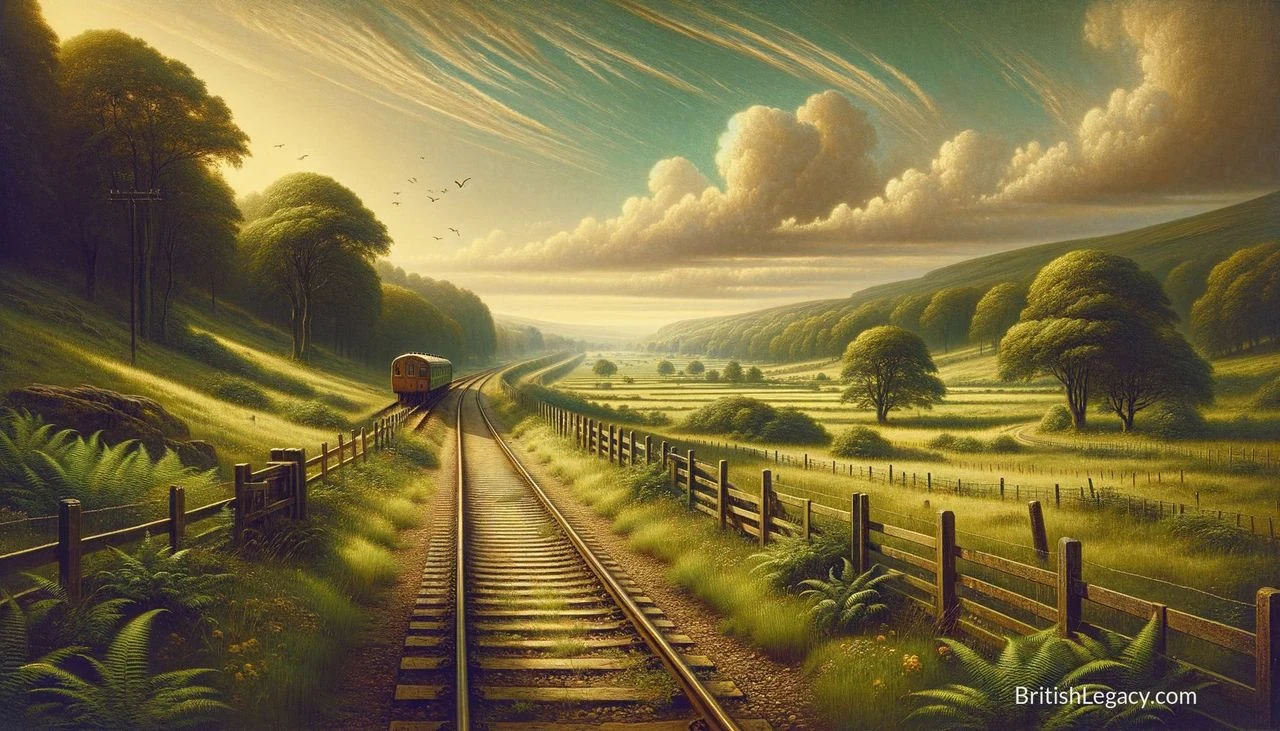
On 24 June 1914, an express train stopped unexpectedly at Adlestrop, a small station in the Cotswolds. Edward Thomas remembered the place-name and the birdsong around it. The pause became the subject of “Adlestrop”, a poem whose stillness has come to stand for the fragile detail of a landscape on the brink of war. Thomas had spent years writing about literature and the countryside before he began writing poems himself, aged 36. Less than three years later, he was killed in France.
A Welsh family and an English education
Philip Edward Thomas was born in Lambeth, then in Surrey and now part of south London, on 3 March 1878. His parents were Mary Elizabeth Townsend and Philip Henry Thomas, a civil servant, author, preacher and local politician. The family had deep Welsh connections. All four of Thomas’s grandparents were born and brought up in Wales; his father was born in Tredegar and continued to visit relatives there after moving first to Swindon and then to London. Thomas, too, kept in touch with Welsh relatives and friends, visiting places including Ammanford, Newport, Swansea and Pontardulais.
Thomas was educated at Belleville School, Battersea Grammar School and St Paul’s School. He went on to study history at Lincoln College, Oxford, from 1898 to 1900. In June 1899, while still an undergraduate, he married Helen Berenice Noble. He had already decided to make his living by writing. Book reviews became a major part of his work: he reviewed as many as 15 books a week and wrote for the Daily Chronicle in London.
Over the following two decades he produced criticism, biographies and books about the countryside, alongside other prose. His publications included The Woodland Life (1897), The Heart of England (1906), The South Country (1909) and In Pursuit of Spring (1914). He also wrote about the history and literature of places he knew, as well as a novel, The Happy-Go-Lucky Morgans (1913). This was not a career before the “real” work: Thomas was already an experienced, wide-ranging writer when poetry became his principal literary pursuit.
From prose to poems
Thomas’s life as a poet began late. Although he regularly reviewed poetry, he started writing it only at the end of 1914, when he was living at Steep in Hampshire. At first, some of his poems appeared under the pen name Edward Eastaway. The American poet Robert Frost, then living in England, encouraged Thomas to write verse and became a close friend. The two discussed settling near one another in the United States.
Thomas and Frost had walked together, and Frost’s “The Road Not Taken” drew on those walks and on Thomas’s indecision over which route to follow. Frost intended a gentle tease; Thomas took the poem seriously. The nature of their friendship and its possible bearing on Thomas’s decision to enlist have been discussed by his biographer Matthew Hollis, but the evidence does not reduce Thomas’s choice to a single cause.
“Adlestrop” grew from an actual interruption to a journey. Thomas’s train stopped at the Gloucestershire station on 24 June 1914, shortly before the First World War began. The poem preserves not only the name but the quiet of the scene: the train’s unexpected halt, the heat of a late-June afternoon and, for a minute, a blackbird singing. It carries the birds beyond the station, across Oxfordshire and Gloucestershire. Thomas’s attention to a particular place and brief moment gives the poem its reach; its calm is not a claim that the world around it was calm.
His poems often bring the countryside into contact with human loss. “In Memoriam”, dated 6 April 1915, turns to flowers in a wood at Easter and remembers men who will never again gather them with their sweethearts. That mixture of rural observation and grief is characteristic of work that can be described as war poetry without being principally about battlefield experience. Thomas’s verse is frequently colloquial in manner, alert to the sounds and shapes of the English countryside and attentive to what a person can notice while walking through it.
Enlistment and the Battle of Arras
Thomas enlisted in the Artists Rifles on 19 July 1915, although his age and family circumstances meant he could have avoided enlistment. He trained at a temporary army camp at High Beach in Epping Forest. Despite the camp’s poor conditions, he valued the surrounding forest; his family later moved to a nearby cottage. In November 1916, he was commissioned as a second lieutenant in the Royal Garrison Artillery.
He arrived in France in 1917 and was killed in action at Arras on Easter Monday, 9 April, aged 39. His death was initially described to his widow as a “bloodless death”, caused by the blast of a shell. A letter from his commanding officer, written in 1936 and discovered much later, records that he was shot through the chest. Thomas is buried in the Commonwealth War Graves Cemetery at Agny, France.
His poems appeared in print during and after his final years. Six Poems, published under the name Edward Eastaway, appeared in 1916. Poems was published in 1917, the year he died; Last Poems followed in 1918. His writing career in verse was brief, but it formed only one part of a body of work built through years of prose, criticism and observation.
Memory, music and commemoration
Thomas’s death was mourned by his friend W. H. Davies, whose poem “Killed in Action (Edward Thomas)” appeared in 1918. His work has continued to draw responses from poets and writers, and his place in twentieth-century poetry has been described in terms of the way he brought a modern sensibility to subjects inherited from Victorian and Georgian poetry. At least 19 of his poems were set to music by the Gloucester composer Ivor Gurney.
In 1985 Thomas was among 16 First World War poets commemorated on a slate stone unveiled in Poets’ Corner at Westminster Abbey. The inscription, written by fellow poet Wilfred Owen, reads: “My subject is War, and the pity of War. The Poetry is in the pity.” Thomas is also remembered by a blue plaque at his birthplace in Stockwell, plaques and memorials elsewhere, and a memorial stone at Steep, where a literary walk follows a landscape closely associated with his life. The Edward Thomas Fellowship, founded in 1980, works to sustain interest in his life and writing. Petersfield Museum houses a study centre with more than 1,800 books by or about him.
These commemorations reflect the range of his reputation: not simply a soldier who wrote poems, but a writer whose work attended to place, memory and the costs of war. “Adlestrop” remains his best-known poem, while prose works such as The South Country and In Pursuit of Spring preserve the same sustained attention to landscape in a different form.
Why Edward Thomas deserves a place in British Legacy
Thomas belongs in British Legacy because his writing joined exact observation of the British landscape to a searching awareness of human time and loss. The stop at Adlestrop was ordinary and brief; his poem made its name, birdsong and surrounding counties memorable without turning them into spectacle. In poems such as “In Memoriam”, countryside and grief meet in a more direct way, as the spring flowers prompt remembrance of men who will not return. Together these works show how a poet can make local detail carry emotional weight without losing its particularity.
His achievement also extends beyond the poems for which he is best known. Thomas spent two decades writing criticism, biography and books about places, and his experience as a reader and reviewer preceded his own late turn to verse. His work offers a record of an English countryside encountered on foot and in changing seasons, while his Welsh family connections and enduring ties to relatives in Wales are part of the story of the writer himself. His death at Arras links his life to the First World War, but the poems resist being confined to that history: nature, memory and ordinary experience remain central. The continuing study of his writing, its musical settings and its commemorations in Poets’ Corner and at Steep demonstrate a specific, enduring contribution to Britain’s literary and cultural memory.
Sources
Edward Thomas (poet), revision 1379016394
Adapted in part from Edward Thomas (poet) by Wikipedia contributors, under CC BY-SA 4.0. Text has been edited and combined with the existing article; this adapted text is shared under the same licence. Contributor history.