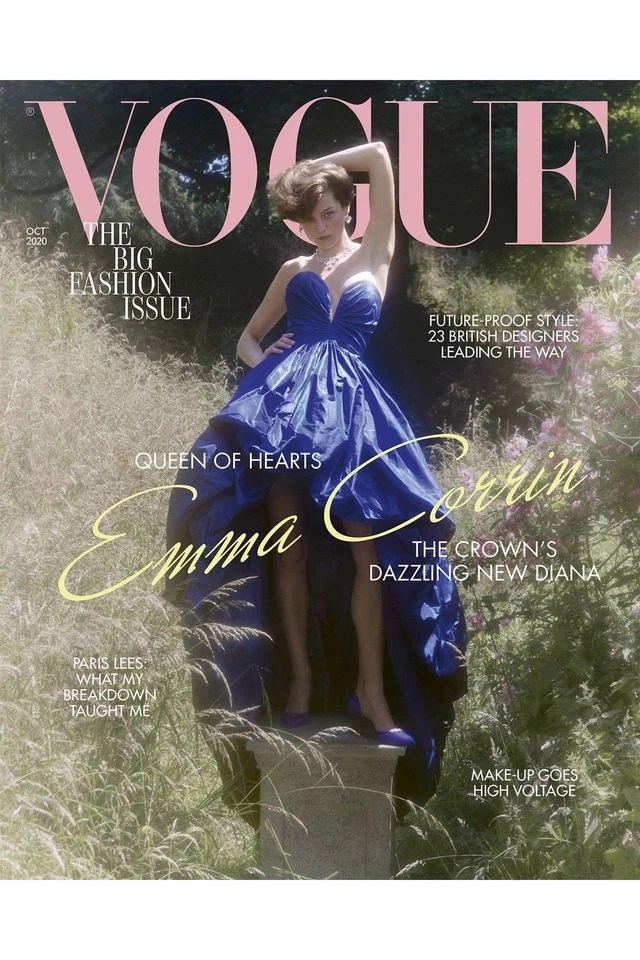
Emma Corrin’s breakthrough as Diana, Princess of Wales, in The Crown brought international attention, but it was only the beginning of a career moving between television, film and the stage. Since that role, Corrin has played characters as varied as a 1950s schoolteacher, a modern amateur detective and a Marvel antagonist. Their route into acting ran through Cambridge student theatre; their later work has taken them from London’s West End to major film productions.
From Kent to Cambridge
Emma Louise Corrin was born on 13 December 1995 in Royal Tunbridge Wells, Kent. They attended Woldingham School in Surrey, where they developed an interest in acting and singing. After school, Corrin took a gap year, attending a Shakespeare course at the London Academy of Music and Dramatic Art and volunteering as a teacher at a school in Knysna, South Africa.
They first studied drama at the University of Bristol, leaving after two months because the course did not provide the practical training they wanted. In 2015, Corrin began studying Education, English and Drama at St John’s College, Cambridge. They immersed themself in student theatre, taking part in as many productions as possible. Alongside their studies, they undertook voice-over and automated dialogue replacement work in London, gaining experience and helping to support themself.
Corrin’s screen career began with a guest appearance in ITV’s detective drama Grantchester in 2019. They also played aspiring actor Esme Winikus in the first season of the DC Comics series Pennyworth. In 2020, Corrin made their feature-film debut as Jillian Jessup, Miss South Africa, in the comedy-drama Misbehaviour.
The Crown and a breakthrough performance
Corrin’s casting as Diana, Princess of Wales, in the fourth season of Netflix’s The Crown brought a rapid change in scale. The series, released in 2020, introduced their performance to an international audience. Corrin described an unusual casting process: they had initially been asked to read as Diana while the production was casting another role. Six months later, they were invited back to read opposite Josh O’Connor, who played Prince Charles, and were offered the part.
The performance was widely praised. Corrin won a Golden Globe and a Critics’ Choice Award for the role, and received nominations for a Primetime Emmy and an Actors Award. The recognition established a significant early marker in their career, but Corrin did not remain within period drama. In 2021, they made their professional theatre debut as Anna in Joseph Charlton’s Anna X at the Harold Pinter Theatre. The play drew on the real-life fraud case of Anna Sorokin and explored social media, uncertainty and the absurdity of contemporary life. Corrin’s performance brought a Laurence Olivier Award nomination, alongside nominations for a WhatsOnStage Award and a Stage Debut Award.
Between screen and stage
In 2022, Corrin appeared in two romantic dramas. In My Policeman, they played Marion, a schoolteacher caught in a love triangle in 1950s Britain. Corrin said they were drawn to the complexity of the relationships and to the film’s treatment of a period when homosexuality was illegal. They also starred as Constance Chatterley in Lady Chatterley’s Lover, a woman whose dissatisfaction with her aristocratic marriage leads to an affair.
That year, Corrin returned to the West End as the title character in Neil Bartlett’s stage adaptation of Virginia Woolf’s Orlando, directed by Michael Grandage at the Garrick Theatre. The role gave Corrin another opportunity to work across questions of gender and identity, and the performance received a positive critical response. Their stage work continued with Nina in Anton Chekhov’s The Seagull at the Barbican Theatre in 2025, earning a WhatsOnStage Award nomination.
On television, Corrin played Darby Hart, an amateur sleuth, in the 2023 series A Murder at the End of the World. They said they had been looking for something modern and different from their earlier roles. In 2024, they took on two contrasting film parts: Cassandra Nova, the antagonist in Deadpool & Wolverine, and Anna Harding in the Gothic horror film Nosferatu. In 2025, Corrin played the title character in the fantasy romance 100 Nights of Hero and appeared as Clara in the feature-length Black Mirror episode “Hotel Reverie”.
Corrin’s work has also reached beyond acting roles. They contributed spoken word to British rapper Little Simz’s 2021 album Sometimes I Might Be Introvert and performed with her at the 2022 BRIT Awards. In fashion, Corrin has worked with the Italian house Miu Miu on advertising campaigns and short films, modelled for the brand on the runway and closed its Autumn/Winter 2023 show at Paris Fashion Week. In 2022, they became Vogue magazine’s first non-binary cover star.
Visibility and public identity
Corrin is non-binary and uses they/them pronouns. They have spoken about gender not feeling fixed and have questioned whether gendered award categories are sufficiently inclusive. Corrin has said that non-binary people should be involved in decisions about how awards categories are defined, and should be recognised for their work. They also came out publicly as queer in 2021, describing the experience as scary and revealing. They have spoken of facing online abuse and of receiving support from the queer community.
These public statements sit alongside a body of work that moves between roles and forms rather than being defined by a single performance. Corrin’s career has included contemporary and historical screen stories, commercial film, student and professional theatre, and collaborations in music and fashion. The distinctions and nominations attached to that work mark different stages of a career that began with early screen roles and quickly expanded across a range of British and international productions.
Why Emma Corrin deserves a place in British Legacy
Corrin’s place in British Legacy rests first on a British acting career with a clear connection to the country’s cultural life. They trained at Cambridge, developed their craft in student theatre and made a professional stage debut in London before becoming widely recognised for The Crown. Their work has since returned to British stages, from Anna X and Orlando in the West End to The Seagull at the Barbican. These are not simply credits on a list: they show an actor moving between screen and theatre, taking on different forms of performance and helping bring literary and dramatic works to new audiences.
The significance of that career is also visible in its range. Corrin’s roles include Diana, Princess of Wales, Marion in a drama about a mid-century British society, and Nina in Chekhov, as well as projects in television, horror and superhero film. Their Golden Globe and Critics’ Choice wins for The Crown, alongside nominations for stage work, record recognition across more than one part of the acting profession. Corrin’s willingness to speak publicly as a non-binary and queer person adds a further, specific contribution: it has placed questions of recognition and inclusion within conversations about awards and public representation. Together, the acting, stage work and public discussion make Corrin a contemporary figure in British culture whose influence is grounded in identifiable work and experience.
Sources
Adapted in part from Emma Corrin by Wikipedia contributors, under CC BY-SA 4.0. Text has been edited and combined with the existing article; this adapted text is shared under the same licence. Contributor history.