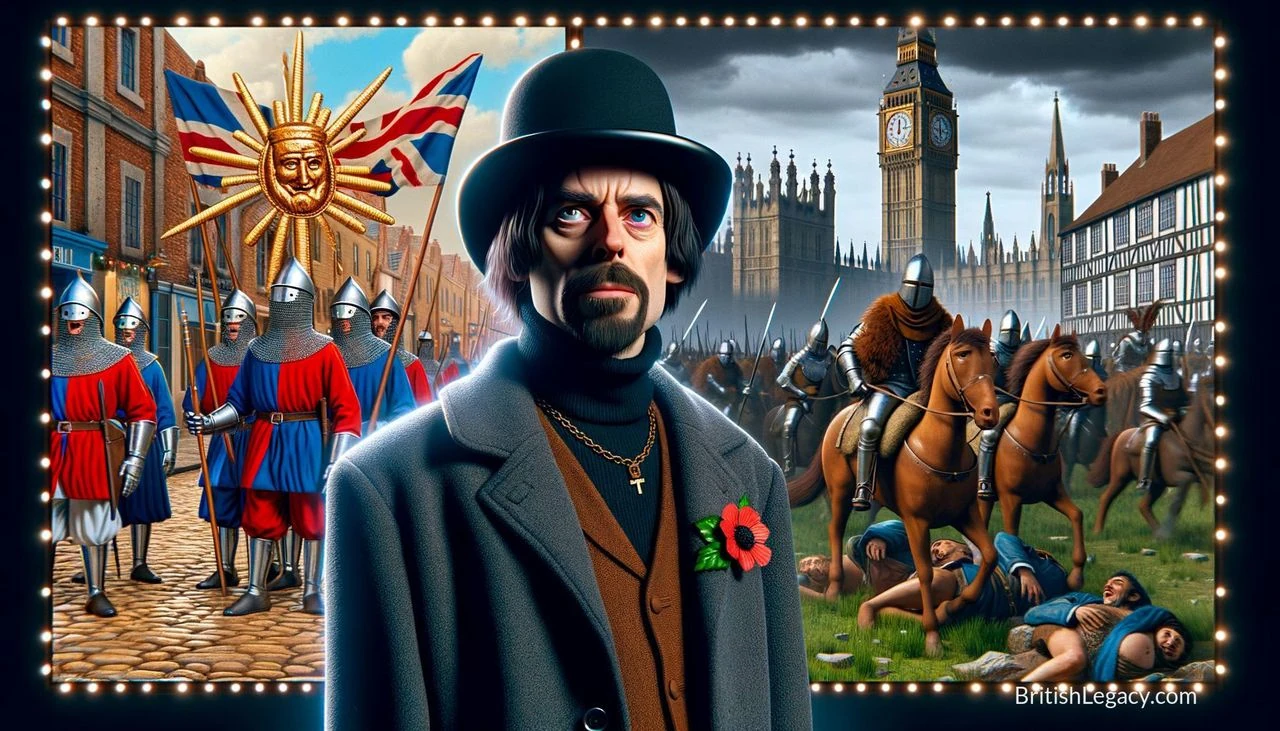
Eric Idle’s work in Monty Python was often carried by a line of dialogue or a song that seemed to take pleasure in its own absurdity. He wrote and performed some of the group’s best-known musical numbers, including “Always Look on the Bright Side of Life”, and brought an ear for language to sketches that could turn a misplaced word or an overlong monologue into the joke itself. His career ranged well beyond Python: he created television comedy, devised the Beatles parody the Rutles and adapted Monty Python and the Holy Grail into the stage musical Spamalot.
From South Shields to Cambridge
Idle was born on 29 March 1943 in South Shields, South Tyneside. His father, Ernest Idle, served in the Royal Air Force during the Second World War and died in a road accident in December 1945. His mother, Norah, worked as a nurse. Idle later said that his mother struggled with full-time work and raising a child; he was brought up for a time by his grandmother in Swinton, Lancashire, and also spent part of his childhood in Wallasey, Cheshire.
At seven, he became a boarder at the Royal Wolverhampton School, then a charitable foundation for children who had lost one or both parents. Idle described its atmosphere as harsh and said that he learned to manage by being “smart and funny and subversive at the expense of authority”. He listened to Radio Luxembourg under the bedclothes and followed Wolverhampton Wanderers, but disliked school sport. He sometimes slipped out to the cinema and was eventually caught watching a film unsuitable for his age under the rules then in force. By that point he was head boy, but lost his prefecture.
Idle supported the Campaign for Nuclear Disarmament and took part in the annual Aldermaston March. He later said that boredom at school helped drive him to study and win a place at Cambridge. At Pembroke College he read English and joined Cambridge University Footlights after being invited to audition by Tim Brooke-Taylor and Bill Oddie. He became Footlights president in 1965 and was the first to allow women to join the club. Before Python, he appeared in the television series Do Not Adjust Your Set with future collaborators Terry Jones and Michael Palin; Terry Gilliam supplied animations.
A distinctive voice in Monty Python
Monty Python’s Flying Circus began in 1969. Idle wrote for the programme, usually on his own, while the other Pythons more often worked in pairs. That independence shaped his comedy, though he later acknowledged the challenge of persuading five colleagues to accept a sketch. His writing frequently played with language and communication: characters spoke in anagrams, put words in the wrong order or shifted abruptly between politeness and rudeness. He also used extended monologues and parodied the speech of television presenters.
Idle’s material often drew on contemporary subjects, including pop music and sexual permissiveness, and made particular use of double entendre. “Nudge Nudge” became one of his best-known sketches; he had originally written it for Ronnie Barker, but Barker rejected it. Idle’s musical ability gave Python another register. He composed and performed songs including “Eric the Half-a-Bee” and “Galaxy Song”, as well as “Always Look on the Bright Side of Life”, written for the closing sequence of Monty Python’s Life of Brian (1979). The song later became associated with football crowds and reached the UK singles chart after being re-recorded in 1991.
Idle also acted in the group’s films, among them Monty Python and the Holy Grail (1975), Life of Brian and The Meaning of Life (1983). After the television series, the six members pursued individual work, but Idle continued to make Python songs and performances part of his own stage career. In 2012 he sang “Always Look on the Bright Side of Life” at the closing ceremony of the London Olympic Games. In 2014 he helped create and direct Monty Python Live (Mostly), performed at the O2 Arena.
Television, the Rutles and other stages
Idle’s post-Python work showed the same interest in music and comic imitation. He created and wrote Rutland Weekend Television, a BBC Two sketch show that ran from 1975 to 1976, with music by Neil Innes. Its name parodied London Weekend Television: Rutland had recently been abolished as an administrative county, and the fictional network was presented as Britain’s smallest. The programme gave rise to the Rutles, an affectionate Beatles parody developed by Idle and Innes.
In 1978, Idle wrote and appeared in All You Need Is Cash, the Rutles mockumentary broadcast on NBC. He played Dirk McQuickly, the group’s Paul McCartney-like member, and also appeared as a commentator. The film brought together Python colleagues and performers from Saturday Night Live, where Idle had appeared several times. He returned to the Rutles with a live show, Rutlemania!, in 2008, marking 30 years since the television film.
His screen work included acting, writing and voice performances. He appeared in Terry Gilliam’s The Adventures of Baron Munchausen, played Ratty in Terry Jones’s The Wind in the Willows and voiced Merlin in Shrek the Third. Not all his projects met with critical or commercial success: Splitting Heirs, which he wrote, starred in and executive-produced, was poorly received. He also wrote books and plays, and in 2003 toured North America with a show combining Python songs and later material; his account of the tour became The Greedy Bastard Diary.
In 2004 Idle created Spamalot, a musical comedy adapted from Monty Python and the Holy Grail, with music by Idle and John Du Prez. It opened on Broadway in 2005 and won the Tony Award for Best Musical. Its original production also received the Grammy Award for Best Musical Theater Album, and Idle won a Drama Desk Award for Outstanding Lyrics. He and Du Prez went on to create Not the Messiah, a comic oratorio first performed at Toronto’s Luminato festival in 2007 and later presented in concert with orchestras and choirs.
Songs that travelled beyond the sketches
“Always Look on the Bright Side of Life” has had a life beyond its original film scene. After it became a football chant in the late 1980s, Idle’s neighbour Gary Lineker suggested releasing a new recording. Radio airplay helped it reach number three in the UK charts in 1991. Idle performed it at the Royal Variety Performance the following month, and later sang it at the London 2012 Olympic closing ceremony and at the final show of the Python reunion at the O2 Arena in 2014.
The song’s reach is one example of how Idle’s writing moved between forms: from a film ending to a recording, a crowd chant and a live performance for a global audience. His catalogue also includes musical work for the stage and screen, from Python songs to Spamalot and Not the Messiah. In 2016, he wrote and co-presented The Entire Universe, a BBC Two comedy and musical programme. These projects show a continuing interest in pairing comedy with music rather than treating songs as an occasional addition to a sketch.
Why Eric Idle deserves a place in British Legacy
Eric Idle deserves a place in British Legacy because his career illustrates how a distinctive comic voice can work across television, film, music and theatre. As a writer and performer in Monty Python’s Flying Circus, he helped make wordplay, awkward speeches and irreverent musical numbers central to a British comedy group whose work travelled internationally. His songs were not incidental to that achievement: “Always Look on the Bright Side of Life” moved from Life of Brian into chart success, football culture and major public performances. “Galaxy Song” and “Eric the Half-a-Bee” show the range of his comic songwriting within Python itself.
His legacy also rests on what he made after the television series. Rutland Weekend Television generated the Rutles, a carefully constructed musical parody that became a film and live act; Spamalot carried the world of The Holy Grail to Broadway and won major theatre and recording awards. Those works demonstrate a talent for adapting a comic idea to a new medium without losing its musical character. Idle’s long career does not need to be described as an unbroken run of success: some independent projects were poorly received. The lasting significance lies instead in the identifiable craft linking his language-based sketches, songs and stage adaptations, and in the way those works have given British comedy a durable presence on screens and stages far beyond Britain.
Sources
Eric Idle — Wikipedia revision 1377340413
Adapted in part from Eric Idle by Wikipedia contributors, under CC BY-SA 4.0. Text has been edited and combined with the existing article; this adapted text is shared under the same licence. Contributor history.