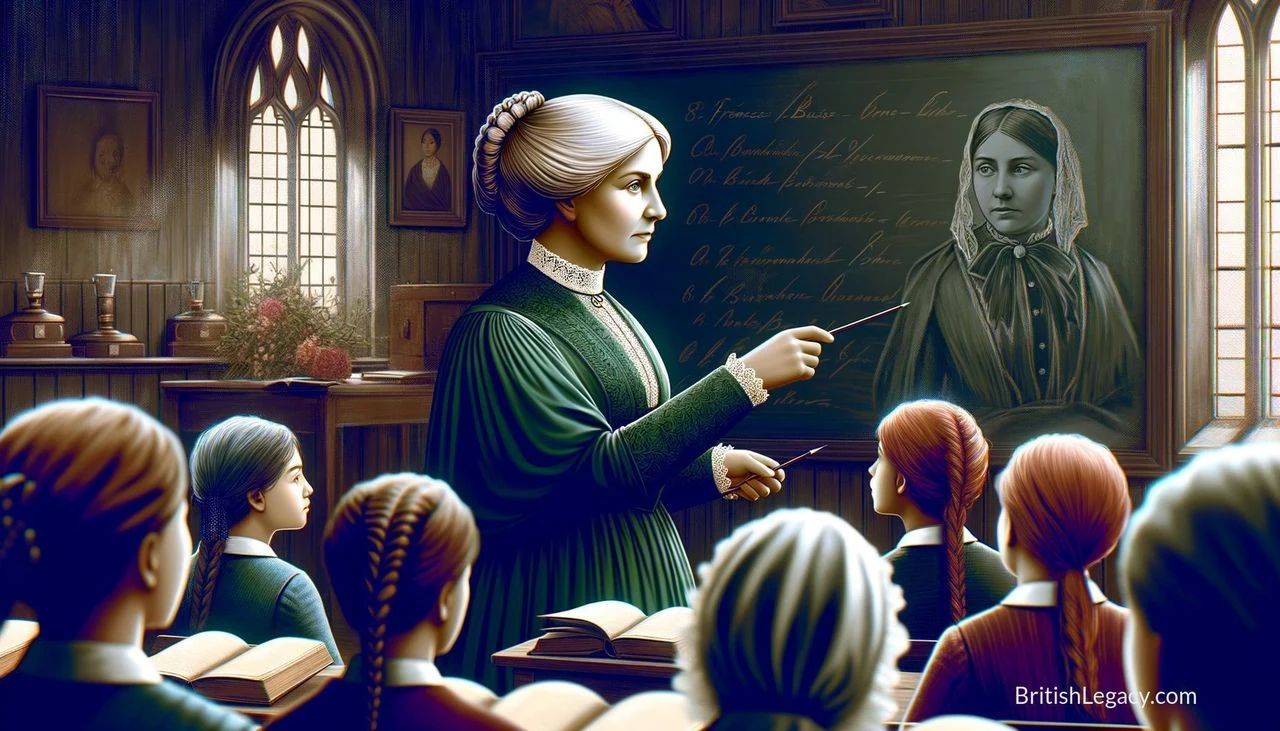
Frances Mary Buss spent her working life making a demanding education available to girls. She led the North London Collegiate School for Ladies from its opening in 1850, campaigned for girls to sit public examinations and enter universities, and established another school for girls who needed a more affordable option. Her influence reached beyond the classroom: she helped organise headmistresses and supported the training of teachers.
A young teacher in a family school
Born in London on 16 August 1827, Buss was the daughter of painter and etcher Robert William Buss and Frances Fleetwood. She was one of six of their ten children to survive into adulthood. Her early schooling included private schools in Aldersgate and Kentish Town, followed by a more advanced school in Hampstead. She was teaching there by the age of fourteen and was occasionally left in charge by sixteen.
Education was also part of the family’s livelihood. In 1845, when her father’s artistic career was not always successful, her mother opened a private school in Clarence Road, Kentish Town. Frances helped teach there. The school drew on the ideas of Johann Heinrich Pestalozzi, an influence that placed education within her practical experience well before she became a headmistress in her own right.
In 1848–49, Buss attended evening lectures at the newly opened Queen’s College in Harley Street. She studied French, German and geography, and was taught by F. D. Maurice, Charles Kingsley and R. C. Trench. She later described the intellectual effect of this education to fellow student Dorothea Beale as opening “a new life”. That experience helps explain the importance she placed on giving girls access to serious study rather than limiting their schooling to a narrow preparation for domestic life.
North London Collegiate School
The school that became the North London Collegiate School for Ladies grew from the family’s earlier work. It moved to larger premises in Camden Street on 4 April 1850 and was renamed; Buss became its first headmistress. She remained in the post for the rest of her life. The distinction matters: her achievement was not simply to open a school on her own, but to lead and develop an institution that became a model for girls’ education.
By 1865, it had 200 day pupils and a few boarders. It remained a private family concern: Buss’s father taught art and her brother Septimus taught scripture. Under Frances’s headship, the school demonstrated that girls could pursue academic work in a sustained institutional setting. The original account describes a curriculum including Latin, mathematics, science and modern languages, and the school’s preparation for public examinations; these details capture the ambition of its approach. The wider point was access to recognised learning and qualifications, not merely the appearance of academic study.
In July 1870, Buss handed the school over to trustees. The following year she founded Camden School for Girls, with the aim of providing education at a more affordable cost. The two schools represent related but distinct parts of her work: strengthening an established academic school and widening access beyond it. Her concern with who could benefit from education was also visible in campaigns for the endowment of girls’ schools, including in the context of the Endowed Schools Act 1869.
Campaigning beyond the classroom
Buss was a leading campaigner for girls to be allowed to sit public examinations and to enter universities. Those aims addressed barriers beyond the day-to-day running of a school: pupils needed routes to recognised examinations and further study if academic education was to carry opportunities beyond the classroom. Her work connected the school’s curriculum to the question of what girls would be permitted to do with their learning.
She also helped build organisations for educators. In 1874, she became the founding president of the Association of Head Mistresses, holding the post until her death. She was involved in establishing the Teachers’ Guild in 1883 and, in 1885, the Cambridge Training College for teacher training, later known as Hughes Hall. These efforts extended her influence from pupils to the professional organisation and preparation of teachers.
In 1869, Buss became the first woman Fellow of the College of Preceptors. Alongside Beata Doreck, she helped establish the College’s professorship of the science and art of education in 1872. Her election as a Fellow was the only public recognition she received. She also served on the Council of the Teachers’ Training and Registration Society. These roles show a reformer working not only to improve access to education, but to give teaching and teacher preparation a more organised place in public life.
A public life and a lasting model
Buss’s interests included women’s political participation as well as education. She took part in the Kensington Society, a women’s discussion society, and the London Suffrage Committee; she was a suffragist. Her involvement sits alongside her educational work as part of a wider engagement with women’s opportunities, without needing to claim that the different campaigns were identical.
The educational values she advanced at North London Collegiate School became a model for other schools in the United Kingdom and overseas. One example was Talbot Heath School in Bournemouth, started by Mary Broad; another was Pretoria High School for Girls in South Africa, founded by former pupil Edith Aitken. The institutions associated with Buss also continue to mark her influence: North London Collegiate School and Camden School for Girls hold annual Founders’ Day observances in her memory.
Buss died in London on 24 December 1894, aged 67, and was buried in the churchyard at Theydon Bois in Essex. Her name also survives in a satirical rhyme shared with her contemporary Dorothea Beale. That verse is a reminder that public memory can preserve a caricature as well as an achievement; her more substantial legacy lies in the schools, organisations and educational routes she helped establish.
Why Frances Buss deserves a place in British Legacy
Frances Buss deserves a place in British Legacy because her work addressed a practical question at the heart of educational equality: could girls receive an academic education, demonstrate what they had learned in public examinations, and continue to university? She led North London Collegiate School for Ladies through decades of development, while campaigning for the examinations and university access that could give schooling consequences beyond the classroom. Her school offered a working example of what girls’ academic education could be, and her campaign connected that example to wider public opportunities.
Her legacy also includes work that is less easily reduced to one school. By founding Camden School for Girls to offer more affordable education, Buss extended her concern to pupils beyond a single institution. As the first president of the Association of Head Mistresses, a participant in the Teachers’ Guild, and a supporter of the Cambridge Training College, she helped strengthen the organisation and preparation of educators. The model associated with her teaching travelled to schools in Britain and overseas, including institutions founded by a former pupil. These are specific, durable contributions: access to learning, routes towards recognised qualifications, and support for the people who teach. Together, they explain why Buss belongs in an account of Britain’s educational history.
Sources
Frances Buss (revision 1359461568)
Adapted in part from Frances Buss by Wikipedia contributors, under CC BY-SA 4.0. Text has been edited and combined with the existing article; this adapted text is shared under the same licence. Contributor history.