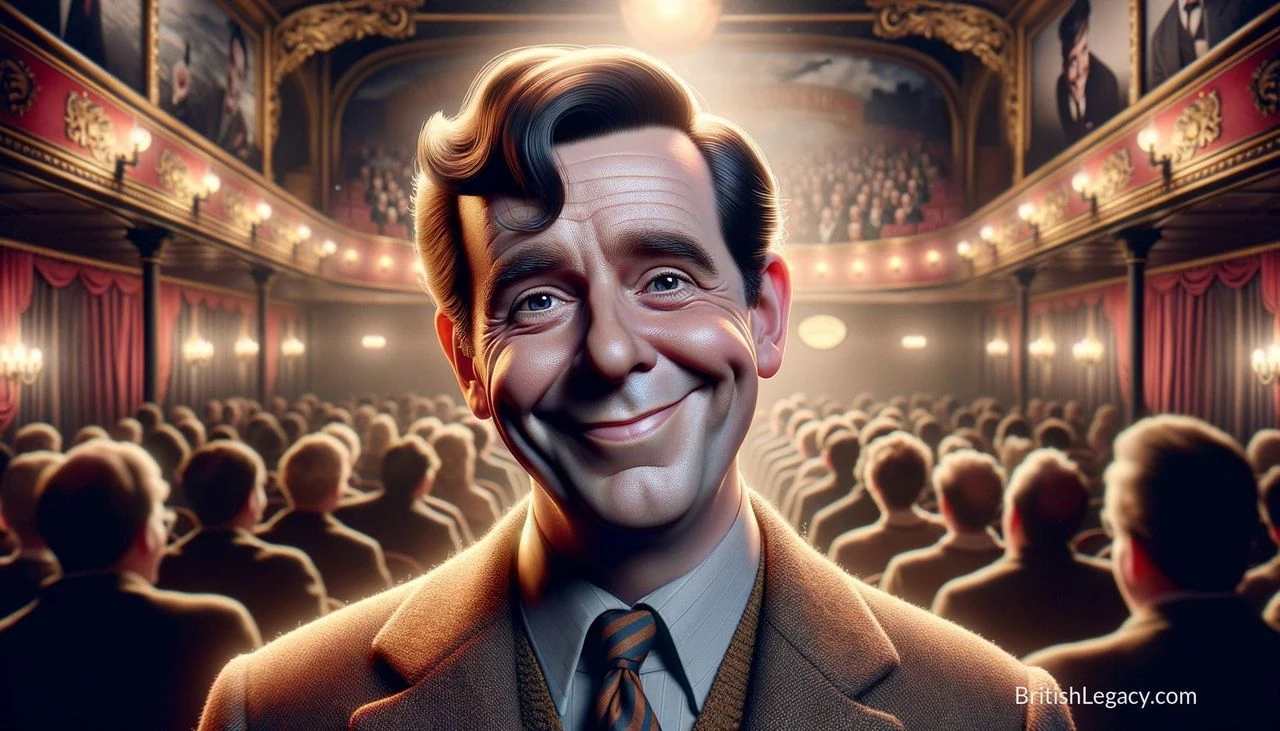
Frankie Howerd’s comedy often seemed to wander off course just as it was approaching a punchline. A pause, a repeated “ooh”, a look towards the audience: each could turn a line of innuendo into a performance in its own right. The apparent spontaneity was carefully made. Howerd’s work moved from wartime concert parties and post-war radio to television, film and the stage, with Lurcio in Up Pompeii! becoming one of his best-known roles.
From York to the concert party
Howerd was born Francis Alick Howard in York on 6 March 1917. His father, Francis Alfred William, was a soldier; his mother, Edith Florence Howard, worked at the Rowntree’s factory. The family lived in Hartoft Street, in an area Howerd later remembered as poor and close to the River Ouse. When his father was posted to Woolwich, they moved to Eltham in London. Howerd attended Shooter’s Hill Grammar School.
He had appeared on stage as a boy of 13 and hoped to become a serious actor, but failed an audition for the Royal Academy of Dramatic Art. During the Second World War he entertained in the British Army, adopting the stage surname Howerd because, as the account records, he wanted “to be different”. In 1944 he was a bombardier in Plymouth, later becoming a sergeant. On D-Day he was part of the effort but remained on a boat off Normandy.
After the war, stage fright did not prevent him from pursuing performance. He began his professional career in the summer of 1946 in the touring show For the Fun of It. That December, he made his radio debut on the BBC’s Variety Bandbox, performing alongside other former servicemen. His profile grew quickly in the post-war years, helped by writing from Eric Sykes, Ray Galton, Alan Simpson and Johnny Speight. Howerd also toured the music-hall circuit, where catchphrases such as “titter ye not” became part of his act.
Making a comic voice
Howerd’s delivery became recognisable for its stops, verbal tics and direct appeals to the people watching. Eric Sykes, who had led a rival wartime concert party, supplied material and wrote in “punctuation pauses”, including “oohs” and “ahhs”. Howerd kept them in his delivery. What might have been a small hesitation on the page became a means of building anticipation and making the audience feel addressed rather than merely observed.
His comedy also depended on feigned innocence. Howerd could offer a risqué double meaning and then appear to rebuke the audience for noticing it. That tension—between what the line suggested and the performer’s mock surprise—gave the innuendo its particular rhythm. His stutter, which had caused him distress earlier in life, also became part of the comic delivery he developed.
The impression that he was improvising was misleading. His monologues and asides were planned, not simply invented in the moment. Comedian Barry Cryer described Howerd’s handling of a script as transformative: the words became a seemingly informal conversation, sustained until the sudden arrival of a laugh. Howerd’s pauses and apparent digressions were not gaps in the act; they were among its most carefully used tools.
Radio, stage and screen
Howerd made his film debut in 1954 in The Runaway Bus, opposite Petula Clark. He went on to work across a range of forms, including stage farce, Shakespearean comedy, radio and television. His appearance at Peter Cook’s Establishment Club in Soho helped mark a recovery in his popularity at the start of the 1960s. He also appeared in the satirical television programme That Was the Week That Was in 1963, and played in the stage production of A Funny Thing Happened on the Way to the Forum from 1963 to 1965.
He worked regularly on television in the 1960s and 1970s, including programmes for the BBC and Thames Television. Among his roles was Francis Bigger, the doctor in Carry On Doctor (1967). He also co-hosted a 90-minute Christmas show with Bruce Forsyth in 1966 and 1967. These projects showed the breadth of a career that was not confined to one character or a single kind of performance.
In Up Pompeii! (1969–70), Howerd played Lurcio, a slave who addressed the audience directly. The series gave his verbal asides and double entendres a setting in which interruptions and knowing looks could become part of the action. He returned as Lurcio in later television productions, and the character also led into the films Up Pompeii (1971), Up the Chastity Belt (1971) and Up the Front (1972), where he played related versions of the role.
The film version of Up Pompeii was a commercial success: British exhibitors voted Howerd the ninth most popular star at the British box office in 1971. His screen work included other comedy parts, among them Professor Inigo Tinkle in Carry On Up the Jungle (1970). In 1978 he appeared as Mean Mr Mustard in the film Sgt. Pepper’s Lonely Hearts Club Band, a Hollywood musical that was poorly received.
Comebacks and later performances
Howerd’s career was not a straight ascent. He experimented with different formats and experienced changes in popularity, but recovered his following in the early 1960s and continued to take on television and stage work through the next two decades. His career has been characterised as a series of comebacks, a description that fits both the changes in his public profile and his ability to find new settings for his performance.
In the final years of his career, Howerd attracted student audiences and performed a one-man show at universities and smaller theatres. His last major West End appearance was a one-man show at the Garrick Theatre in 1990. He also appeared on BBC Radio 1’s late-night programme Into the Night, and returned to television in Channel 4’s Superfrank! in 1987 after several years without a regular UK television show. In 1990 he contributed to Freudiana, the last studio collaboration between Alan Parsons and Eric Woolfson, performing “Sects Therapy”.
Private life, death and remembrance
Howerd kept his homosexuality private during a period when he feared that disclosure could damage his career or expose him to blackmail. In 1958 he met Dennis Heymer, who became his partner and manager. Heymer supported him for more than thirty years, including during the period when Howerd was rebuilding his career. They lived together for the last twenty years of Howerd’s life at Wavering Down in Cross, Somerset.
Howerd died of heart failure on 19 April 1992, aged 75, after developing respiratory problems. He was buried at St Gregory’s Church in Weare, Somerset. Heymer died in 2009 and was buried near him. Howerd was appointed an Officer of the Order of the British Empire in 1977.
His memory is marked in places associated with his life. A plaque was installed at his former home in Edwardes Square, Kensington, in 1993. In York, a plaque at the Grand Opera House was unveiled in 1999, and a York Civic Trust plaque was placed at his childhood home in Hartoft Street in 2016. In Eltham, the hall of St Barnabas Church was renamed the Frankie Howerd Centre and opened by Howerd himself. His former home at Wavering Down has also hosted concerts and opened as a museum of memorabilia, with funds raised for charity.
Why Frankie Howerd deserves a place in British Legacy
Frankie Howerd deserves a place in British Legacy because he developed a recognisable comic method and sustained it across changing forms of entertainment. His pauses, verbal tics and carefully performed innocence made the double entendre more than a type of joke: they turned timing and audience response into the substance of the act. From the BBC’s post-war variety programmes to the music-hall circuit, television and theatre, he adapted that style without losing its distinctive voice. In Up Pompeii!, Lurcio’s direct address gave his asides a central place in a television comedy that became one of his most enduring roles.
His career also offers a distinctly British record of popular performance across radio, stage, film and television. Howerd’s appearances in Carry On Doctor and Carry On Up the Jungle, his success at the British box office in 1971, and his later return to student and theatre audiences show a performer who could reach different generations and settings. The plaques in York, London and Eltham, and the museum at Wavering Down, connect that public career to specific places and preserve material traces of it. Remembering Howerd means recognising not only the familiar catchphrases and characters, but the craft—planned pauses, precise delivery and direct engagement—that made them work.
Sources
Frankie Howerd — Wikipedia revision 1374467014
Adapted in part from Frankie Howerd by Wikipedia contributors, under CC BY-SA 4.0. Text has been edited and combined with the existing article; this adapted text is shared under the same licence. Contributor history.