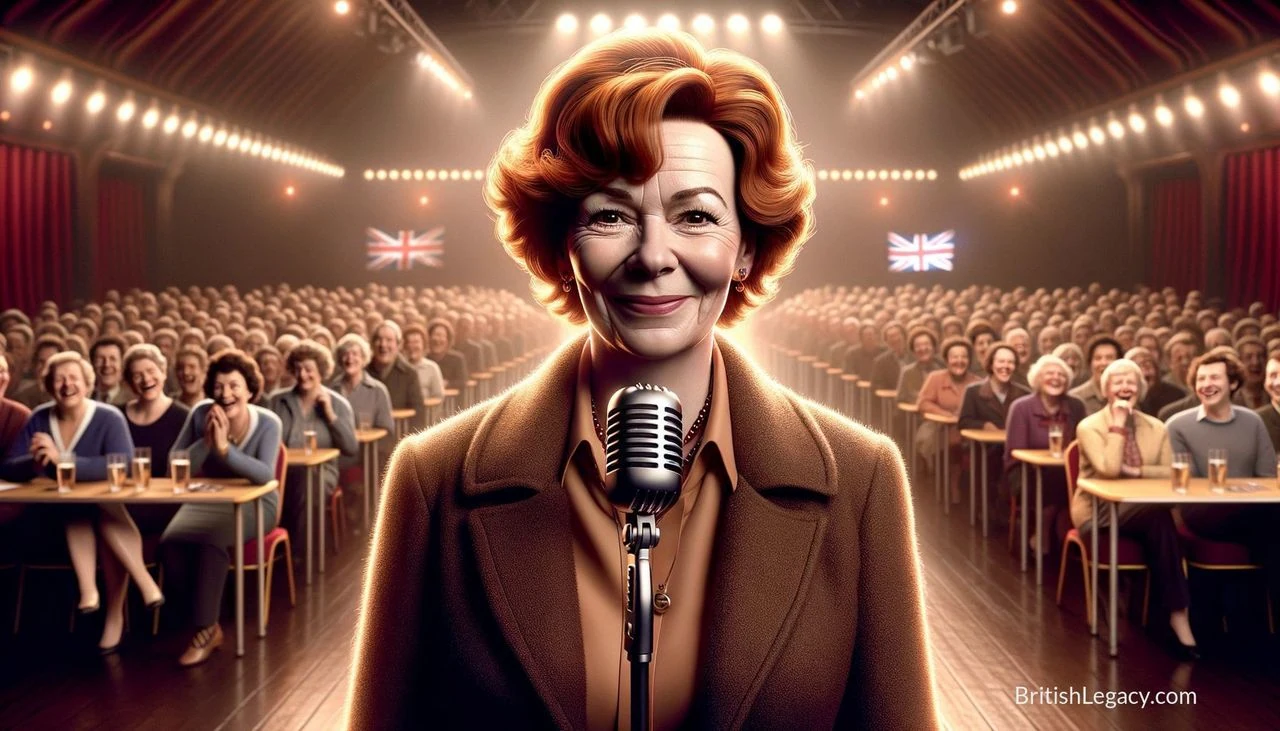
Jo Brand’s route into comedy ran through psychiatric nursing. After working for ten years in hospitals, she entered London’s alternative comedy scene in the mid-1980s, bringing a deadpan delivery and a distinctive perspective to a movement that was changing British stand-up. Her work later ranged from the NHS satire Getting On to panel shows, radio, novels and television presenting.
A working life before comedy
Brand was born Josephine Grace Brand in Clapham, London, on 23 July 1957. She grew up in East Sussex and Kent, and attended schools in St Mary’s Platt, Benenden, Tunbridge Wells and Hastings before studying at Bexhill College. Before entering nursing, she worked in a pub, for Barnardo’s and as a nursing assistant in a residential unit for adults with learning disabilities.
At Brunel University, she took a joint social science degree alongside a qualification as a registered mental nurse. She then worked for ten years as a psychiatric nurse, including at Bethlem Hospital in south London, Cefn Coed Hospital in Swansea and the Maudsley Hospital. The experience gave her direct knowledge of mental health care, its staff and its institutions. It would later inform work that could find comedy in workplace routines without losing sight of the people living and working within them.
Finding a voice in alternative comedy
Brand began performing in London’s alternative comedy clubs in the mid-1980s, using the stage name “Sea Monster”. Her early television appearances included Saturday Live. She delivered jokes in a bored-sounding monotone, one line at a time, leaving pauses that became part of the performance. The style stood apart from more conventional stand-up: its rhythm was unhurried, while its observations drew on pop culture and public figures.
Her arrival coincided with a comedy scene in which women were under-represented. The original account describes a persona built around being “hard-drinking” and “hard-smoking”; rather than treating that description as a complete account of her act, it is more useful to recognise how Brand made a recognisable stage voice from understatement and sharply observed material. Her career began in the alternative-club circuit, then widened through television and radio, where the same dry timing could work in both scripted comedy and unscripted conversation.
In 1993, she became a resident panellist on the BBC show The Brain Drain. She went on to write and present Jo Brand Through the Cakehole for Channel 4 and fronted other programmes, including Jo Brand’s Commercial Breakdown. Guest appearances on Have I Got News for You and QI made her a familiar panel-show presence; she also appeared on Would I Lie to You? and BBC Radio 4 programmes including The News Quiz and Just a Minute.
Comedy rooted in the NHS
Brand’s nursing experience came into especially clear focus in Getting On, the BBC Four sitcom she co-created, co-wrote and starred in with Joanna Scanlan and Vicki Pepperdine. Set on a geriatric ward, the series makes its comedy from the pressures and routines of NHS work. Brand played Kim Wilde, one of the ward’s nurses. Its setting connected her professional experience with a precise comic subject: the institution, the work and the human exchanges that take place inside it.
The programme’s satire did not rely on nursing being an abstract backdrop. Brand’s years in psychiatric nursing offered a basis for writing about healthcare from close knowledge, while the ensemble’s performances kept the focus on the ward’s everyday life. For her work on the series, she won the 2011 BAFTA for Best Female Performance in a Comedy Role. The award recognised a specific performance and writing achievement, rather than a BAFTA for the programme in 2003.
Her television work has continued in different forms. Brand co-wrote and starred as Rose in Damned, which began as a Sky Arts pilot before Channel 4 commissioned a series; a second series followed. She presented The Great British Bake Off: An Extra Slice from its 2014 launch through 2025, bringing her familiar comic voice to a companion programme about baking. Other presenting work included Jo Brand’s Big Splash, Jo Brand’s Cats & Kittens and the Sport Relief documentary Jo Brand’s Hell of a Walk.
Books, performance and public service
Brand’s writing extends beyond television comedy. Her books include the novels Sorting Out Billy, It’s Different for Girls and The More You Ignore Me, as well as the autobiographies Look Back in Hunger and Can’t Stand Up For Sitting Down. She adapted The More You Ignore Me for a feature film released in 2018. Her work across forms has allowed the comic voice associated with her stand-up to move into fiction, memoir and screenwriting.
She has also taken part in charity broadcasting and events. In 2016, Brand walked 150 miles across Britain for Sport Relief, with the journey documented in a television programme. She supports ActionAid and has been involved in fundraising for Children in Need. Her public service work also includes roles with organisations such as the National Self Harm Network, International Animal Rescue, the Prader-Willi Syndrome Association and the Ectopic Pregnancy Trust; she is an ambassador for the Alzheimer’s Society. These activities sit alongside, rather than replace, her work as a comedian and writer.
Recognition has included British Comedy Awards for stand-up and television, as well as a 2011 BAFTA for her performance in Getting On. Brand received honorary degrees from the University of Glamorgan in 2007, the University of Suffolk in 2009 and Canterbury Christ Church University in 2014. The 2007 award recognised her work as a psychiatric nurse, while later recognition also reflected her contribution to public awareness of mental health. Together, these honours point to the unusual breadth of a career that has joined entertainment with experience in care.
Why Jo Brand deserves a place in British Legacy
Jo Brand’s place in British Legacy rests on the way her career connects two kinds of public work. She spent a decade as a psychiatric nurse before becoming a comedian, and that experience gave her a foundation for writing and performing about institutions and the people who work in them. In Getting On, the NHS ward is not merely a setting for jokes: it is the centre of a comedy shaped by the realities of healthcare work. Brand’s role as co-creator, writer and performer, and her 2011 BAFTA for the series, make that achievement concrete.
Her contribution also lies in the range of audiences and formats she has reached. From London’s alternative comedy clubs and early appearances on Saturday Live to panel shows, BBC Radio 4, novels and long-running television presenting, Brand has carried a recognisable comic voice across British popular culture. Her nursing background has also remained part of her public contribution: honorary recognition explicitly acknowledged that work, while her links with mental-health and other charities have given her profile uses beyond entertainment. This is a specifically British story of comedy informed by public services and carried into national broadcasting. It is worth remembering not as a claim that one performer speaks for a whole profession or generation, but as the record of a sustained career joining observation, performance and experience of care.
Sources
Jo Brand — Wikipedia revision 1378540123
Adapted in part from Jo Brand by Wikipedia contributors, under CC BY-SA 4.0. Text has been edited and combined with the existing article; this adapted text is shared under the same licence. Contributor history.