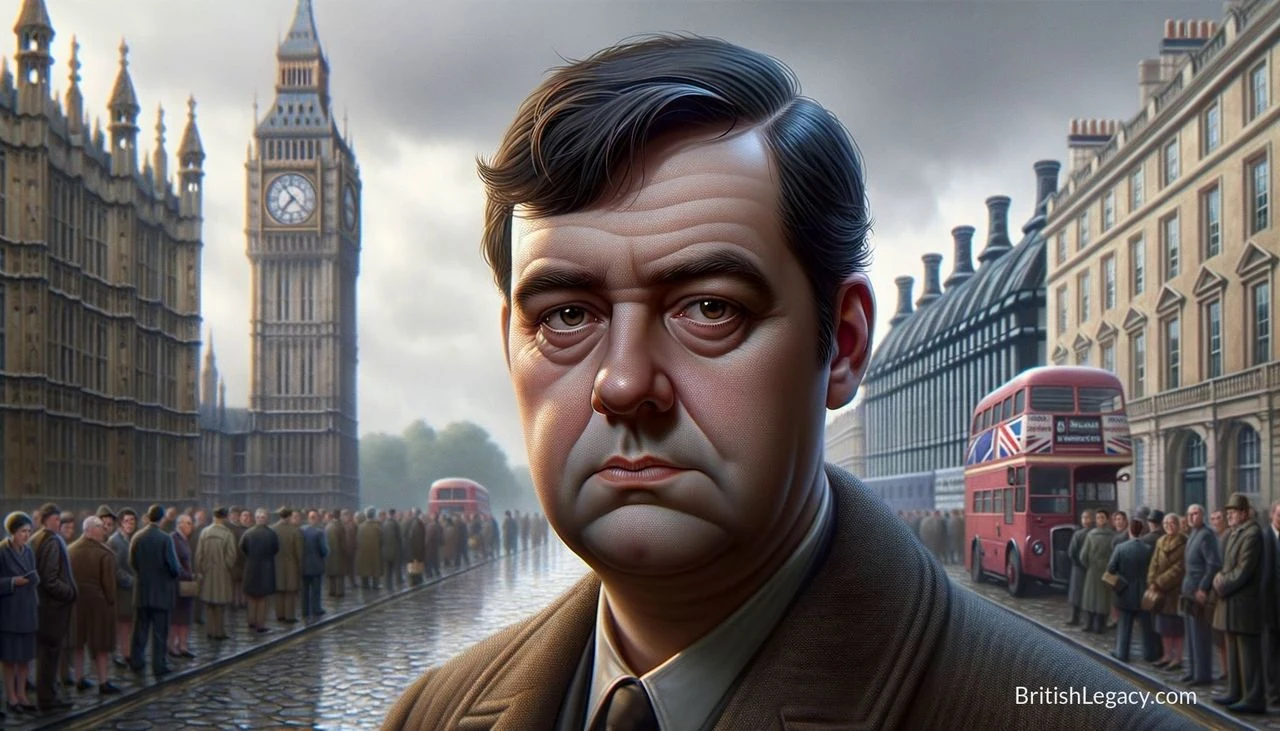
Tony Hancock’s comic character wanted recognition, comfort and a life beyond his shabby surroundings. Usually, his own vanity and poor judgement stood in the way. That gap between aspiration and failure became the engine of Hancock’s Half Hour, the BBC radio and television series that made him one of Britain’s best-known comedians of the 1950s and early 1960s. Its humour came not from a succession of variety turns but from a recognisable person caught in ordinary situations of his own making.
From Hall Green to the stage
Anthony John Hancock was born on 12 May 1924 in Hall Green, Birmingham, the second of three sons of Jack and Lily Hancock. In 1927 the family moved to Bournemouth, where his father ran a laundry and later became the licensee of a hotel. After his father died in 1934, Hancock lived with his mother, brothers and stepfather. He attended several schools, including Durlston Court and Bradfield College, and left school at 15.
Hancock made his stage debut in 1940, billed as “Anthony Hancock – The Confidential Comic”. During the Second World War he joined the RAF Regiment and, after unsuccessful auditions for the Entertainments National Service Association, performed with Gang Shows for troops in Europe. After the war he toured with the Ralph Reader Gang Show, worked in a double act with musician Derek Scott at the Windmill Theatre, and appeared in radio programmes including Workers’ Playtime and Variety Bandbox.
His first national recognition came through radio. In 1951–52 he appeared in Educating Archie, mainly as a tutor and foil to the ventriloquist’s dummy. His frequently used line “Flippin’ kids!” entered popular parlance. He also made regular appearances on BBC television’s light-entertainment programme Kaleidoscope.
A character built for radio
In 1954 Hancock was given his own BBC radio series, Hancock’s Half Hour, written by Ray Galton and Alan Simpson. It ran for seven years and more than a hundred episodes on radio, while a television version began in 1956. Hancock played Anthony Aloysius St John Hancock, living at the shabby “23 Railway Cuttings” in East Cheam. Many episodes followed his attempts to get ahead as a struggling comedian with ambitions to be taken seriously as an actor.
The series moved away from the variety format common in radio comedy. Its stories grew out of character and circumstance: Hancock’s self-importance met domestic frustrations, setbacks and the unwelcome presence of other people. The radio cast included Sid James, Bill Kerr, Kenneth Williams and, at different times, Moira Lister, Andrée Melly and Hattie Jacques. On television the cast was reduced largely to Hancock and James, whose more practical character often exposed Hancock’s pretensions. Their comic partnership became one of the show’s defining features.
The television series retained the everyday situations while making Hancock’s expressions and timing visible. From the autumn 1959 series, episodes were recorded before transmission rather than performed live. Hancock was also the first performer to receive a £1,000 fee for a half-hour show, according to the biographical account.
Leaving the partnership behind
Hancock worried that working with Sid James made them seem like a double act. He ended their professional partnership after the final series they made together; his last BBC series in 1961 was retitled Hancock and featured no James. Some of its most remembered episodes came from that period. In “The Blood Donor”, Hancock objects to giving a pint of blood: “I don’t mind giving a reasonable amount, but a pint! That’s very nearly an armful!” In “The Radio Ham”, his character receives a distress call but cannot work out where the sender is.
Hancock also sought a different kind of writing. After his break with Galton and Simpson in 1961, he made The Punch and Judy Man (1963), playing a struggling seaside entertainer who dreams of a better life. His later television work included an ATV series with different writers and two variety series for ABC Weekend TV. The ATV programme appeared in 1963, on the same evenings as Steptoe and Son, the BBC series created by his former writers. His final British television work included The Blackpool Show (1966) and Hancock’s (1967).
Final years
Hancock’s career became increasingly troubled. His alcoholism affected his performances, and he collapsed with acute liver failure on 1 January 1967. In March 1968 he went to Australia under contract to make a 13-part television series for the Seven Network. He completed three programmes before his death; the shows were not broadcast for nearly four years.
Hancock died in Bellevue Hill, New South Wales, on 25 June 1968, aged 44. His death was ruled a suicide. He had married Cicely Romanis in 1950 and divorced her in 1965; later that year he married Freddie Ross. The marriage was short-lived. His personal difficulties are part of the record of his life, but they do not explain away the craft of the performances or the lasting precision of the comic character he created.
A comic presence beyond the broadcasts
Hancock’s work continued to be revisited after his death. In a 2002 poll, BBC radio listeners voted him their favourite British comedian. Galton and Simpson linked the appeal of later characters such as Alan Partridge and David Brent to Hancock’s self-delusion: their protagonists, like his, believe in their own importance while audiences see the mismatch between aspiration and reality.
His work also remained in circulation through recordings and new performances. BBC Radio 4 restaged five missing radio instalments in 2014 as The Missing Hancocks, with Kevin McNally in the title role; other missing episodes were subsequently remade. The Tony Hancock Appreciation Society, formed in 1976, continues to bring together admirers and holds an archive at De Montfort University. Memorials mark his connections to Birmingham, Bournemouth and London, including an English Heritage blue plaque at the South Kensington home where he lived from 1952 to 1958.
Why Tony Hancock deserves a place in British Legacy
Hancock’s place in British cultural history rests on a specific change in comic form. Hancock’s Half Hour took comedy away from a sequence of separate variety acts and made a single character’s habits, hopes and failures the source of the story. Radio gave that character room to inhabit imagined situations; television brought his reactions into view. The approach made ordinary frustrations usable as sustained comedy, without requiring the protagonist to be admirable or successful. His shabby home in East Cheam and persistent hunger for recognition gave the audience a comic figure whose grand ideas repeatedly collided with commonplace realities.
The work’s afterlife shows that this was more than a successful broadcast formula. Listeners chose Hancock as their favourite British comedian in the 2002 BBC poll, and Galton and Simpson identified his self-delusion as a feature echoed in later comic characters. The preservation, remaking and discussion of missing episodes, alongside the society and memorials devoted to him, keep the work available to new audiences. Hancock’s British legacy is therefore not simply a reputation attached to one performer: it is a durable model of character-led situation comedy, built from the recognisable gap between how people see themselves and how the world sees them.
Sources
Adapted in part from Tony Hancock by Wikipedia contributors, under CC BY-SA 4.0. Text has been edited and combined with the existing article; this adapted text is shared under the same licence. Contributor history.