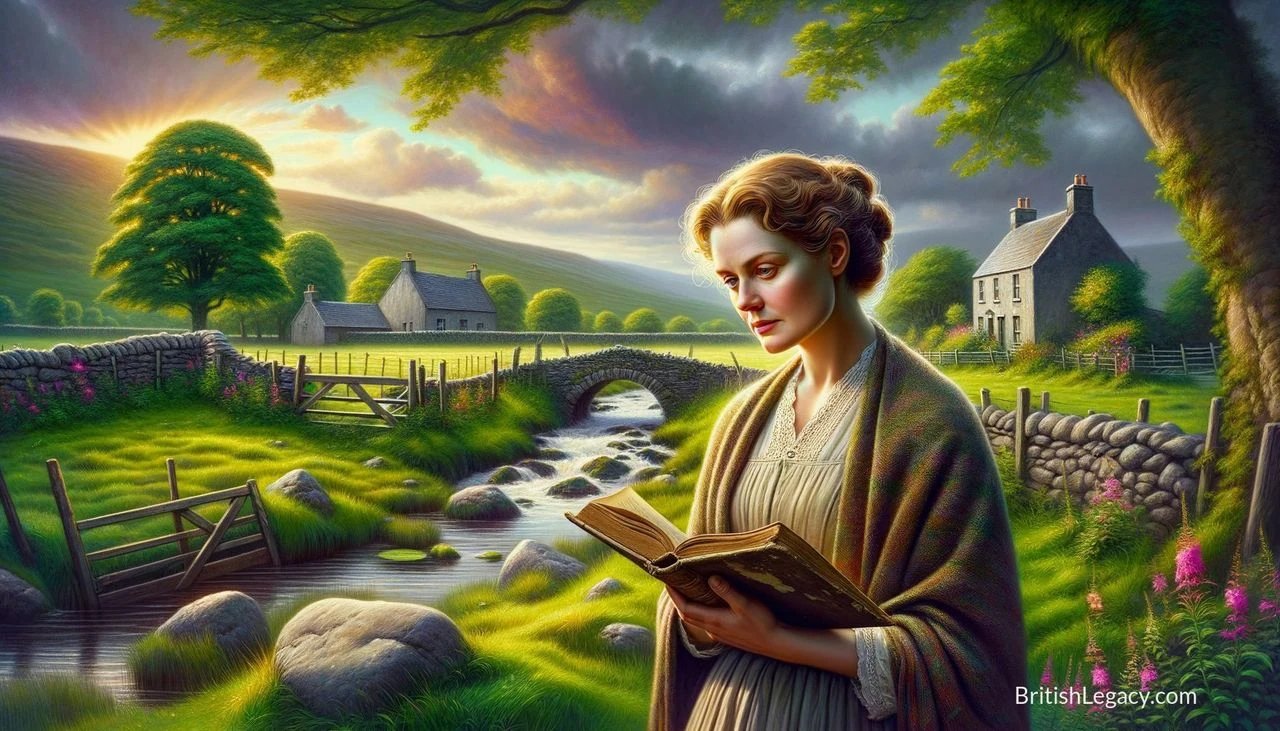
Eavan Boland’s poetry placed the lives of women alongside the histories nations tell about themselves. Writing from an Irish perspective, she explored how public events, inherited stories and domestic experience shape identity. Her work also travelled beyond Ireland: collections appeared in Britain, where several became Poetry Book Society Choices, and her teaching career later took her to Stanford University. Boland’s achievement was not simply to add women to an existing account of history, but to make their ordinary experiences part of the material through which history could be understood.
An Irish childhood, with a view of Britain
Boland was born in Dublin on 24 September 1944. Her father, Frederick Boland, was a career diplomat, and her mother, Frances Kelly, was a painter. When Eavan was six, her father became Irish ambassador to the United Kingdom and the family moved to London. There she encountered anti-Irish sentiment, an experience that strengthened her identification with her Irish heritage. She later addressed that period in the poem “An Irish Childhood in England: 1951”. The move gave her early life a direct connection with Britain, but her work remained grounded in questions of Irish identity and history.
At 14, Boland returned to Dublin to attend Holy Child School in Killiney. She entered Trinity College Dublin in 1962 and published a poetry pamphlet, 23 Poems, during her first year. In 1966 she graduated with a first-class BA in English literature and language. Her first book of poetry, New Territory, followed in 1967, published by Dublin firm Allen Figgis. It established an early point in a career that would keep returning to the relationship between personal experience and the stories a society inherits.
The War Horse appeared in 1975, followed by In Her Own Image in 1980. Night Feed (1982) developed Boland’s attention to the ordinary lives of women and to the difficulties women poets faced in a male-dominated literary world. The subjects were not separate: writing about daily experience also challenged assumptions about what deserved a place in literature. Her poetry made domestic life a serious subject without detaching it from the political and historical forces around it.
Making women’s experience part of history
Boland’s work repeatedly questioned the absence of women from conventional accounts of Irish history. She brought personal memory into contact with national identity, showing how the two can be intertwined rather than kept in separate spheres. Her poems ask readers to attend to what grand narratives leave out: the people whose lives are shaped by history, but who may not appear in its familiar public images.
In In a Time of Violence (1994), the personal and political meet in poems that place intimate experience beside wider historical and social questions. The collection includes “The Pomegranate”, which draws on the myth of Persephone to consider motherhood and loss. The poem’s use of an ancient story gives those experiences a longer frame, while keeping the emotional weight of the mother-and-child relationship in view.
Boland also explored Irish history through poems including “The Doll’s Museum in Dublin” and “That the Science of Cartography is Limited”. Her historical attention was not a detached survey of events: memory, place and individual lives mattered to how the past could be represented. The result was a poetry that could question inherited narratives while recognising how national history enters private life. That interest in the overlooked and the ordinary also underpins her insistence that women’s experience belongs within the literary record.
In 1994, Boland was writer in residence at Dublin’s National Maternity Hospital. She composed “Night Feed” and “The Tree of Life” during that period; her work is commemorated on a plaque in the hospital garden. The residency brought her attention to motherhood into direct contact with a place shaped by women’s lives and care, while her poetry continued to consider how apparently private experience might speak to larger questions.
A career between Ireland, Britain and the United States
After graduating, Boland held a number of teaching posts while publishing poetry, criticism and essays. She taught at Trinity College Dublin, University College Dublin and Bowdoin College, and was a member of the International Writing Program at the University of Iowa. She was also writer in residence at Trinity College Dublin. In 1969 she married novelist Kevin Casey; they had two daughters. Her experiences as a wife and mother informed her writing about the centrality of the ordinary.
From 1996, Boland was a tenured professor of English at Stanford University in California, where she taught creative writing. She divided her time between Palo Alto and her home in Dublin. Her career therefore connected Irish literary life with universities in the United States, while her books also had a substantial British route to readers. Several volumes were selected as Poetry Book Society Choices in the UK, and Carcanet Press was her principal British publisher. These publishing connections are a concrete part of her British literary presence, rather than a reason to detach her work from its Irish context.
Her writing also reached public audiences beyond the university and book trade. In 1976 she received a Jacob’s Award for her involvement in RTÉ Radio’s The Arts Programme. In 2008, Irish Taoiseach Bertie Ahern quoted from “The Emigrant Irish” in an address to the two houses of the US Congress. In 2016, President Barack Obama quoted lines from “On a Thirtieth Anniversary” at a White House reception marking Saint Patrick’s Day.
In 2018, Boland was commissioned by the Irish Government and the Royal Irish Academy to write “Our future will become the past of other women”, for centenary commemorations of women gaining the vote in Ireland in 1918. The poem was to be read at the United Nations and in Ireland. That commission brought her long-standing interest in women’s place in history into a public act of remembrance.
Books, recognition and later years
Boland’s work extended beyond poetry. She co-edited The Making of a Poem: A Norton Anthology of Poetic Forms with Mark Strand in 2000, and with Edward Hirsch co-edited The Making of a Sonnet in 2008. Her essay collection A Journey with Two Maps: Becoming a Woman Poet received a PEN Award for creative nonfiction in 2012. These books reflect a sustained interest not only in writing poems, but also in the forms, practices and conditions that shape a poet’s work.
In a Time of Violence received a Lannan Award and was shortlisted for the T. S. Eliot Prize. Other recognition included the Irish PEN Award for Literature in 2019, an honorary membership of the Royal Irish Academy in 2018, and honorary degrees from institutions including University College Dublin and Trinity College Dublin. Her collection Domestic Violence (2007) was shortlisted for the Forward Prize in the UK. The range of these acknowledgements reflects a career read and recognised across more than one national setting.
Boland died in Dublin on 27 April 2020, aged 75. Her final collection, The Historians, received the Costa Book Award for poetry posthumously that year. In 2024, Trinity College Dublin announced that its former Berkeley Library would be renamed the Eavan Boland Library; the name became official in March 2025. It was the first building named after a woman on the university’s city-centre campus.
Why Eavan Boland deserves a place in British Legacy
Boland belongs in British Legacy because her literary presence in Britain is evidenced in the life of her work: several volumes became Poetry Book Society Choices, and Carcanet Press was her principal British publisher. Her childhood also included years in London, where anti-Irish hostility strengthened rather than dissolved her sense of Irish identity. These connections make a British account of her legacy meaningful, but they do not make her work simply British. Its centre remains the Irish histories, memories and experiences she explored.
Her contribution matters because she changed the scale at which poetry could treat history. By setting women’s ordinary lives beside public events and inherited narratives, she made domestic experience a way of thinking about national identity, not a subject to be excluded from it. Poems such as “The Pomegranate” connect motherhood and loss with myth; her historical poems ask what conventional accounts leave unseen. Her writing, teaching and editorial work carried these questions into different literary communities, while honours and publication in Britain gave British readers sustained access to them. Remembering Boland here recognises both that cross-border readership and the distinctively Irish perspective that made her work valuable: she widened the stories poetry could tell and whose lives those stories could include.
Sources
Adapted in part from Eavan Boland by Wikipedia contributors, under CC BY-SA 4.0. Text has been edited and combined with the existing article; this adapted text is shared under the same licence. Contributor history.