Wendy Cope’s poetry can turn the familiar into a neat surprise: a delay in romance becomes a queue of buses, while ordinary scenes and private feelings acquire the lift of rhyme, compression and a well-judged change of tone. Her humour is immediate, but it is not the whole story. Across five collections of adult poetry, she has written about intimacy, hope, frustration and unhappiness, and built a substantial readership without making poetry feel remote from everyday experience.
From Kent to the classroom
Cope was born in Erith, Kent, on 21 July 1945. Her father, Fred Cope, managed the local department store, Hedley Mitchell. She attended West Lodge Preparatory School in Sidcup and Farrington’s School in Chislehurst before reading history at St Hilda’s College, Oxford. She also studied at Westminster College, Oxford.
After graduating, Cope spent fourteen years teaching in primary schools. In 1981 she became arts and reviews editor of Contact, the Inner London Education Authority magazine. Five years later, she left that post to work as a freelance writer. She also became a television critic for The Spectator, a role she held until 1990. These jobs formed a varied working life around her writing; the available evidence does not establish that her years in teaching directly produced particular themes in her poems.
A debut with a distinctive voice
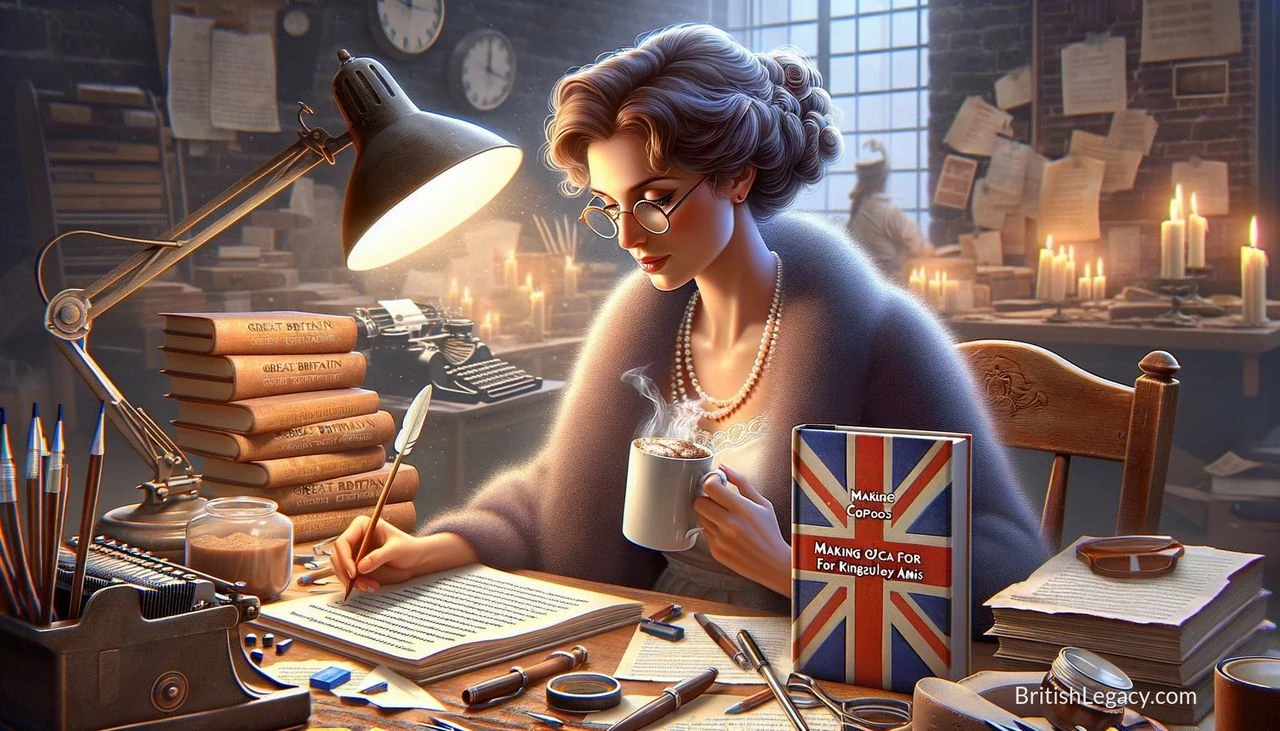
Cope’s first adult collection, Making Cocoa for Kingsley Amis, appeared in 1986. Its title announces a comic sensibility, but the collection’s place in her career rests on more than a witty conceit. Her verse is known for its close attention to ordinary English life and to the desires, disappointments, hopes and confusions of intimate relationships. Clear language and compact forms let a joke land quickly, while the feeling beneath it gives the poems their staying power.
“Bloody Men” is one example of how she makes an everyday comparison carry a recognisable romantic frustration. The poem’s image of buses arriving in a group after a long wait turns an awkward experience into a concise comic observation. The effect depends on economy: an ordinary situation, a carefully controlled rhythm and a punchline that makes the reader see the situation anew.
Cope’s books have often been described through their wit and lightness, but her own account of her work points to change as well as continuity. She has said that her first two collections differ from the later three, linking that shift in part to changes in her happiness. The earlier books share a strong interest in rhyme and punchline; the later collections include more free verse and darker tones. Depression is a recurring subject in her work. A single label such as “comic poet” therefore misses the movement between the playful and the more searching parts of her writing.
Five collections, and work beyond them
After Making Cocoa for Kingsley Amis, Cope published Serious Concerns in 1992, If I Don’t Know in 2001, Family Values in 2011 and Anecdotal Evidence in 2018. Serious Concerns became her most popular book, and its success changed her circumstances: the money and resources enabled her to leave teaching and devote herself to writing. Cope has named Anecdotal Evidence as her favourite of her own works and “Flowers”, from Serious Concerns, as her favourite poem of her own.
Her publishing has also included poetry for children, selected poems, limited editions and prose. She has edited several anthologies of comic verse, including The Orchard Book of Funny Poems and The Funny Side: 101 Humorous Poems, and selected or introduced other poetry collections. These activities extend her contribution beyond her own poems: she has also helped bring comic verse and the work of other poets before readers.
Cope’s poems have travelled into other forms. Three haikus from her first collection, attributed there to the fictional poet Jason Strugnell, were set by composer Colin Matthews as Strugnell’s Haiku in 1990. In 2008, “After The Lunch” provided the lyric for “Waterloo Bridge”, a song by Jools Holland and singer Louise Marshall. Her poem “The Orange” later found a particularly broad audience online; Faber & Faber published a new selection, The Orange and other poems, in 2023.
Recognition, readership and an archive
Cope was elected a Fellow of the Royal Society of Literature in 1992. Her honours include the Cholmondeley Award, received in 1987, and the American Academy of Arts and Letters award and Michael Braude Award for Light Verse, both in 1995. In 1998, listeners to a BBC Radio 4 poll chose her as their preferred successor to Ted Hughes as Poet Laureate. When Andrew Motion’s term ended in 2009, she was again widely considered a popular candidate, though Cope has said she believes the post should be discontinued. Carol Ann Duffy was appointed instead. Cope was made an Officer of the Order of the British Empire in the 2010 Birthday Honours for services to poetry.
In April 2011, the British Library acquired Cope’s archive. It includes manuscripts, school reports, 67 poetry notebooks, unpublished poems and 40,000 emails, which the library described as its largest email archive purchase to that date. Cope said she wanted the archive to have a good home and that the sale came at a time when she and her husband needed money and space for a move. Once catalogued, the collection would be available to researchers. The archive preserves not only finished poems but also the records and correspondence of a working literary life.
Cope married the poet Lachlan Mackinnon in a register office in 2013, after they had lived together for nineteen years. In 2019, she appeared on BBC Radio 4’s Desert Island Discs, choosing The Compleet Molesworth by Geoffrey Willans as her book and writing materials as her luxury. Such details sit alongside the public record of her books and honours, but the work itself remains the central measure of her achievement.
Why Wendy Cope deserves a place in British Legacy
Wendy Cope’s place in British literary life rests on a particular kind of accessibility: she makes poems that are easy to enter without making them slight. Her precise rhymes, comic reversals and observations of ordinary experience have brought readers to contemporary poetry through recognisable situations, especially the hopes and irritations of intimate relationships. Yet her development across five adult collections resists the idea that accessibility means a single tone. The later books make room for darker subjects and altered forms, including free verse and writing shaped by depression. That range gives her work both a welcoming surface and greater emotional depth.
Her contribution also reaches beyond the page. She has edited comic-poetry anthologies, written for children, and seen poems taken up in music and popular culture. The British Library’s acquisition of her manuscripts, notebooks and extensive correspondence gives researchers material for studying both the finished poems and the process behind them. Her career connects individual craft with a wider literary public: a poet whose work has been read for its humour, taken seriously for its feeling, and preserved as part of the record of modern British writing. That combination—not generic national pride, but an evidenced record of readership, publication and lasting cultural attention—is why her story belongs in British Legacy.
Sources
Wendy Cope — Wikipedia, revision 1377930219
Adapted in part from Wendy Cope by Wikipedia contributors, under CC BY-SA 4.0. Text has been edited and combined with the existing article; this adapted text is shared under the same licence. Contributor history.