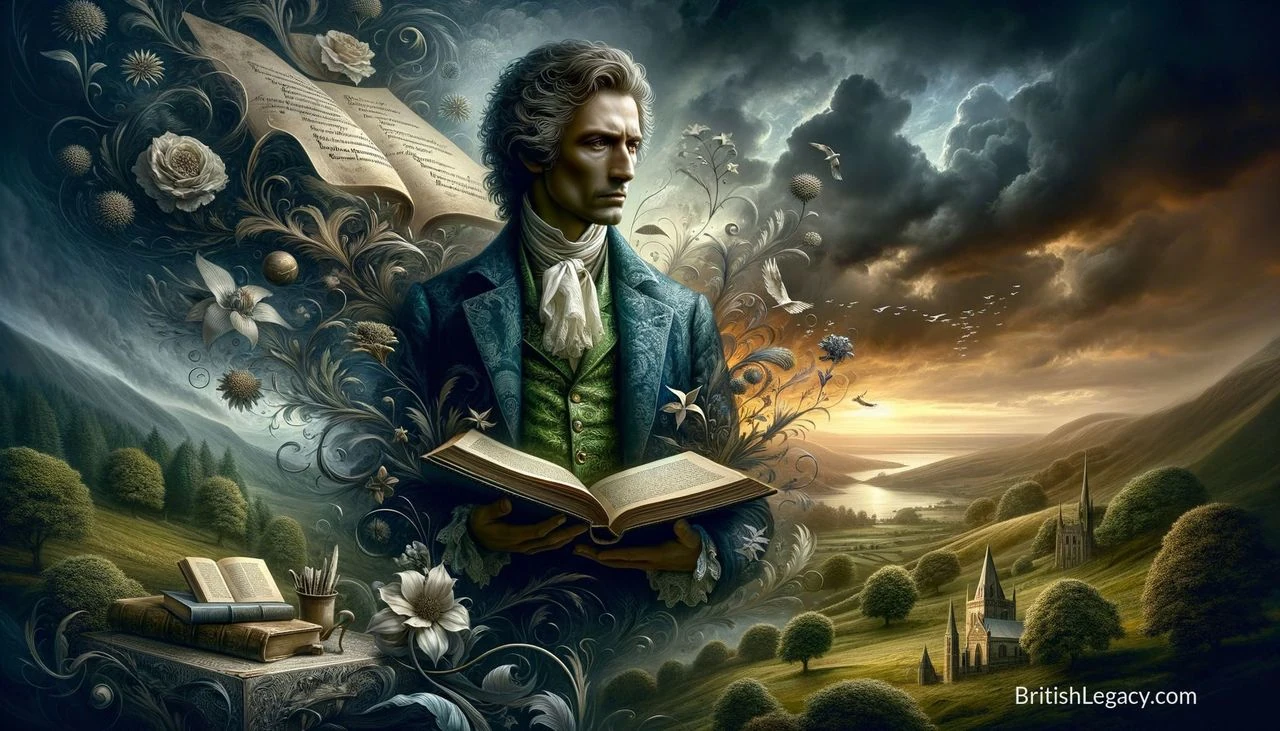
John Milton’s career joined two forms of writing rarely kept apart: the vast imaginative reach of Paradise Lost and the urgent argument of political prose. He wrote of Adam, Eve and Satan in unrhymed verse, but also defended the English Republic and challenged pre-publication censorship. Those pursuits were shaped by a life lived through civil war, political reversal and the loss of his sight.
A London education and years of study
Milton was born on 9 December 1608 in Bread Street, in the City of London. His father, also John Milton, was a successful scrivener and a composer; his mother was Sarah Jeffrey. The younger Milton received private tuition before attending St Paul’s School, where he studied Latin and Greek. In 1625 he entered Christ’s College, Cambridge, taking his BA in 1629 and his MA in 1632.
After Cambridge, he spent years in private study, reading history, theology, philosophy, politics, literature and science. He continued to write poetry, including L’Allegro, Il Penseroso and Comus. His pastoral elegy Lycidas, written in memory of a fellow Cambridge student, appeared in a memorial collection in 1638. These early works established a practice that would mark his writing throughout his life: drawing on classical and religious learning while testing what English poetry could do.
In 1638 Milton travelled through France and Italy, meeting scholars and intellectuals and encountering the artistic and religious life of the continent. He returned to England in 1639 as the country moved towards civil war. The experience of travel broadened his learning, but the political crisis soon redirected his work from poetry towards public argument.
Writing through revolution and restoration
From 1641 Milton published prose tracts opposing episcopacy and arguing over the government of the Church of England. He also worked as a schoolmaster and wrote Of Education (1644), which proposed reform of the universities. His pamphlets on divorce brought controversy; in 1644, he turned the dispute into a broader challenge to pre-publication licensing with Areopagitica, addressed to Parliament. It condemned censorship before a work could be printed and made the case for freedom of thought and expression, though its argument was tied to Milton’s religious understanding of conscience and the search for truth.
After the execution of Charles I, Milton defended republican government in print. In March 1649 he became Secretary for Foreign Tongues to the Council of State. His work included preparing the English Republic’s foreign correspondence in Latin and other languages, as well as writing defences of the regime. He held the post until the Restoration, even after blindness made him dependent on deputies for much of its practical work.
Milton had become totally blind by 1652. He continued writing by dictating to assistants, including, at one point, the poet Andrew Marvell. The Restoration of the monarchy in 1660 ended his public role and put him at risk: he went into hiding, was briefly imprisoned after emerging, and was released following intervention by influential friends. He remained in London for much of his later life, leaving the city during the plague for a cottage at Chalfont St Giles.
The making of Paradise Lost
Milton’s blindness and the defeat of the political cause to which he had devoted himself form part of the context for his late poetry, but they do not reduce it to autobiography. He composed Paradise Lost between 1658 and 1664, dictating the poem to others. Published in 1667, it tells the biblical story of the Fall: Satan’s rebellion, the temptation of Adam and Eve, and their expulsion from Eden. The poem’s twelve books use blank verse, without rhyme, to sustain an epic narrative in English.
Milton followed it with Paradise Regained and the tragedy Samson Agonistes, both published in 1671. The poems return to questions of obedience, freedom, defeat and redemption, but in different forms and through different stories. He supervised a second edition of Paradise Lost in 1674, adding an explanation of its unrhymed verse and prefatory lines by Marvell.
Blank verse gave Milton room to vary the pace and movement of his lines without the regular closure of rhyme. His handling of the form, expansive sentences and densely learned language offered later poets a demanding model. Milton’s work also ranged beyond English: he wrote in Latin and Italian, among other languages, and his classical learning informs the poem’s epic scale as well as its biblical subject.
A long argument with power and conscience
Milton’s political writing changed with the fortunes of the state. In The Tenure of Kings and Magistrates (1649), he defended the people’s right to hold rulers to account. Later, as the Republic faltered, he argued against the return of monarchy in The Ready and Easy Way to Establish a Free Commonwealth. His proposals were not a simple programme for popular democracy: he favoured a continuing council, and his political positions shifted as he confronted the limits of the revolution he had supported.
His defence of freedom of expression likewise needs to be read in its historical and religious setting. Areopagitica remains influential for its opposition to licensing before publication, but Milton’s case was not an uncomplicated endorsement of unrestricted speech. He connected liberty to conscience, religious inquiry and the pursuit of truth. That combination—forceful advocacy alongside limits and contradictions—makes his prose part of the history of political argument, rather than a slogan detached from its context.
Milton died in London in November 1674 and was buried at St Giles-without-Cripplegate. His reputation did not settle into a single political or literary interpretation. Readers and writers including John Dryden, William Blake and William Wordsworth engaged with his poetry; others, including T. S. Eliot, criticised its influence or style. The continuing debate is one measure of how persistently his work has invited response.
Why John Milton deserves a place in British Legacy
Milton’s place in British literary history rests first on what he made possible in English poetry. Paradise Lost took the scale of classical epic and gave it a sustained English blank verse, using that form to explore the Fall, choice and human responsibility. Its ambition was not simply formal: the poem gives its readers a way to think through the relations between freedom, obedience and loss. Milton’s shorter poems and later works show that his achievement was not confined to a single book, while his influence on subsequent poets kept questions of poetic form and inheritance alive.
His public writing adds a distinct strand to that legacy. As a civil servant of the Commonwealth, Milton wrote for a government formed amid revolution; as a pamphleteer, he contested censorship and argued about the rights of rulers and subjects. Areopagitica continues to matter because it made pre-publication control a subject of sustained argument, even though its conception of liberty had boundaries. Milton’s life also connects the work to its circumstances: after losing his sight, he continued to compose through dictation, and after the Restoration he returned to writing in a changed political world. Taken together, the poetry and prose show an English writer working across art, religion and government, whose arguments remain substantial enough to be studied, challenged and reconsidered.
Sources
John Milton — Wikipedia, revision 1378908503
Adapted in part from John Milton by Wikipedia contributors, under CC BY-SA 4.0. Text has been edited and combined with the existing article; this adapted text is shared under the same licence. Contributor history.