
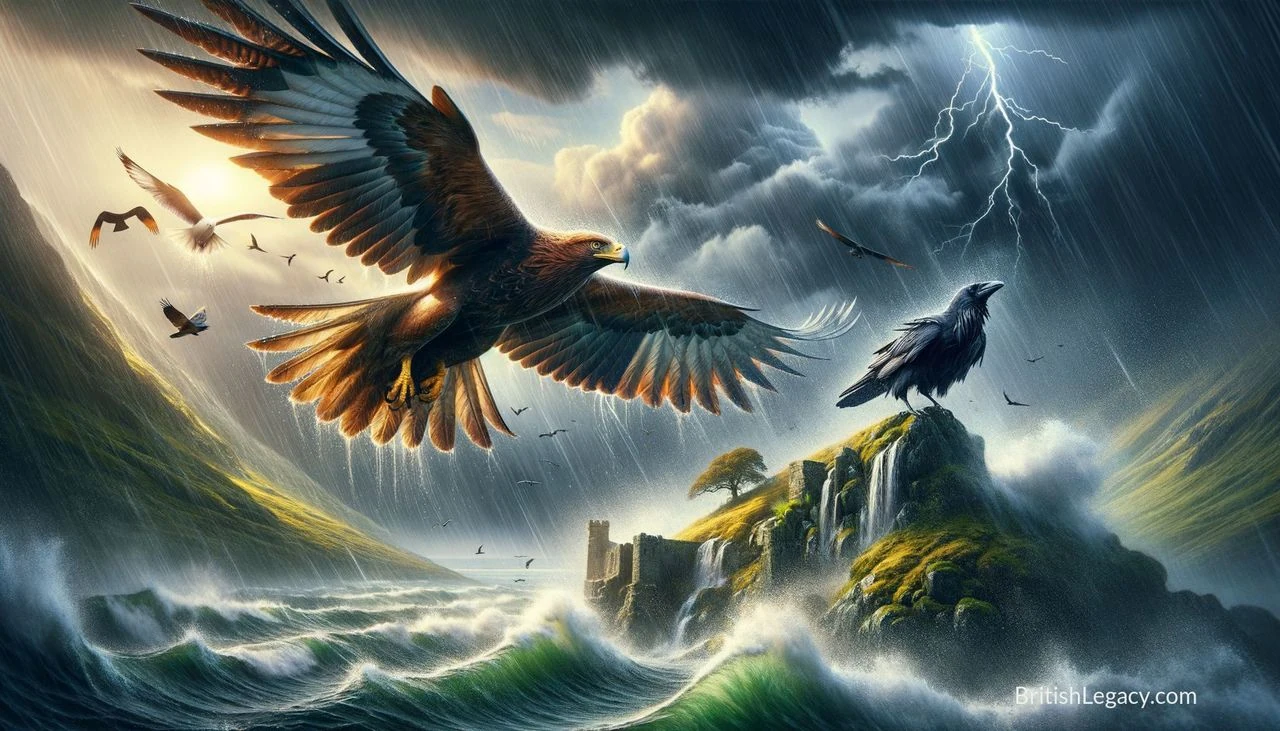
Animals in Ted Hughes’s poetry are not picturesque visitors to the page. They struggle, hunt and endure; their vivid presence became one way for him to examine the forces shaping human life. From the Yorkshire landscapes of his childhood to the unsettling mythology of Crow, Hughes built a body of work that reached across poetry, children’s writing, translation and public service. Appointed Poet Laureate in 1984, he held the role until his death in 1998.
A Yorkshire childhood and a change of course
Edward James Hughes was born in Mytholmroyd, in the West Riding of Yorkshire, on 17 August 1930. He was raised in the Calder Valley and among Pennine moorland, first around the farms of the valley and later in Mexborough, where his parents ran a newsagent’s and tobacconist’s shop. His father, William, was a joiner who had served in the First World War. Hughes later described his first six years as shaping everything.
He was fascinated by animals, collecting and drawing toy creatures, and spent time outdoors hunting and fishing with his family. In Mexborough, he explored the surrounding farms and countryside. He remembered Manor Farm at Old Denaby as a place he came to know better than anywhere else. A friend introduced him to Crookhill Lodge, where Hughes learnt about wildlife from the estate’s head gardener and gamekeeper. Those experiences informed early writing, including the poem “The Thought Fox” and the story “The Rain Horse”.
At Mexborough Secondary School, teachers encouraged his writing and introduced him to poets including Gerard Manley Hopkins and T. S. Eliot. Poems appeared in the school magazine when he was 16; by then, he had set his sights on becoming a poet. He won an exhibition to study English at Pembroke College, Cambridge, but completed two years of National Service first, serving in the RAF as a ground wireless mechanic in east Yorkshire. At Cambridge he began with English, then transferred to anthropology and archaeology. The change of subject would prove useful to a poet drawn to ritual, myth and the deep histories of human belief.
The first collections: landscape, animal life and myth
After university, Hughes held a variety of jobs in London and Cambridge, including work as a rose gardener, nightwatchman and reader for the film company J. Arthur Rank. At London Zoo, a job washing up gave him opportunities to observe animals closely. His first published poetry appeared in the magazine Chequer; a poem was also published in Granta under the pseudonym Daniel Hearing.
His first collection, The Hawk in the Rain, appeared in 1957 and brought wide critical attention. Its title poem and others attend to the natural world not as a comforting idyll but as a place of beauty, force and danger. The collection won a poetry competition run by the Poetry Center of the Young Men’s and Young Women’s Hebrew Association of New York, with publication as its first prize. Hughes also received the Somerset Maugham Award. His forceful rhythms and grounded language became characteristic, while the animals in his poems offered more than subjects for close observation: they embodied the struggle for survival and ascendancy.
Lupercal, published in 1960, won the Hawthornden Prize. Hughes resisted being defined simply as a poet of animals. Myth and esoteric traditions became increasingly important to his work, including shamanism, alchemy and Buddhism. In 1965 he founded the journal Modern Poetry in Translation with Daniel Weissbort, helping bring poetry from other languages to English-speaking readers. The journal’s work included poets from countries such as Poland and Hungary, then under Soviet control.
In Crow: From the Life and the Songs of the Crow (1970), Hughes created a recurring, unstable figure through which to explore creation, destruction and a universe that can seem both comic and merciless. The poems combine mythic ambition with stark, sometimes childlike language. The sequence developed over several years, alongside related work such as Cave Birds. Hughes’s poetry did not settle into a single register: he also wrote about the northern landscape, farming, rivers and the lives of animals, while continuing to work with myth and archetype.
Plath, children’s books and public work
Hughes met the American poet Sylvia Plath at Cambridge in 1956, and they married that year. They lived in the United States and England, had two children, Frieda and Nicholas, and separated in 1962. Plath died by suicide in 1963. Hughes later became the executor of her literary estate and oversaw posthumous publications, including Ariel. His editorial decisions and the handling of her papers became subjects of sustained criticism and dispute. In Birthday Letters, published in 1998, Hughes addressed their relationship in poems that had been withheld from publication for decades. The collection received major literary awards and brought their shared history into his own published work.
Hughes wrote extensively for children as well as adults. His works include How the Whale Became, Season Songs and The Iron Man, a story written to comfort his children after their mother’s death. The book later inspired Pete Townshend’s rock musical and the animated film The Iron Giant. His animal writing also found a young readership: What Is the Truth?, illustrated by R. J. Lloyd, won the Guardian Children’s Fiction Prize in 1984. Hughes and Seamus Heaney edited the poetry anthology The Rattle Bag, another contribution to making poetry available to younger readers.
Appointed Poet Laureate in December 1984, Hughes served until his death. He continued to write across forms, including translations of classical drama and Ovid. His 1997 Tales from Ovid won the Whitbread Book of the Year Award. He also worked with theatre, including a close collaboration with Peter Brook and the National Theatre Company, and supported writing education through the Arvon Foundation. In 1994, concerned about declining fish numbers in rivers near his Devon home, he became a founding trustee of the Westcountry Rivers Trust, which works to restore rivers through catchment-scale management.
Final years and remembrance
Hughes married Carol Orchard in 1970; they remained together until his death. He divided his life between Devon and Yorkshire, maintaining a farm near Winkleigh and buying Lumb Bank near Hebden Bridge. The Devon farm gave its name to Moortown, a collection shaped by rural life. In his later years, the Laureate’s writing ranged from public poems to translations and the intensely personal Birthday Letters. He was appointed to the Order of Merit shortly before his death.
Hughes died in London on 28 October 1998, aged 68, while receiving hospital treatment for colon cancer. He was buried after a funeral at North Tawton church and cremated in Exeter. His work and life have since been commemorated through memorials, poetry trails, festivals and a memorial stone in Poets’ Corner at Westminster Abbey. His papers are held by several institutions, including the British Library, which acquired a substantial collection of his manuscripts, letters, journals and diaries.
Why Ted Hughes deserves a place in British Legacy
Hughes’s place in British literary history rests on more than the intensity of his animal poems or the public distinction of the laureateship. He transformed the landscapes he knew into a distinctive poetic world: the Calder Valley, Pennine moorland, farms and rivers are not mere scenery, but places where human beings encounter lives and forces beyond themselves. From The Hawk in the Rain to Crow, he made nature’s beauty and violence central to a poetry that also draws on myth and the unconscious. His work for children, including The Iron Man and What Is the Truth?, carried that imaginative range to readers beyond the adult poetry audience.
His British legacy also includes work done beyond his own books. As a translator and co-founder of Modern Poetry in Translation, he helped English-language readers encounter poets whose work was little known in the West. Through children’s writing, anthology editing and support for writing education, he contributed to the ways poetry is shared and taught. His concern for rivers found practical expression in his role as a founding trustee of the Westcountry Rivers Trust. These strands—poet, children’s writer, translator and conservation advocate—make Hughes a compelling subject for British Legacy: his achievements joined close attention to the natural world with a lasting contribution to the country’s literary culture.
Sources
Ted Hughes — Wikipedia, revision 1378907745
Adapted in part from Ted Hughes by Wikipedia contributors, under CC BY-SA 4.0. Text has been edited and combined with the existing article; this adapted text is shared under the same licence. Contributor history.
.jpg)