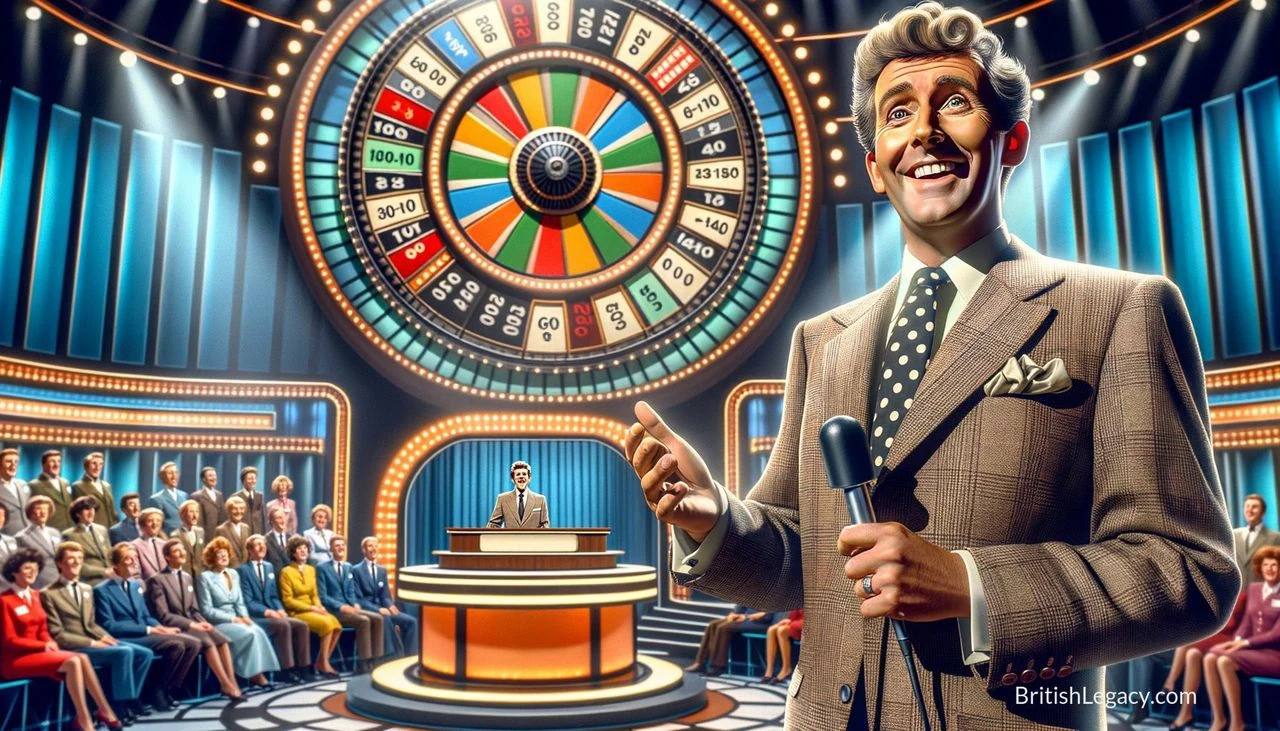
Noel Edmonds made live radio and Saturday-night television feel like events. His career moved from Radio Luxembourg and BBC Radio 1 to children’s programmes, light entertainment and the long-running game show Deal or No Deal. Noel’s House Party, with its elaborate pranks and the arrival of Mr Blobby, became his defining television success; the quieter persistence of his broadcasting career is visible in the programmes that came before and after it.
From radio to children’s television
Born in Ilford, Essex, on 22 December 1948, Noel Ernest Edmonds began in broadcasting as a newsreader on Radio Luxembourg in 1968. He had sent recordings to offshore radio stations. The following year he joined BBC Radio 1, first recording trails and filling in for other presenters, then taking on his own programmes. In June 1973 he became presenter of the Radio 1 Breakfast Show, a role he held until April 1978. He later presented other programmes for the station and left in 1983, with brief returns in 1985 and 1992.
Television soon became a parallel strand of his work. Edmonds presented Top of the Pops at intervals between 1972 and 1978, and hosted the Saturday-morning children’s programme Multi-Coloured Swap Shop from 1976 to 1982. He also appeared on programmes including Top Gear and Telly Addicts, and in 1981 recorded the single “I Wanna Be a Winner” with Swap Shop colleagues Maggie Philbin and Keith Chegwin as Brown Sauce. It reached number 15 in the UK singles chart.
His first Saturday-evening light-entertainment show for the BBC was The Late Late Breakfast Show, broadcast live from 1982 to 1986. The programme’s “Give it a Whirl” slot involved viewers attempting stunts. In 1986, Michael Lush died during rehearsals for a bungee jump after a clip holding the rope failed. Edmonds resigned from the BBC, and the programme was cancelled. It is a grave episode in the history of a show otherwise built around spectacle, and belongs in any account of how that spectacle was made.
Building the Saturday-night shows
Edmonds returned to Saturday evenings with Noel’s Saturday Roadshow, which ran from 1988 to 1990. Its premise was that each edition came from a different location, represented by a specially dressed studio set. The programme developed features that would reappear in Noel’s House Party, including the Gunge Tank, Gotcha Oscars and Wait ’Til I Get You Home.
Noel’s House Party began in 1991 and ran until 1999. Broadcast from Edmonds’s mansion in the fictional village of Crinkley Bottom, it mixed studio entertainment with filmed pranks and recurring features. In “NTV”, hidden cameras recorded people in their homes; the “Gotchas” placed celebrities in elaborate set-ups. Mr Blobby first appeared in a Gotcha segment before becoming a regular character. The pink-and-yellow-spotted figure became one of the show’s most recognisable creations and had a Christmas number one in 1993.
At its peak, House Party drew audiences of 15 million. Its popularity later fell, alongside a broader decline in traditional Saturday-night television audiences, and the final edition aired on 20 March 1999. The format helps explain Edmonds’s particular place in British entertainment: it brought studio comedy, audience participation and practical jokes together in a weekly family programme, with characters and features that travelled beyond the broadcast itself.
Edmonds also presented Noel’s Christmas Presents, in which people received gifts such as trips for ill or disadvantaged children and family reunions. The BBC broadcast the programme on Christmas Day from 1989 to 1999, apart from 1992. It later returned in a series of Sky One specials. Alongside his presenting, Edmonds owned the format for Telly Addicts, a television quiz that ran from 1985 to 1998 and tested contestants on programmes past and present.
A return with Deal or No Deal
After a break from television presenting, Edmonds returned in 2005 to host Channel 4’s Deal or No Deal. He initially expected to make a short run of 66 programmes. The UK series began transmission on 31 October and continued for 11 years, with almost 3,000 shows recorded and more than £40 million given away. Its format placed contestants and a set of sealed boxes at the centre of a repeated decision: whether to accept the banker’s offer or continue playing.
The programme became one of Edmonds’s best-known roles, and he was nominated for a BAFTA Television Award for his work on it in 2006. The series ended by mutual agreement between Edmonds and Channel 4 in 2016. Its last programmes were recorded at striking locations, including the Flying Scotsman, Blackpool Tower and a cave in Somerset. Edmonds also hosted the UK version of Are You Smarter than a 10 Year Old? for Sky, and in 2017 presented Cheap Cheap Cheap, a game show he devised.
His wider television work included presenting major events such as the BAFTA Awards, the Brit Awards and the launch of the National Lottery. During Live Aid in 1985, he transported performers by helicopter between locations and introduced Sting and Phil Collins at Wembley Stadium. Edmonds also continued to work in radio: in 2003 he covered the BBC Radio 2 drivetime programme for eight weeks, and in 2020 set up an online radio network in New Zealand called Positivity Radio.
Production, business and life beyond the studio
Edmonds established the Unique Group in 1985, bringing together a range of business interests. Its broadcasting arm produced audio programmes for the BBC and independent radio, and the group had interests in radio stations and other ventures. Edmonds resigned as a non-executive director of Unique Broadcasting Company Media Group in 2006. The group’s collapse in 2005 became a major dispute with Lloyds Banking Group over alleged fraud involving staff at HBOS’s Reading branch. In 2019, Edmonds agreed a compensation deal with Lloyds, which apologised for the distress he had suffered.
His plans also extended to attractions based on Crinkley Bottom and Mr Blobby. Attractions opened at existing parks in Somerset and Lowestoft, while a separate project in Morecambe ended amid disappointing visitor numbers and disputes with the local council. A district auditor found that the council had acted unlawfully in its dealings with Edmonds, and the controversy became known in the media as “Blobbygate”. The ventures show a side of his career beyond presenting: characters and formats could be turned into commercial projects, but those projects did not always endure.
Edmonds married Liz Davies in 2009. After the BBC years and his long run on Channel 4, he and Davies moved to New Zealand in 2019. In 2020 he established Positivity Radio, an online network that the Wikipedia account describes as comprising 100 community radio stations. His work has ranged from programmes made for a British national audience to this later broadcasting venture abroad; the defining chapters of his public career, however, were made in British radio and television.
Why Noel Edmonds deserves a place in British Legacy
Noel Edmonds deserves a place in British Legacy because his career captures several distinct eras of British broadcasting. He moved from Radio 1 to children’s television, then helped shape Saturday-night light entertainment through The Late Late Breakfast Show, the Saturday Roadshow and Noel’s House Party. House Party’s scale—15 million viewers at its peak—and its mixture of studio entertainment, hidden-camera features and celebrity pranks made it more than a presenter’s vehicle. Mr Blobby, first introduced within a programme feature, became a character with a life beyond the show. Edmonds’s work with Telly Addicts and Noel’s Christmas Presents further shows the range of formats he fronted over many years.
His return with Deal or No Deal gave a new generation of viewers a different kind of Edmonds: a presenter presiding over repeated choices and suspense rather than the broad comic disorder of House Party. Eleven years on Channel 4, thousands of recorded editions and more than £40 million awarded to contestants mark the programme’s substantial run. His career also provides a fuller picture than a succession of television hits alone. It included radio presenting, programme and format ownership, production businesses and ventures built around television characters. The mixed results of those ventures are part of the record, as is the tragedy during The Late Late Breakfast Show. Remembering both achievement and consequence makes his place in British broadcasting history more useful and more honest than celebration without context.
Sources
Noel Edmonds — Wikipedia, revision 1377651275
Adapted in part from Noel Edmonds by Wikipedia contributors, under CC BY-SA 4.0. Text has been edited and combined with the existing article; this adapted text is shared under the same licence. Contributor history.