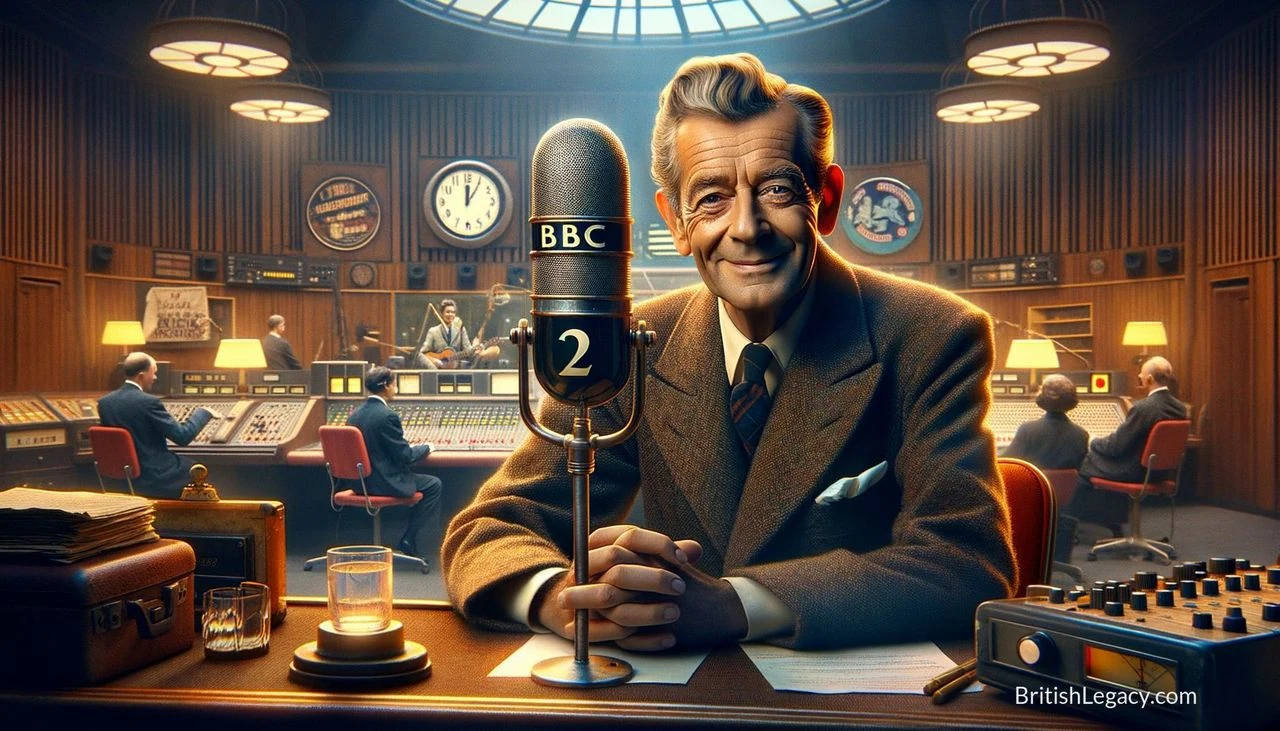
For millions of listeners, Terry Wogan was part of the morning routine: a familiar voice, apparently at ease with a song, a newsreader or a listener’s joke. His long BBC career also encompassed television chat shows, Eurovision commentary and Children in Need. Born in Limerick, he remained Irish by birth and identity while becoming one of the most recognisable broadcasters in Britain, later taking British citizenship as well as retaining his Irish nationality.
From Limerick to the microphone
Michael Terence Wogan was born in Limerick on 3 August 1938. His father managed a grocery store, and Wogan attended Crescent College, a Jesuit school. When he was 15, his family moved to Dublin; there he attended Belvedere College, took part in amateur dramatics and developed a love of rock and roll. After leaving school in 1956, he worked briefly in banking.
Wogan joined Ireland’s national broadcaster, Raidió Teilifís Éireann (RTÉ), in his early twenties, after responding to a newspaper advertisement. He began as a newsreader and announcer, then presented documentary features and interviews before moving into light entertainment. He became a disc jockey and hosted television quiz and variety programmes, including Jackpot, a popular RTÉ quiz show in the 1960s.
His first BBC broadcasts came while he was still working from Dublin. He began broadcasting on the BBC Light Programme in September 1966 and later commuted to London to present radio programmes. From 1969, he had a weekday afternoon slot, first on Radio 1 and subsequently also on Radio 2. In April 1972, he took over Radio 2’s breakfast show. His career was therefore not a sudden move from Ireland to an established British platform: it developed across RTÉ and the BBC, with the radio providing a route into a much wider British audience.
Making the breakfast show his own
Wogan’s first Radio 2 breakfast stint ran from 1972 to 1984. In 1984 he left the programme to concentrate on television, but returned to Radio 2 in 1993. The new show, Wake Up to Wogan, gave his broadcasting persona room to develop: he could wander into an apparently tangential thought, exchange jokes with his producer Paul Walters and let listeners’ letters and emails become part of the entertainment.
The programme’s audience reached an estimated eight million. Wogan joked that his fans were “TOGs”, a name that stood for “Terry’s Old Geezers” or “Terry’s Old Gals”; he also invented “TYGs” for younger listeners. The affectionate shorthand reflected the informal relationship he built with his audience, but the programme’s reach was not limited to a single age group. His delivery was conversational without sounding unprepared, and the humour often depended on the contrast between his measured voice and the absurdity of the material.
Listeners contributed to the show’s running jokes and characters, including the “Janet and John” stories, read by Wogan and John Marsh, and exchanges with Welsh traffic reporter Lynn Bowles. Six CDs and two books of the stories raised more than £4 million for Children in Need. Wogan also repeatedly played Katie Melua’s first single, “The Closest Thing to Crazy”; he credited Walters with discovering her. His final breakfast show was broadcast on 18 December 2009, when Chris Evans took over.
Wogan returned to Radio 2 in 2010 with Weekend Wogan, a Sunday programme featuring guests and live music. He continued until his final broadcast on Remembrance Sunday 2015, when declining health prevented him from carrying on. Across the two breakfast-show periods and his later Sunday programme, radio remained the medium in which his particular combination of understatement, music and listener participation was most at home.
Television, Eurovision and public performance
Wogan’s television career ran alongside his radio work. He first appeared on British television in 1972, and went on to present the game show Blankety Blank from 1979 to 1983. His television chat show, Wogan, began in 1982 and continued until 1992, moving from Saturday evenings to a weekday slot. It brought a different aspect of his style to the fore: he could let a guest speak, but was also ready with a dry response when an interview took an unexpected turn.
He became closely associated with the Eurovision Song Contest. Wogan provided BBC radio commentary in 1971 and from 1974 to 1977, and television commentary in 1973, 1978 and every year from 1980 to 2008. In 1998, he co-hosted the contest in Birmingham with Ulrika Jonsson while also providing commentary. His deadpan remarks became part of the British television experience of Eurovision, though their sharpness could draw criticism. After the 2008 contest, he stepped down from the commentary role; Graham Norton succeeded him the following year.
His other television work included presenting Auntie’s Bloomers, a compilation of broadcasting mishaps, and the long-running audience programme Points of View. In 2015, he also presented Terry and Mason’s Great Food Trip, travelling around Britain with cab driver Mason McQueen to explore regional food. The range of formats shows how he moved between live events, interviews, entertainment and audience-led programmes without relying on a single on-screen role.
Children in Need and public service
Wogan was one of the regular presenters of the BBC’s Children in Need telethon from its launch in 1980. He appeared alongside Sue Lawley and Esther Rantzen in the first appeal and became its best-known long-term presenter. He campaigned for the charity on television and radio, including through auctions on his breakfast show and sponsored activities. He was a regular presenter through 2014; poor health meant he could not take part in the live 2015 appeal, although he appeared briefly in a pre-recorded item.
His charity work also included music. In 2008, he and Aled Jones released “Little Drummer Boy” and “Peace on Earth” for Children in Need; the single reached number three in the UK charts. A second Christmas single, “Silver Bells”, followed in 2009, again in aid of the charity. The fundraising work connected his broadcasting with a practical public purpose: his familiar presence helped draw attention to the appeal, while radio features and recordings provided other ways for audiences to contribute.
Wogan’s Children in Need appearances were reported to attract a fee from the BBC. He said that he had not asked for one and would have presented without payment, and that he donated his BBC fees to the charity. The BBC said the fee came from its own resources rather than the Children in Need fund. His role was not simply a recurring television appearance: he used several parts of his broadcasting career to support the appeal.
Honours, citizenship and final years
Wogan was appointed an honorary Officer of the Order of the British Empire in 1997 and received an honorary knighthood in 2005. That year, he acquired British citizenship while retaining his Irish nationality. He was knighted in October 2005 and became Sir Terry. The honours recognised his work in broadcasting, while his continuing connection to Ireland remained part of his public identity.
He was appointed a Deputy Lieutenant of Buckinghamshire in 2007. His other honours included the Freedom of the City of Limerick, an honorary degree from the University of Limerick and an honorary degree from the University of Leicester. In 2009, he was inducted into the Radio Academy Hall of Fame. Radio 2 listeners had also voted him the station’s “Ultimate Icon” in a poll marking its 40th birthday.
Wogan married Helen Joyce in 1965; they had four children, one of whom died in infancy, and five grandchildren. He lived in Taplow, Buckinghamshire, and also had a home in Gascony. His final radio broadcast was on 8 November 2015. He died at home on 31 January 2016, aged 77, after being diagnosed with advanced prostate cancer. A memorial service was held at Westminster Abbey later that year. The BBC renamed its Western House building, then home to Radio 2, Wogan House in his memory.
Why Terry Wogan deserves a place in British Legacy
Wogan’s place in British broadcasting rests on more than the length of his BBC career. On Radio 2, he helped make the breakfast programme feel like a conversation shared with listeners: the audience supplied names, letters and jokes, while his timing and restraint gave those contributions room to land. The estimated audience of eight million for Wake Up to Wogan indicates the scale of that relationship. His later return with Weekend Wogan extended it beyond the weekday routine, and his work in television demonstrated an ability to adapt from chat shows and game shows to live international events.
His British legacy is also specifically connected to public service. As a regular face of Children in Need for decades, Wogan helped make an annual appeal a familiar fixture, and he used his radio programme, fundraising stories and recordings to support it. The millions raised by the “Janet and John” books and CDs, as well as the proceeds of his singles with Aled Jones, give that contribution a concrete dimension. His life also complicates any simple national label: he was born and educated in Ireland, built a career across RTÉ and the BBC, and later held both Irish and British citizenship. Remembering him in British Legacy means recognising both the broadcaster who became part of daily life in Britain and the Irish identity he continued to acknowledge.
Sources
Terry Wogan, revision 1376631145
Adapted in part from Terry Wogan by Wikipedia contributors, under CC BY-SA 4.0. Text has been edited and combined with the existing article; this adapted text is shared under the same licence. Contributor history.