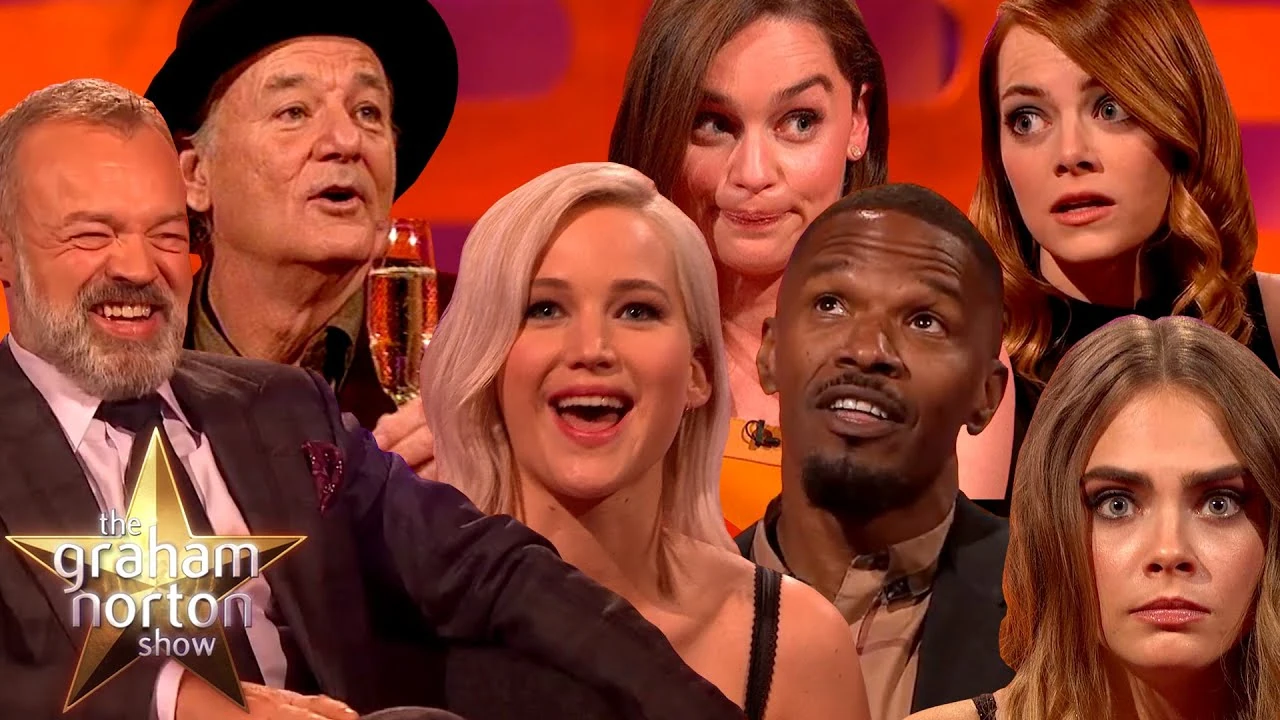
Graham Norton’s most recognisable television setting is a red sofa shared by a group of guests. Since 2007, The Graham Norton Show has made the celebrity interview an ensemble event: Norton guides the conversation, guests respond to one another, and humour sits alongside discussion of their work. The format has its roots in the chat shows he made for Channel 4, but it is only one strand of a career spanning television, radio, live events and writing.
From County Cork to London stages
Born Graham William Walker on 4 April 1963 in Clondalkin, County Dublin, Norton grew up in Ireland and settled with his family in Bandon, County Cork. He attended Bandon Grammar School and began studying English and French at University College Cork in 1981. He later stopped his studies and, in the late 1980s, moved to London to attend the Central School of Speech and Drama. When he joined the actors’ union Equity, he took Norton, his great-grandmother’s maiden name, as his professional surname.
His early work brought performance and comedy together. In 1992, a stand-up appearance at the Edinburgh Festival Fringe, in which he performed as Mother Teresa, attracted press attention after a religious-affairs department mistakenly thought the act represented the real figure. In the early 1990s he also became a regular comedian and panellist on BBC Radio 4’s Loose Ends. The appearances helped establish a comic, character-led style before he began hosting his own television programmes.
Norton’s early career crossed broadcasters and formats. He appeared on Channel 5 as a stand-in talk-show host, then presented its comic quiz Bring Me the Head of Light Entertainment. In 1996, he co-hosted ITV’s late-night quiz Carnal Knowledge with Maria McErlane. Between 1996 and 1998, he played Father Noel Furlong in three episodes of Channel 4’s Father Ted, a supporting role that brought him to a different television audience.
Channel 4 and a comic presenting style
In 1998, Norton moved to Channel 4 to present So Graham Norton, a weekly chat show that ran until 2002. The daily weeknight programme V Graham Norton followed from 2002 to 2003. These shows gave him room to develop a fast, mischievous style: an interest in celebrity, an eye for comic detail and a willingness to let conversation move beyond the conventional interview.
His presenting work was not confined to late-night chat. Norton hosted Comic Relief on BBC One in 2001. After moving to the BBC in 2005, he presented the Saturday-evening reality series Strictly Dance Fever and the comedy chat show Graham Norton’s Bigger Picture. He also became the host of talent competitions linked to West End productions: How Do You Solve a Problem like Maria? in 2006, Any Dream Will Do in 2007, I’d Do Anything in 2008 and Over the Rainbow in 2010. Together, these programmes show the range of his work as a presenter, beyond the late-night persona that first made his name.
The making of the red-sofa show
The Graham Norton Show began on BBC Two on 22 February 2007, in a format similar to his earlier chat shows. It moved to BBC One in October 2009, with a new one-hour format. The shared sofa is central to its approach: instead of separating guests into a series of isolated interviews, the programme lets stories and reactions pass between them. Norton’s role is to keep those exchanges moving, with questions and jokes that help make the group conversation the event.
The show became the best-known strand of his television work, while Norton continued to take on other roles. He hosted the British Academy Television Awards on multiple occasions, including from 2007 to 2011, from 2013 to 2016 and in 2019. He became a judge on RuPaul’s Drag Race UK in 2019, joining a competition format as well as his established work in chat and live entertainment.
His achievements have been recognised by the British Academy Television Awards. Norton has won Best Entertainment Performance six times, a record, and has an additional BAFTA win for producing. Other recognition includes the Royal Television Society’s Best Presenter award in 2001 and the National Television Awards’ Special Recognition Award in 2017. In 2012, he sold his production company, So Television, to ITV for around £17 million.
Radio, Eurovision and books
Radio has been a substantial part of Norton’s career. From 1999, he appeared regularly on BBC Radio 4’s panel show Just a Minute. On 2 October 2010, he took over BBC Radio 2’s Saturday-morning slot, presenting it for a decade with Maria McErlane. The programme included “Grill Graham”, in which McErlane featured as an agony aunt, and “Tune with a Tale”, where listeners suggested songs by summarising their stories. Norton’s final Saturday show aired on 19 December 2020. He joined Virgin Radio UK in January 2021 to host weekend programmes and announced in February 2024 that he would leave the role.
His Eurovision work joined comic commentary to a major annual broadcast. Norton and Claudia Winkleman co-hosted the Eurovision Dance Contest in London in 2007 and Glasgow in 2008. In 2009, he took over from Terry Wogan as the BBC’s television commentator for the Eurovision Song Contest. In 2023, when Liverpool hosted the contest, Norton co-hosted the final with Alesha Dixon, Hannah Waddingham and Julia Sanina, while sharing the commentary with Mel Giedroyc.
Writing has given Norton another route to an audience. He wrote an advice column for The Daily Telegraph from 2006 to 2018; the columns were collected in Ask Graham, published in 2010. His memoir The Life and Loves of a He-Devil appeared in 2014 and won the Irish Book Award for Non-Fiction Book of the Year. His first novel, Holding, published in 2016, follows a murder in an Irish rural community. It won Popular Fiction Book of the Year at the Irish Book Awards, and an ITV adaptation aired in 2022. His other novels include A Keeper, Home Stretch, Forever Home and Frankie.
Why Graham Norton deserves a place in British Legacy
Norton’s place in British Legacy rests on a substantial career in British broadcasting, not on a claim that he is British by birth. He is Irish, and the bulk of his television career has been in the UK. From his Channel 4 chat shows to the BBC programme that bears his name, he has helped make the shared celebrity conversation a recognisable television format: a host, a group of guests and an exchange shaped as much by their interaction as by a list of prepared questions. The show’s long run, alongside his work on talent competitions, award ceremonies and RuPaul’s Drag Race UK, demonstrates his reach across different parts of British television.
His contribution also extends beyond the television studio. A decade presenting BBC Radio 2’s Saturday-morning programme took his work to radio listeners; his Eurovision commentary has become part of the BBC’s annual coverage of the contest; and his writing has found readers in advice, memoir and fiction. Each strand reflects a different kind of communication, from the live pace of broadcast entertainment to the sustained narrative of a novel. Taken together, they show a broadcaster with unusual range and staying power, whose work has helped shape popular entertainment in the UK. That specific, continuing connection to British television, radio and major live broadcasts is the basis for his place in British Legacy.
Sources
Graham Norton — Wikipedia, revision 1379661945
Adapted in part from Graham Norton by Wikipedia contributors, under CC BY-SA 4.0. Text has been edited and combined with the existing article; this adapted text is shared under the same licence. Contributor history.