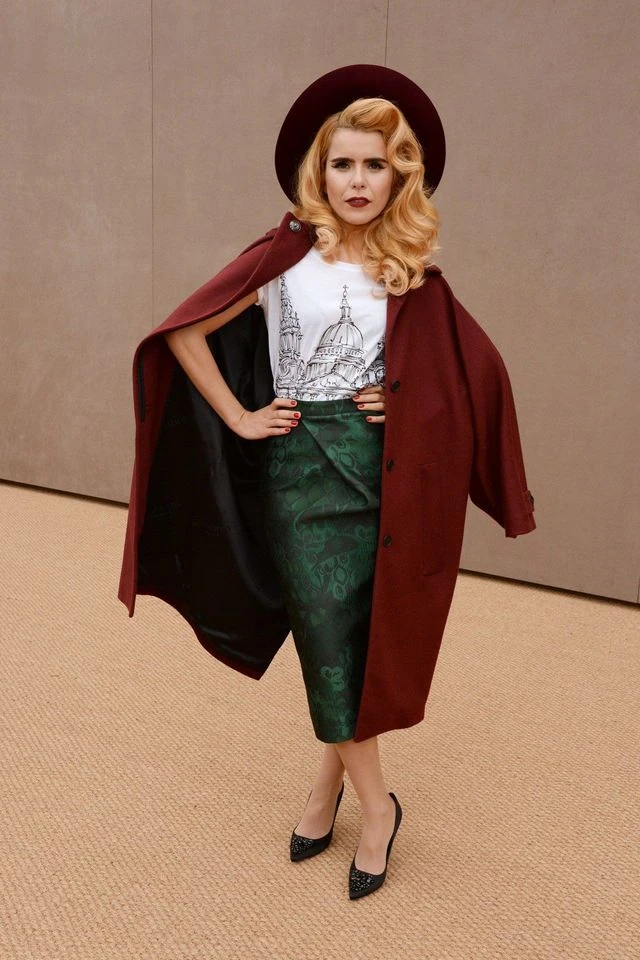
Paloma Faith’s route to British pop was not a straight line. Before her first album, she studied dance and theatre, worked a succession of jobs and performed with a pub band. She made her recording breakthrough in 2009 with a sound drawing on soul and jazz, and a recognisable stage persona shaped by retro style and theatrical flair. Since then, her career has encompassed chart-topping albums, acting roles and television presenting and judging.
From Hackney to the stage
Born Paloma Faith Blomfield on 21 July 1981 in Hackney, London, she was raised by her mother in Stoke Newington after her parents separated. Her mother was English and her father Spanish; both parents had been raised in Norfolk. As a child, Faith took ballet classes in Dalston. She completed her A-levels at City and Islington College before studying contemporary dance at the Northern School of Contemporary Dance in Leeds.
While studying, she worked as a hip-hop dancer at the Leeds nightclub LoveDough. She later took an MA in theatre directing at Central Saint Martins College of Art and Design. Her other jobs included working as a sales assistant, bartender and life model, singing in a burlesque cabaret and assisting a magician. During her time at college, a pub manager asked her to front his band; it became Paloma and the Penetrators.
Faith’s early musical performances drew on soul and jazz singers including Etta James and Billie Holiday. In 2007, she met managers Jamie Binns and Christian Wåhlberg after a producer who had worked with her recommended her. An audition for Epic Records did not go smoothly: Faith walked out after asking the label manager to turn off his phone. He later offered her a contract. She chose to write and perform her own songs rather than join Amy Winehouse’s band. In 2008, she recorded “It’s Christmas (and I Hate You)”, a duet with Josh Weller.
A breakthrough built song by song
Faith signed with Epic Records in 2008. Her first single, “Stone Cold Sober”, reached number 17 in the UK in June 2009; “New York” reached number 15 that September. Both were among her early chart successes, rather than number-one singles. Her debut album, Do You Want the Truth or Something Beautiful?, followed in September. Faith wrote or co-wrote all its songs. The album entered the UK chart at number 14 and later peaked at number nine. Its mix of pop, soul, R&B and jazz gave her a setting for a voice and performance style that resisted a single genre label.
In 2010, Faith began her first headline tour of the UK and Ireland and appeared at festivals including the Cheltenham Jazz Festival and the iTunes Festival. She also sang “Keep Moving” with Adam Deacon and Bashy for the British film 4.3.2.1. The following year, she received a BRIT Award nomination for British Female Solo Artist.
Her second album, Fall to Grace, arrived in 2012 and reached number two in the UK. “Picking Up the Pieces” became her first top-ten single, peaking at number seven. The album also included her version of INXS’s “Never Tear Us Apart”, recorded for a John Lewis television advertisement. Faith received two BRIT nominations in 2013, for British Female Solo Artist and British Album of the Year. The album was later certified double platinum by the British Phonographic Industry.
A Perfect Contradiction, released in 2014, also reached number two in the UK and was certified double platinum. Its singles included “Can’t Rely on You”, produced by Pharrell Williams, and “Only Love Can Hurt Like This”. The latter reached number six in the UK and topped the charts in Australia. Faith’s collaboration with drum-and-bass duo Sigma, “Changing”, reached number one in the UK singles chart in September 2014. At the 2015 BRIT Awards, she won British Female Solo Artist.
In November 2017, The Architect debuted at number one in the UK, giving Faith her first chart-topping album there. Her later studio albums continued to reach the UK top five: Infinite Things in 2020 and The Glorification of Sadness in 2024. The latter was announced alongside a nationwide tour and drew inspiration from the end of her long-term relationship. Across these releases, Faith has moved between soul, pop, R&B, disco and jazz, while remaining closely identified with her own theatrical approach.
Acting, television and a distinctive style
Acting was part of Faith’s career before her records brought her wider recognition. She appeared in the BBC police drama HolbyBlue in 2007 and played Andrea in the film St Trinian’s that year. Her film work also includes Terry Gilliam’s The Imaginarium of Doctor Parnassus and the horror film Dread, both released in 2009. Later roles included Georgia in the BBC’s 2013 adaptation of P. G. Wodehouse’s Blandings, and Tinker Bell in the television film Peter & Wendy in 2015.
Faith played Bet Sykes in the television series Pennyworth from 2019 to 2022, and voiced Portia Poodle in the animated series 101 Dalmatian Street. She also appeared as herself in Paolo Sorrentino’s film Youth. Her television work has included coaching on The Voice UK in 2016 and on its children’s spin-off, The Voice Kids UK, in 2020. In 2025, she was a contestant on the first series of The Celebrity Traitors.
Faith is known for a retro and eccentric style, alongside a vocal approach that draws on soul and elements of jazz and gospel. Her public identity brings music and presentation together: the clothes and theatricality are part of the performance, not a separate footnote to it. In 2024, she published MILF, a memoir focused on motherhood and womanhood; it became a Sunday Times bestseller. In 2025, she launched the podcast Mad, Sad & Bad.
Public voice and later work
Faith’s public activity has included specific political and charitable work. In March 2024, she signed an Oxfam letter calling for an end to UK arms exports to Israel. That December, she took part in a benefit concert that raised more than £115,000 for Medical Aid for Palestinians. In March 2025, she spoke at a protest against Israeli attacks on Gaza. These documented appearances show her using her public platform to address political questions; they are more concrete evidence of that engagement than broad claims about causes she supports.
Her career has also brought recognition beyond the charts. In 2023, she won the British LGBT Awards’ Advocacy award. Her musical work has included a contribution to Band Aid 30, the 2014 charity recording made to raise money for the Ebola crisis in West Africa. Alongside solo albums and tours, she has continued to move between recorded music, screen roles and television work, making a career that is not confined to one format.
Why Paloma Faith deserves a place in British Legacy
Paloma Faith belongs in British Legacy because her career offers a substantial, specifically British record of achievement in popular music. Her albums have repeatedly reached the top of the UK chart: The Architect became her first number-one album, while Fall to Grace, A Perfect Contradiction, Infinite Things and The Glorification of Sadness all reached the top five. “Changing”, her collaboration with Sigma, topped the UK singles chart, and she won the BRIT Award for British Female Solo Artist in 2015. Those milestones describe both individual success and sustained work across more than a decade.
Her contribution is not limited to chart positions. Faith’s background in dance and theatre, her acting roles and her work as a television coach show how a contemporary performer can build a public career across several forms. Her distinctive retro style is part of that identity, while songs such as “Only Love Can Hurt Like This” demonstrate the reach of her music beyond the UK. The evidence also supports a public role beyond entertainment: she has participated in a fundraising concert for Medical Aid for Palestinians, spoken at a protest and received an advocacy award from the British LGBT Awards. Taken together, these achievements make her a relevant subject for a British cultural collection: a London-born artist whose recorded work, performances and public activity have all left a recognisable mark.
Sources
Adapted in part from Paloma Faith by Wikipedia contributors, under CC BY-SA 4.0. Text has been edited and combined with the existing article; this adapted text is shared under the same licence. Contributor history.