Freddie Mercury brought an unusual range of talents to Queen: a distinctive singing voice, a gift for writing songs that crossed musical boundaries, and a theatrical command of the stage. Born Farrokh Bulsara in Zanzibar, he moved with his family to England as a teenager. His journey from Middlesex art student to the frontman of one of Britain’s best-known rock bands gives his story a distinctly British chapter, while his music reached audiences far beyond the country.
From Zanzibar to Queen
Mercury was born on 5 September 1946 in Stone Town, Zanzibar, to Bomi and Jer Bulsara, members of the Parsi community whose family origins were in western India. He spent much of his childhood in India, where he began piano lessons and attended St Peter’s School, a British-style boarding school near Bombay. There, at 12, he formed a band called the Hectics with fellow pupils. He later returned to Zanzibar, but the family fled the violence of the 1964 revolution and settled in Middlesex, England.
In England, Mercury studied first at Isleworth Polytechnic and then graphic art and design at Ealing Art College, graduating in 1969. Before Queen, he joined bands including Ibex, later renamed Wreckage, and Sour Milk Sea. In April 1970 he joined guitarist Brian May and drummer Roger Taylor in their band Smile. Bassist John Deacon joined in 1971, and the group became Queen. Mercury chose the band’s name and changed his surname from Bulsara to Mercury. He also designed Queen’s crest, drawing on the zodiac signs of the four members.
Songs made for the stage
Mercury’s songwriting ranged from intricate, multi-part construction to direct, concise rock and roll. Among the Queen songs he wrote were “Killer Queen”, “Bohemian Rhapsody”, “Somebody to Love”, “We Are the Champions”, “Don’t Stop Me Now” and “Crazy Little Thing Called Love”. The contrast between the elaborate sections of “Bohemian Rhapsody” and the few chords of “Crazy Little Thing Called Love” illustrates the breadth of his approach. He often composed at the piano, though he said he could barely read music.
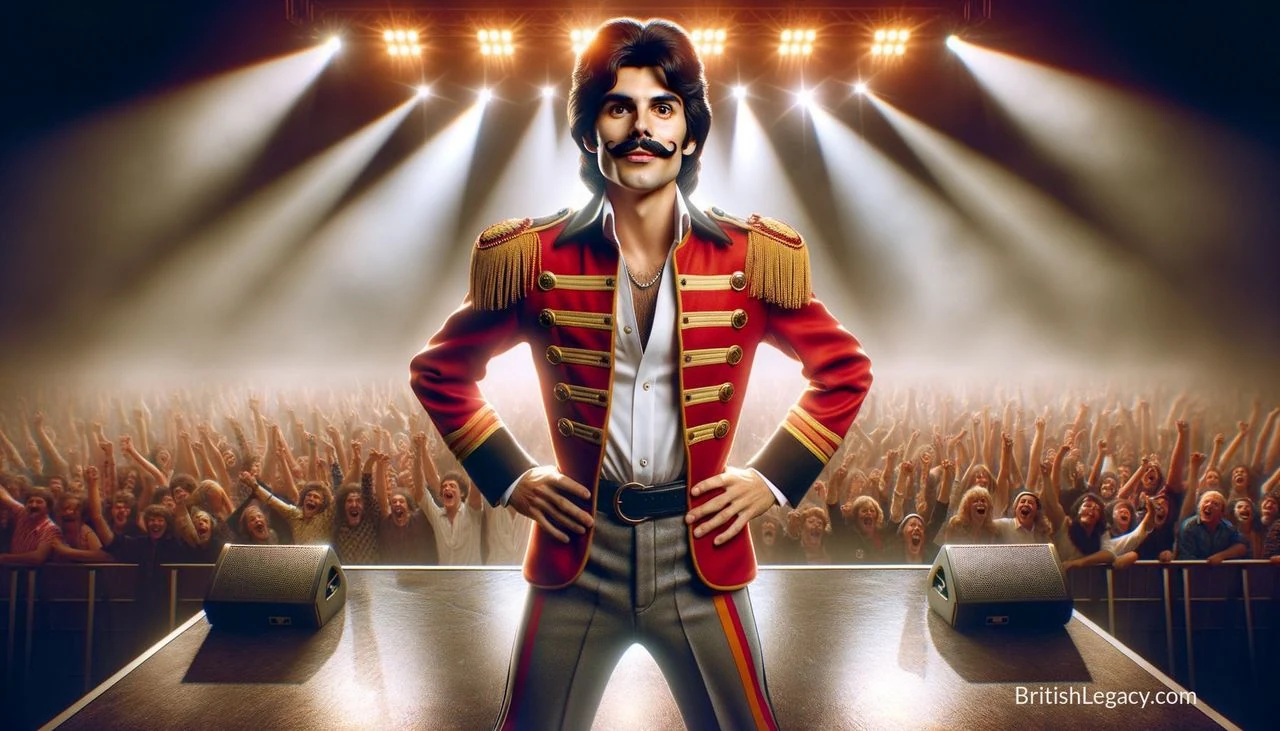
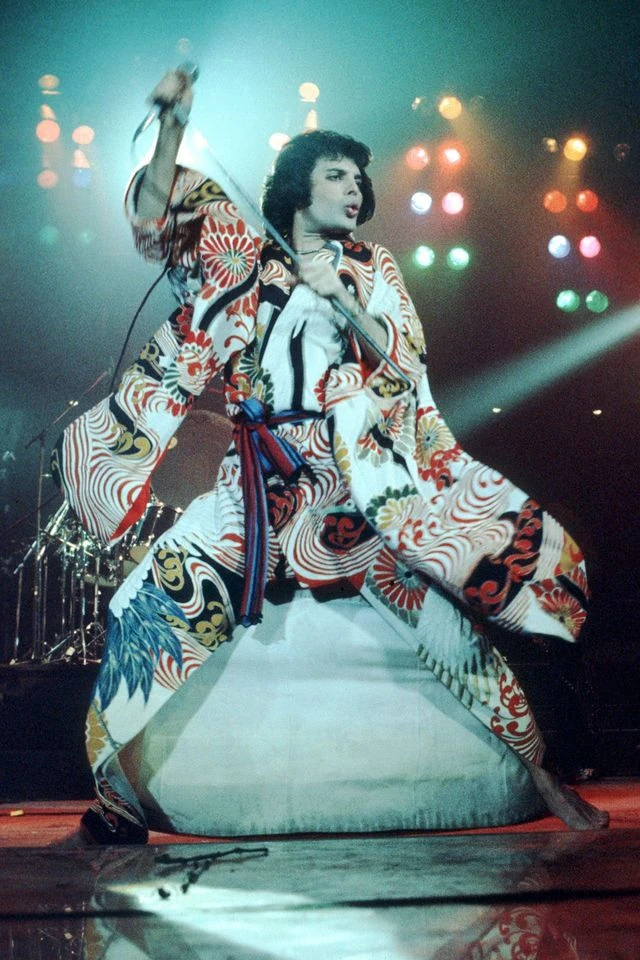
His speaking voice naturally fell in the baritone range, while he sang much of Queen’s material in the tenor range. The original account describes his range as four octaves; the Wikipedia article likewise characterises it as four-octave, while giving a more specific range. His performance style made that voice part of a larger spectacle. Mercury worked a crowd with theatrical gestures and costume, turning the conventions of a rock frontman into something more expansive. At Queen’s 1985 Live Aid performance, his exchanges with the audience helped make a stadium-scale set feel participatory. The band’s final live performance with him took place at Knebworth Park in August 1986.
Mercury’s work was not confined to Queen. He released two solo albums, Mr. Bad Guy (1985) and Barcelona (1988), the latter recorded with soprano Montserrat Caballé. He also performed on recordings and worked with other artists. His career therefore joined an unmistakable role within a band to an independent interest in different musical settings.
Private life, illness and final recordings
Mercury’s stage persona was not a straightforward guide to his private character. The Wikipedia account describes him as shy and retiring away from performance, and records a long relationship and enduring friendship with Mary Austin, followed by a relationship with Jim Hutton. Public descriptions of his sexuality have varied; rather than reducing that complexity to a single label, it is more accurate to recognise that he did not publicly define himself in the way the imported account suggests. His flamboyance on stage became a point of identification for many fans, but it should not be mistaken for a complete account of his private life.
Mercury was diagnosed with AIDS in 1987. He continued recording with Queen, sometimes working in short sessions as his health declined. On 23 November 1991, he publicly confirmed that he had AIDS; he died at his Kensington home the following day, aged 45. The cause was bronchial pneumonia resulting from AIDS. Queen’s album Made in Heaven, released in 1995, included his final recordings and was dedicated to his memory.
In April 1992, Queen’s remaining members established the Mercury Phoenix Trust and organised a tribute concert at Wembley Stadium to raise money for AIDS research and awareness. The event brought together performers from across rock and popular music and was broadcast internationally. It linked remembrance of Mercury with a practical response to the disease that had taken his life.
A continuing British presence
Mercury’s connection with Britain is rooted in more than Queen’s international success. His family made its home in England after leaving Zanzibar; he studied in Middlesex and west London, and Queen formed in London from musicians who would become central to his career. In 1990, he and the other band members received the Brit Award for Outstanding Contribution to British Music. He received the award individually after his death in 1992. Queen’s songs and performances became part of British popular culture, while Mercury’s story remained connected to the places where he had settled and worked.
That connection has been marked in public memorials. A Royal Mail Millennium Stamp showed Mercury on stage. In 2009, a star commemorating his achievements was unveiled in Feltham, where his family had settled after arriving in England. English Heritage unveiled a blue plaque at his former home at 22 Gladstone Avenue in Feltham in 2016. The same year, an asteroid was named after him. Such tributes sit alongside the continuing life of the music: Queen’s final studio album with Mercury’s recordings, public commemorations, and the 2018 film Bohemian Rhapsody, which brought his story to another generation, though the film was also criticised for historical inaccuracies.
Why Freddie Mercury deserves a place in British Legacy
Mercury deserves a place in British Legacy because his career joined artistic invention to a formative story of migration and settlement in England. Born in Zanzibar and educated in India, he came to Middlesex with his family in 1964. In London he studied graphic design, joined the musicians who became Queen, helped define the band’s name and image, and wrote songs that remain among its best-known work. His path cannot be reduced to a simple story of British birth, but his contribution to British music was made through a life and career established in England.
His achievements also changed what a rock performance could contain. Mercury combined vocal control, piano-led songwriting, visual drama and direct engagement with audiences; at Live Aid, those elements made Queen’s performance an event that extended beyond the stage. His songs moved between complex structures and accessible anthems, while his solo work with Montserrat Caballé showed an appetite for musical exchange. The awards, Feltham plaque and other memorials record a public legacy, but the Mercury Phoenix Trust adds a more practical one: a continuing effort to fund AIDS-related causes in response to the illness that killed him. Together, these achievements explain his lasting significance to British music and its international reach.
Sources
Freddie Mercury — Wikipedia revision 1379651217 · Freddie Mercury — Wikipedia
Adapted in part from Freddie Mercury by Wikipedia contributors, under CC BY-SA 4.0. Text has been edited and combined with the existing article; this adapted text is shared under the same licence. Contributor history.