
Vivienne Westwood helped carry punk from the streets and a small Kings Road shop into the history of British fashion. Working with Malcolm McLaren, she made clothes that disrupted expectations of taste and gender, while later collections drew on historical dress, textiles and tailoring. Her career moved between rebellion and research: from provocative T-shirts and bondage trousers to the mini-crini, Harris Tweed and academic gowns. She also used her public platform to campaign on civil liberties and the environment.
From teaching to the Kings Road
Westwood was born Vivienne Isabel Swire on 8 April 1941 in Hollingworth, Cheshire, and grew up in nearby Tintwistle. Her family moved to Harrow in 1958. She briefly studied jewellery and silversmithing at Harrow Art School, then left, later explaining that she could not see how a working-class girl like her could make a living in the art world. After work in a factory and teacher training, she became a primary-school teacher. She also made jewellery and sold it at a stall on Portobello Road.
In 1962 she married Derek Westwood, and their son Benjamin was born the following year. She met McLaren and the two later lived and worked together; their son Joseph was born in 1967. Westwood continued teaching until 1971, while also making clothes. The combination of her designs and McLaren’s involvement in music would become central to the emergence of London punk.
Their first shop, Let It Rock, opened on the Kings Road in 1971. Its changing names reflected changing influences: it became Too Fast To Live Too Young To Die, then Sex in 1974 and Seditionaries in 1976. The shop was more than a place to buy clothes. It became a meeting point for the developing punk scene, while its changing stock gave Westwood and McLaren a way to connect style with music and confrontation.
Making punk visible
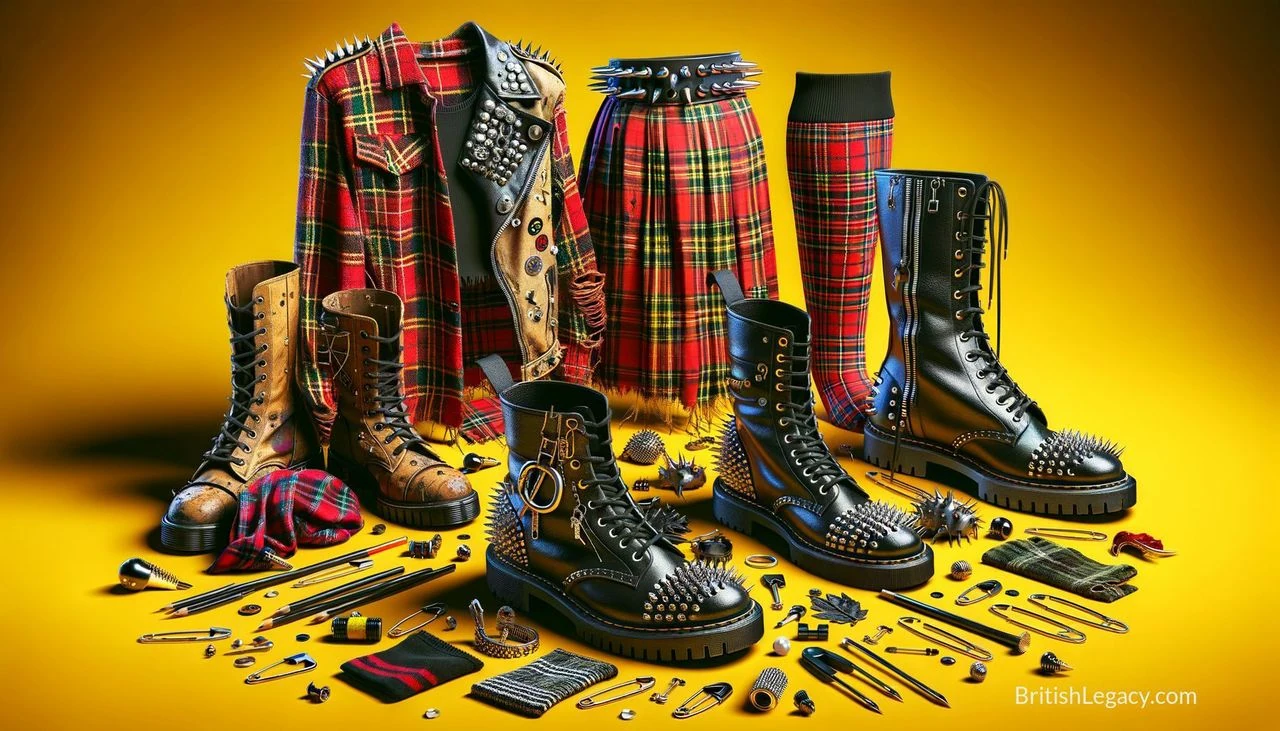
The designs sold through Sex deliberately challenged respectable expectations. Westwood used slogans, safety pins, rips and zips; the shop also sold garments drawing on fetish and sado-masochistic imagery. At Seditionaries, bondage trousers, loosely knitted jumpers and printed tops became recognisable elements of the punk look. Westwood’s work did not simply decorate a musical movement: it helped make its challenge to convention visible on the body.
She described her interest in punk as a way of seeing whether one could “put a spoke in the system”. That ambition did not mean that every wearer shared the same politics. Westwood became disenchanted with the adoption of punk as style without its radical values, and later found different sources for her work. Her early designs drew on the 1950s Teddy Boy look and post-war youth culture; the shop’s successive identities brought changes in both clothes and ideas.
Historical research became increasingly important. Westwood and McLaren’s Pirate collection, shown in 1981, combined references to eighteenth- and nineteenth-century dress, British history, textiles and African prints. Later collections included Savages, Buffalo/Nostalgia of Mud, Punkature and Witches. After their creative partnership ended, Westwood continued to build collections from historical sources rather than treating the past as a fixed archive.
History, cloth and reinvention
In the mid-1980s, Westwood developed the mini-crini, a short, rounded shape inspired by the Victorian crinoline and the miniskirt. The design brought two different ideas about women’s dress into deliberate tension: the restriction associated with the crinoline and the apparent freedom of the miniskirt. Across her collections she returned to corsets, ruffs, bustles, breeches and paniers, reworking forms found in historical garments and art.
Her Autumn–Winter 1987–88 Harris Tweed collection began a long relationship with the Scottish cloth and its authority. The collection helped renew attention to Harris Tweed as a fashion fabric. Westwood also developed the Orb logo, which prompted controversy because of its resemblance to the Harris Tweed Authority’s mark; the two brands later collaborated. In 2008, she designed academic gowns and hoods for King’s College London, reworking traditional robes to connect past, present and future.
Westwood’s influence also reached beyond her own collections. She designed uniforms for Virgin Atlantic using recycled polyester, and her work was worn by musicians and performers. A design featured in the 2008 film Sex and the City, bringing one of her wedding dresses to a wide screen audience. These different commissions showed how her historical references could be adapted for institutions, commercial work and popular culture without losing their distinctive visual character.
Politics and public recognition
Westwood made political expression part of her public identity as well as her design work. In 1989 she appeared on the cover of Tatler dressed in a suit ordered for Margaret Thatcher, under the caption “This woman was once a punk”. In 2005 she worked with the civil-rights group Liberty on T-shirts carrying the slogan “I AM NOT A TERRORIST, please don’t arrest me”, raising funds and drawing attention to habeas corpus. She also supported Campaign for Nuclear Disarmament and campaigned on climate change.
Her activism included advocacy for a more sustainable fashion industry, but it was not without criticism. The Wikipedia account records criticism of the environmental claims made around the business and its use of materials, as well as debate about the relationship between her public values and commercial practice. Westwood herself said that she did not want people to buy too much. In 2015, she said she would stop expanding her business as a way of addressing environmental and sustainability concerns. The tension between campaigning and the realities of fashion commerce belongs in an account of her work, rather than being smoothed into an uncomplicated story of advocacy.
Westwood was appointed an Officer of the Order of the British Empire in 1992 for services to fashion design. At the Buckingham Palace ceremony she twirled her skirt for photographers; the resulting image became widely associated with her defiant public persona. She was made a Dame Commander of the same order in 2006 for services to British fashion and won the British Designer of the Year award three times. In 2008, Heriot-Watt University awarded her an honorary degree for her contribution to the industry and use of Scottish textiles.
Why Vivienne Westwood deserves a place in British Legacy
Westwood’s place in British Legacy rests on the specificity of what she changed. In the 1970s, her work with McLaren connected clothing to the sound and confrontational spirit of London punk. The changing Kings Road shop gave that work a public home, while garments such as bondage trousers and printed, deliberately distressed tops helped establish a visual language that travelled well beyond the shop. This was not simply a matter of a designer adopting a youth style: Westwood helped create and circulate clothes that made dissent legible.
Her later career showed that British fashion could be radical without abandoning its history. Pirate drew on historical dress and textiles; the mini-crini reworked the crinoline; and the Harris Tweed collection brought renewed attention to a Scottish cloth and its associated industry. Her academic gowns for King’s College London similarly reinterpreted an established form for a contemporary institution. Alongside these achievements, her campaigns on civil liberties, nuclear disarmament and climate change made her a designer who publicly argued about the conditions in which people live and consume. Her legacy is not a claim that fashion alone can solve those problems. It is the more concrete example of a British designer using clothes, collections and public attention to challenge assumptions, revive design histories and bring political questions into view.
Sources
Vivienne Westwood — Wikipedia revision · Vivienne Westwood — Wikipedia
Adapted in part from Vivienne Westwood by Wikipedia contributors, under CC BY-SA 4.0. Text has been edited and combined with the existing article; this adapted text is shared under the same licence. Contributor history.

.jpg)