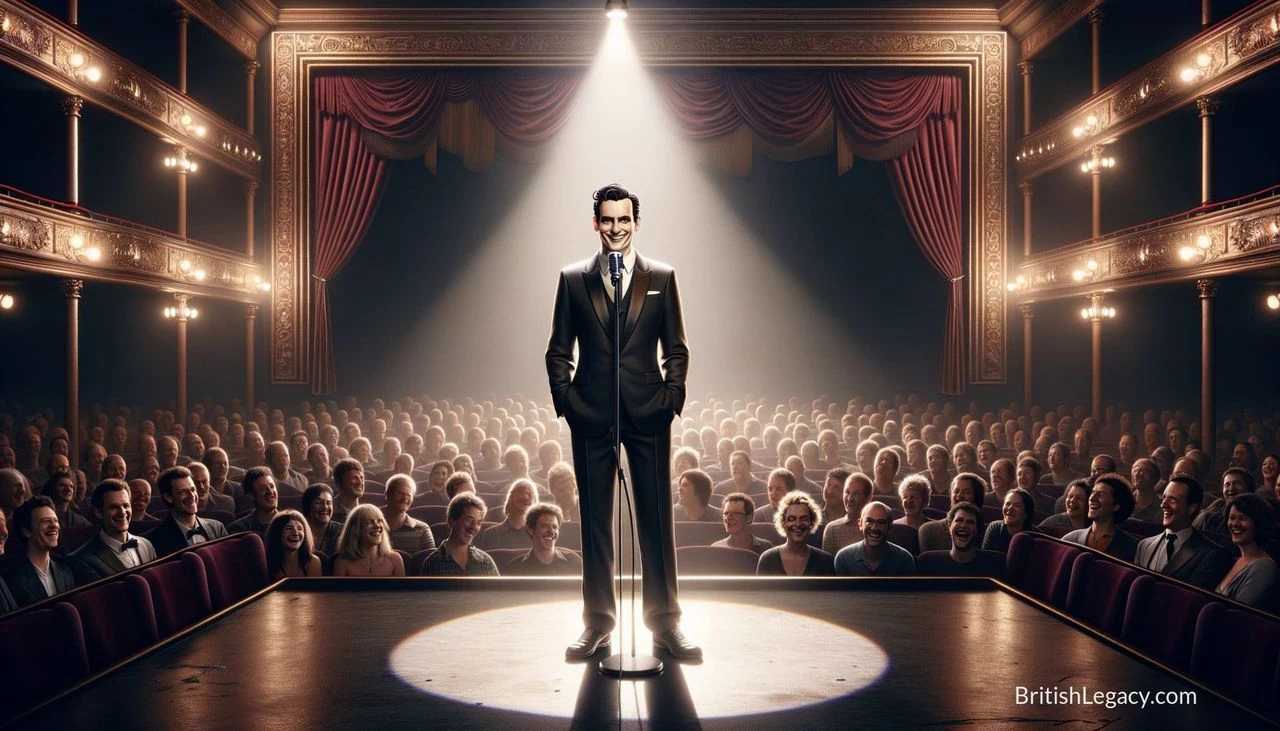
Jimmy Carr’s comedy depends on precision: a rapid-fire one-liner, delivered in a deadpan voice, often turns on an abrupt change of direction. That style made him a familiar presence on British television, from 8 Out of 10 Cats to The Big Fat Quiz of the Year, while his touring work carried him well beyond the UK. His career has also repeatedly raised a harder question about comedy: where does provocation end, and what responsibility comes with making a joke in public?
From Cambridge to the comedy circuit
James Anthony Patrick Carr was born in Isleworth, London, on 15 September 1972. He spent much of his childhood in Farnham Common, Buckinghamshire, and attended Farnham Common School and Burnham Grammar School before completing sixth form at the Royal Grammar School in High Wycombe. He has spoken about having dyslexia and difficulty reading and writing at the expected level until he was around ten or eleven.
Carr studied social science and political science at Gonville and Caius College, Cambridge, graduating with first-class honours in 1994. He then joined the marketing department at Shell. In January 2000, he took voluntary redundancy; later that month, he performed his first paid stand-up gig. His early progress came through regular appearances at London comedy clubs, including Up The Creek, the Banana Cabaret and the Bearcat Comedy Club.
The Edinburgh Festival Fringe became an important stage in that development. Carr appeared in the revue Rubbernecker in 2001, alongside Ricky Gervais, Stephen Merchant and Robin Ince. The following year he performed his first solo Fringe show, Bare Faced Ambition, and was nominated for the Perrier Award. By 2003, he had built enough television and touring recognition to move to a larger venue; the festival rules meant he was no longer eligible for that award. His later Fringe appearances included Rapier Wit, Laughter Therapy and, after a ten-year absence, Laughs Funny in 2024.
Making a television career
Carr’s move into television began with presenting and panel work in the early 2000s. He hosted Channel 4 game shows including Distraction and Your Face or Mine?, and became presenter of The Big Fat Quiz of the Year in 2004. The quiz’s recurring format placed celebrities in teams to answer questions about the year’s events, giving Carr a role in a programme built as much around their exchanges as the answers.
In 2005, he began presenting 8 Out of 10 Cats, a Channel 4 panel show whose topics draw on statistics and opinion polls. Carr remained its presenter until 2021. Since 2012, he has also hosted 8 Out of 10 Cats Does Countdown, which combines the panel-show format with the word and numbers rounds of Countdown. The two programmes show how his clipped delivery and quick responses could work within a repeatable television format as well as in a solo set.
His other presenting work has included Channel 4’s topical comedy programme 10 O’Clock Live, the US version of Distraction, Comedy Central’s Roast Battle, and the Channel 4 quiz show I Literally Just Told You. Carr has also appeared on British and American television panel and late-night programmes. His work in the United States, including Netflix projects and comedy performances, widened the reach of a career rooted in British clubs, festivals and television.
One-liners, touring and controversy
Carr has described stand-up as his principal work, even though television made him widely recognisable. His live shows have included Gag Reflex, which won the 2006 British Comedy Award for Best Live Stand-Up, Funny Business, Terribly Funny and Laughs Funny. He has toured internationally and released performances as DVDs and streaming specials. His first Netflix stand-up special, Funny Business, appeared in 2016; His Dark Material followed in 2021, and Natural Born Killer in 2024.
The dark and provocative subjects in Carr’s material have brought criticism as well as attention. In 2009, a joke about injured British service personnel drew condemnation; Carr responded that he respected those who served and apologised if people were offended, while maintaining that the material reflected his style of comedy. He was criticised again over material in his 2019 touring show and, more widely, over a Holocaust joke in His Dark Material. Carr said the joke was intended to draw attention to Romani victims of Nazi persecution. The Auschwitz Memorial, the Holocaust Memorial Day Trust and other organisations condemned it. These disputes are part of the public record of his career, not simply a question of taste: they show how his claim that comedy should test boundaries meets the experiences and views of the people its subjects concern.
In 2012, Carr apologised after reports linked him to the K2 tax-avoidance scheme, saying he had made “a terrible error of judgement”. He withdrew from the scheme. The episode attracted particular notice because his television work had included jokes about tax avoidance. In 2018, he revisited the controversy on Room 101, acknowledging that what he had done was wrong and arguing that the law should be clearer about loopholes.
Work beyond the stage
Carr has written about comedy as well as performed it. In 2006, he and Lucy Greeves published The Naked Jape: Uncovering the Hidden World of Jokes, a book about the history and theory of joke-telling. His later books include Before & Laughter, published in 2021. These projects sit alongside a career in which the mechanics of a joke—its construction, timing and reversal—are central to both the performance and the persona.
He has also taken part in charity comedy events, including Amnesty International’s 2012 Secret Policeman’s Ball in New York and Stand Up for Heroes events in 2018 and 2023. Such appearances add another strand to a career otherwise defined by touring, television and material that frequently courts controversy. Carr’s work has been recognised with awards including the Royal Television Society Award for Best On-Screen Newcomer in 2003 and the British Comedy Award for Best Live Stand-Up in 2006.
Why Jimmy Carr deserves a place in British Legacy
Jimmy Carr belongs in a record of British entertainment because his career connects two influential settings for modern comedy: the live circuit and the television panel show. He developed his act through clubs and the Edinburgh Fringe, then became the regular host of formats that brought comedians and celebrity guests into British homes. 8 Out of 10 Cats and 8 Out of 10 Cats Does Countdown made the quick exchange, the one-liner and the performer’s reaction central to their appeal. His work on The Big Fat Quiz of the Year similarly made a recurring television event out of jokes about public events and popular culture.
His legacy is not a claim that every joke succeeds or that provocation is beyond criticism. Carr’s controversies, including the backlash to his Holocaust joke and his apology over the K2 scheme, belong in any honest account of his public life. They make his career a useful case study in the changing limits of comedy, the consequences of public performance and the difference between a comedian’s intention and an audience’s response. At the same time, his long-running television work, award-winning stand-up and international touring show how a distinctive British comedy career can move between clubs, broadcast formats and global streaming audiences. That combination of craft, reach and debate is the specific reason his story merits a place in British Legacy.
Sources
Jimmy Carr — Wikipedia, revision 1379387957
Adapted in part from Jimmy Carr by Wikipedia contributors, under CC BY-SA 4.0. Text has been edited and combined with the existing article; this adapted text is shared under the same licence. Contributor history.