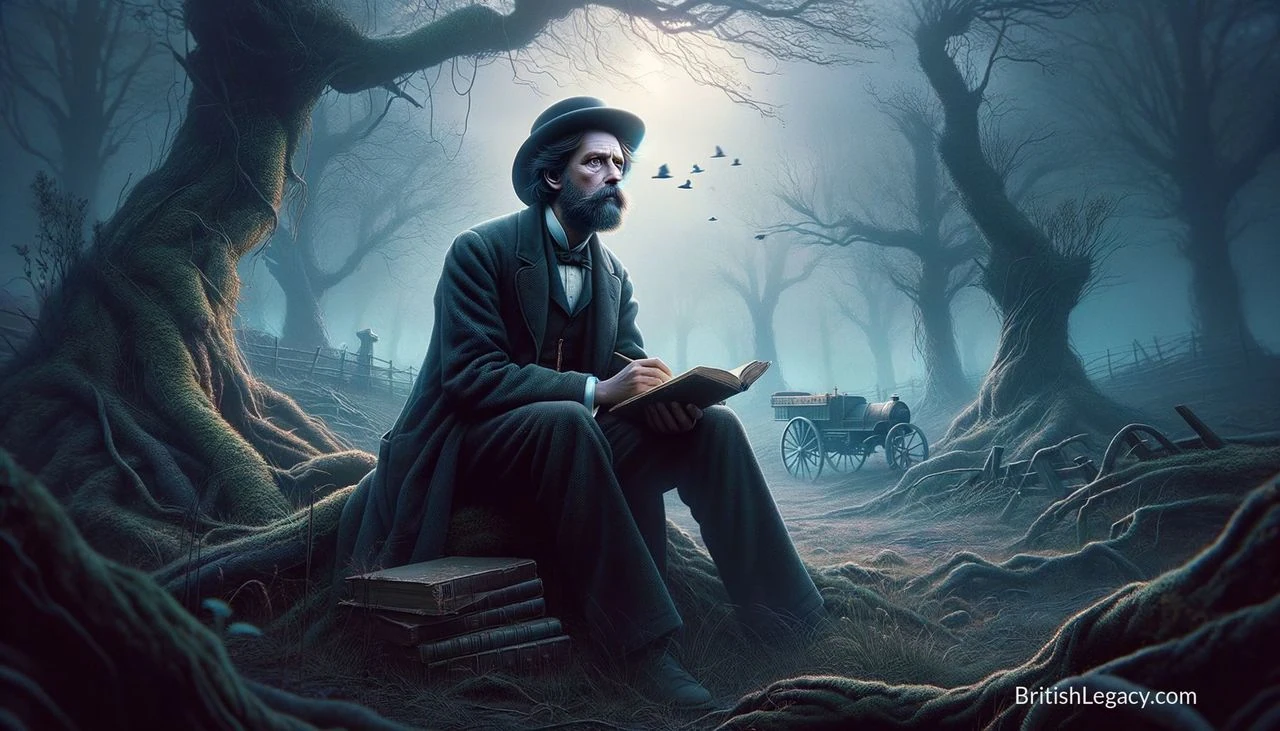
Thomas Hardy made the people and landscapes of south-west England central to a body of work that moves between close observation of rural life and questions about chance, suffering and social constraint. His novels made him famous; his poetry, which he continued to write after turning away from fiction, secured another kind of literary legacy. Both are rooted in a recognisable place, yet attentive to forces that reach well beyond it.
From Dorset to architecture
Hardy was born on 2 June 1840 at Higher Bockhampton, a hamlet in the parish of Stinsford, near Dorchester in Dorset. His father, Thomas, was a stonemason and builder; his mother, Jemima, was well read and educated him before he began school. Hardy attended school in Dorchester, where he studied Latin and showed academic promise. His formal education ended at 16, when he became an apprentice to the local architect James Hicks.
In 1862 Hardy moved to London and studied at King's College London. He worked as an assistant architect, won prizes from the Royal Institute of British Architects and the Architectural Association, and contributed to church projects. After five years in London, he returned to Dorset, concerned about his health, and resolved to devote himself to writing. His architectural training and his knowledge of buildings and landscapes remained part of the practical world from which his fiction drew.
He met Emma Gifford in 1870 while working on the restoration of St Juliot's parish church in Cornwall. They married in 1874. In 1885 they moved to Max Gate, a house near Dorchester designed by Hardy and built by his brother. Hardy later married Florence Dugdale in 1914. Emma had died in 1912; the poems he wrote in the following years would return to their shared past and his grief.
Building a fictional Wessex
Hardy's first novel, The Poor Man and the Lady, was completed by 1867 but never published. On advice from the writer George Meredith, he set it aside and destroyed the manuscript. His next two novels, Desperate Remedies (1871) and Under the Greenwood Tree (1872), appeared anonymously. A Pair of Blue Eyes (1873) was published under his own name; its serialised story includes a character left literally hanging from a cliff, an episode associated with the origin of the term “cliffhanger”.
Far from the Madding Crowd (1874) brought commercial success and allowed Hardy to leave architectural work for a literary career. It also introduced his name for the region in which many of his stories unfold: Wessex. Based on the historic kingdom, Hardy's fictional Wessex expanded to encompass parts of Dorset, Wiltshire, Somerset, Devon, Hampshire and Berkshire. Its familiar farms, towns and paths are not merely scenery. They place characters in communities shaped by work, class and inherited custom, while the novels ask how far a person can choose a different course.
Over the next 25 years he wrote ten more novels. Among them were The Return of the Native (1878), The Mayor of Casterbridge (1886), The Woodlanders (1887), Tess of the d'Urbervilles (1891) and Jude the Obscure (1895). Tess, subtitled A Pure Woman Faithfully Presented, challenged the moral judgements directed at a woman condemned by the society around her. Jude confronted barriers of education and class, as well as conventions surrounding sex, religion and marriage. Both novels drew strong criticism, particularly Jude; Hardy's last novel, The Well-Beloved, was published in 1897.
From the novels to the poems
Hardy had written poetry throughout his life, but his first collection, Wessex Poems, did not appear until 1898. In the twentieth century he published poetry rather than novels. The change did not mark an end to his engagement with the pressures found in his fiction. His poems also examine disappointment, suffering, love, chance and the uneasy relation between human hopes and a larger, indifferent world.
“The Darkling Thrush”, first published as “The Century's End”, appeared in Poems of the Past and the Present in 1901. Its winter landscape conveys desolation at the close of a century; the thrush's unexpected song offers a slender counterpoint, without making the poem's uncertainty disappear. In “The Convergence of the Twain” (1912), written after the Titanic disaster, the ship and the iceberg are presented as forces moving towards a fatal meeting. Hardy's interest in fate is not limited to grand catastrophes: in his fiction, small accidents can change the direction of an ordinary life.
His verse ranged widely in form, from lyrics and ballads to satire, dramatic monologues and dialogue. He also wrote The Dynasts, a three-part verse drama about the Napoleonic Wars, published between 1904 and 1908. After Emma's death, the poems collected in Poems 1912–13 addressed memory, remorse and the places associated with their courtship. Hardy's later recognition as a poet rested on work that combined formal experiment with direct, often colloquial speech.
Public life and a lasting home in Dorset
Hardy's interest in place extended beyond fiction. From the 1880s he took part in efforts to protect old buildings from demolition or damaging alteration and became an early member of the Society for the Protection of Ancient Buildings. He wrote about unsuccessful attempts to prevent major changes to Puddletown parish church and encouraged the careful restoration of Athelhampton House. This work connected his architectural experience with a concern for the built history of the region that had shaped his writing.
His standing also grew among younger writers. D. H. Lawrence, John Cowper Powys and Virginia Woolf were among those who admired his work; poets including W. H. Auden and Philip Larkin later praised his verse. Hardy was appointed to the Order of Merit in 1910. He died at Max Gate on 11 January 1928. His funeral brought a dispute over his burial: Hardy had wished to be buried at Stinsford with Emma, while his executor argued for Westminster Abbey. The compromise placed Hardy's heart at Stinsford and his ashes in Poets' Corner.
His birthplace at Higher Bockhampton and Max Gate are now owned by the National Trust. The places that informed his writing can therefore still be encountered as physical locations as well as through the fictional Wessex he made from them. That continuing connection between landscape, literature and preservation is one of the clearest threads running through his life and work.
Why Thomas Hardy deserves a place in British Legacy
Hardy deserves a place in British Legacy because he made the lives of rural people and the character of south-west England central to major works of English literature. His Wessex is a literary creation, but it is built from close attention to real landscapes, communities and buildings. In novels such as Far from the Madding Crowd, Tess of the d'Urbervilles and Jude the Obscure, that setting gives shape to stories about class, education, gender and moral judgement. Hardy did not treat rural life as an uncomplicated pastoral refuge: his characters meet social barriers, chance events and losses they cannot simply overcome.
His achievement also crosses genres. After becoming known as a novelist, Hardy devoted the twentieth century to poetry, producing work that ranges from the bleak turn-of-century scene of “The Darkling Thrush” to the historical sweep of The Dynasts and the personal elegies written after Emma's death. His writing influenced later authors and poets, while his practical concern for historic buildings carried his attachment to place beyond the page. The preservation of Max Gate and his birthplace keeps that connection visible. Together, his fiction, poetry and conservation activity show how a writer's local knowledge can become part of a wider cultural inheritance: specific to Dorset and the south-west, yet enduring in British literary life.
Sources
Thomas Hardy — revision 1378219258
Adapted in part from Thomas Hardy by Wikipedia contributors, under CC BY-SA 4.0. Text has been edited and combined with the existing article; this adapted text is shared under the same licence. Contributor history.