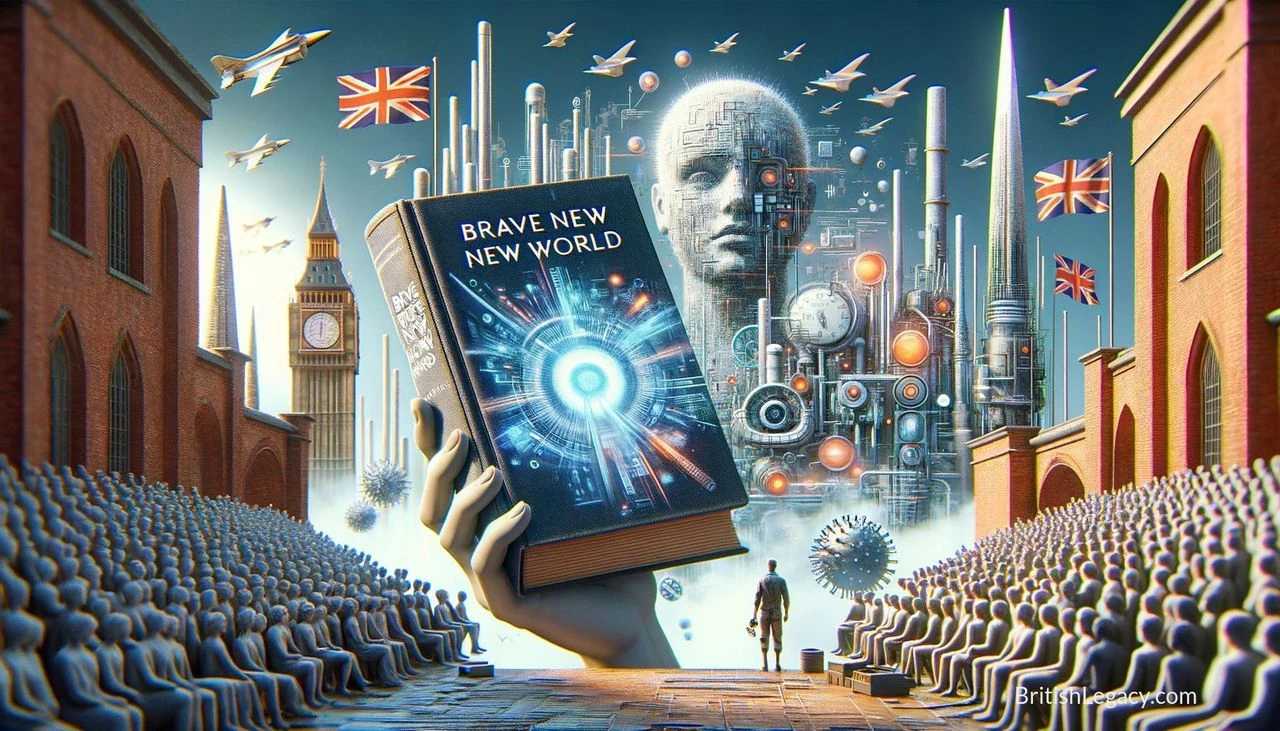
Aldous Huxley’s best-known novel, Brave New World, imagines a society in which human beings are produced for predetermined roles and kept compliant through conditioning and pleasure. Published in 1932, it made the possibility of a technologically organised, politically controlled future a subject for fiction. Yet Huxley’s writing was never confined to dystopia: across novels, essays, poetry and screenplays, he examined social change, pacifism, science and the search for meaning.
Family, education and early writing
Huxley was born Aldous Leonard Huxley in Godalming, Surrey, on 26 July 1894. His father, Leonard Huxley, was a writer and schoolmaster; his mother, Julia Arnold, founded Prior’s Field School. His grandfather was the biologist Thomas Henry Huxley, often called “Darwin’s Bulldog”. His brothers Julian and Andrew also became biologists.
After his early education, Huxley attended Eton. In 1911, keratitis punctata severely impaired his eyesight, interrupting his ambition to become a doctor. He later regained some sight and went on to study English literature at Balliol College, Oxford, graduating with first-class honours in 1916. He edited Oxford Poetry that year. After university he taught French at Eton, where Eric Blair—later known as George Orwell—was among his pupils.
Huxley began publishing poetry and short stories before establishing himself as a novelist and social satirist. His early novels included Crome Yellow (1921), Antic Hay (1923), Those Barren Leaves (1925) and Point Counter Point (1928). Alongside fiction, he wrote for magazines including Vanity Fair and British Vogue. His work at the chemical company Brunner and Mond in Billingham, County Durham, later provided a point of reference for the ordered industrial world of Brave New World.
The making of a dystopia
Brave New World was Huxley’s fifth novel and his first dystopian one. Its future London is governed through mass production, social hierarchy and Pavlovian conditioning. People are shaped to fit their place in society, while the drug soma helps sustain contentment and conformity. The novel’s unease comes not only from state power but from a population encouraged to accept its own constraint.
Huxley’s subject was not technology in isolation. The novel connects scientific organisation with consumption, political control and the loss of individual choice. That combination has kept it in conversation with debates about the relationship between innovation and human freedom. His later fiction took a different imaginative direction: Island (1962), his final novel, presented a utopian vision rather than another dystopia.
In the years around Brave New World, Huxley also wrote about pacifism. He joined the Peace Pledge Union and produced works including Ends and Means (1937), addressing war, inequality, religion and ethics. These concerns reflected an interest in how social arrangements might be changed without treating violence as the answer.
California, cinema and changing interests
In 1937 Huxley moved to Hollywood with his wife, Maria, their son Matthew and his friend Gerald Heard. He lived in the United States for the remainder of his life, mainly in southern California. Work in the film industry became one part of his career: he received screen credit for Pride and Prejudice (1940), and was paid for work on other films, including Jane Eyre (1944). A script he was commissioned to write in 1945, based on Alice’s Adventures in Wonderland, was not used.
Huxley’s writing widened further into spiritual and philosophical questions. The Perennial Philosophy (1945) considered common ground among mystical traditions. From the late 1930s he was associated with the Vedanta Society of Southern California, and from 1941 to 1960 contributed 48 articles to its journal, Vedanta and the West. His engagement with these traditions sat alongside, rather than simply replacing, his interest in science and social questions.
In 1954, The Doors of Perception recounted an experience with mescaline. Huxley treated altered consciousness as a subject for reflection, and his writing on the experience became part of a wider cultural interest in psychedelics. He later advised Timothy Leary and Richard Alpert during their early research at Harvard, but distanced himself from Leary as he became concerned about indiscriminate promotion of the drugs. The book’s title also became the name of the band the Doors: Jim Morrison took it from Huxley’s work.
Warnings, recognition and final years
Huxley continued to address the future of modern society in essays, talks and interviews. In a televised interview in 1958, he discussed overpopulation, hierarchy, the use of technology in mass society and the political presentation of leaders as marketable figures. His late concerns extended beyond the dystopian machinery of his most famous novel to the habits and institutions that might make people vulnerable to persuasion.
He was elected a Companion of Literature by the Royal Society of Literature in 1962. Huxley had been diagnosed with cancer in 1960, and his health declined over the following years. He died in Los Angeles on 22 November 1963, aged 69. His ashes were interred in the family grave at Compton, Surrey, in 1971. The distance between his English beginnings and his long American residence is part of his biography; his literary recognition in Britain remained substantial, and the Royal Society of Literature honour came in the final year of his life.
Why Aldous Huxley deserves a place in British Legacy
Huxley belongs in British Legacy first as an English writer whose fiction gave durable form to questions about technology, power and personal freedom. Brave New World does not rely on a single tyrant or a society held together only by force. Its unsettling premise is that control can be maintained through conditioning, consumption and manufactured satisfaction. By bringing these elements together, Huxley made a distinctive contribution to the British tradition of social criticism and speculative writing. His early novels, pacifist essays and later work also show a career that cannot be reduced to one famous title.
His legacy is also valuable because his interests crossed literary and intellectual boundaries. He wrote novels, poetry, essays and screenplays; addressed pacifism and the organisation of society; and pursued questions of consciousness and spiritual experience. His British connection is concrete: he was born and educated in England, worked in County Durham, published as a writer there, and was recognised by the Royal Society of Literature. He spent most of his final decades in the United States, but his work continued to frame arguments about the future of society for readers far beyond either country. Remembering Huxley means keeping both sides of his achievement in view: the imaginative force of his fiction and the restless enquiry that carried him well beyond it.
Sources
Aldous Huxley — Wikipedia, revision 1379792787
Adapted in part from Aldous Huxley by Wikipedia contributors, under CC BY-SA 4.0. Text has been edited and combined with the existing article; this adapted text is shared under the same licence. Contributor history.