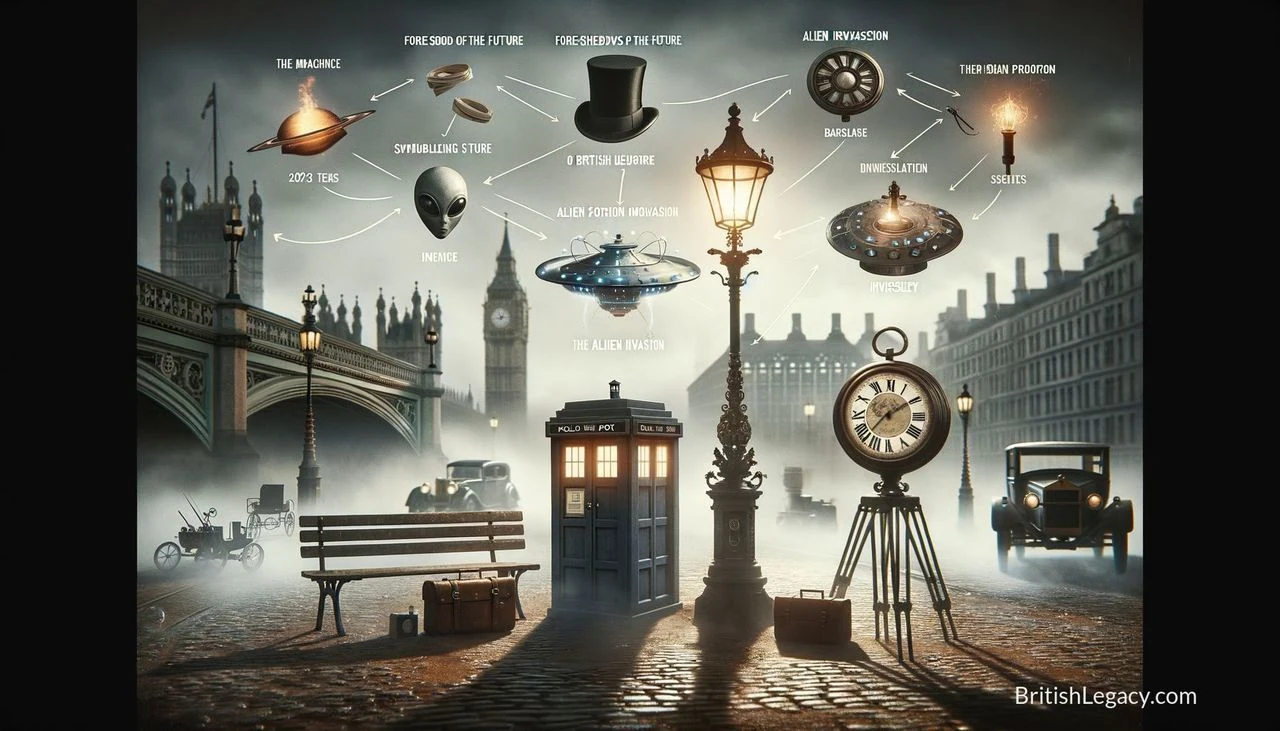
H. G. Wells made extraordinary ideas feel close at hand. In The Time Machine, a journey into the distant future becomes a way to examine class; in The War of the Worlds, an invasion of Britain overturns familiar assumptions about human power. These stories helped establish the form of science fiction, but they were only part of a career that also encompassed social novels, journalism, popular history and political argument.
A difficult start, and a route into science
Herbert George Wells was born in Bromley, Kent, on 21 September 1866. His father, Joseph, was a shopkeeper and professional cricketer; his mother, Sarah Neal, had worked as a domestic servant. The family’s china and sporting-goods shop struggled, and Joseph’s earnings from cricket were uncertain. When Wells broke his leg in 1874, books brought from the local library gave him a means of escape and helped kindle his ambition to write.
His education was interrupted by financial pressure. From 1880 to 1883 he worked as a draper’s apprentice in Southsea, enduring long days and dormitory life. Those years later informed Kipps, The History of Mr Polly and The Wheels of Chance, novels attentive to the constraints and aspirations of lower-middle-class life. A position as a pupil-teacher at Midhurst Grammar School offered a way forward. In 1884 he won a scholarship to the Normal School of Science in South Kensington, where he studied biology under Thomas Henry Huxley. The institution later became the Royal College of Science.
Wells did not complete his degree there, but his scientific training shaped his work. He earned a Bachelor of Science degree in zoology through the University of London External Programme in 1890. After teaching, he turned increasingly to journalism and fiction. His first book-length publication was a two-volume biology textbook, issued in 1893; his first novel, The Time Machine, followed in 1895.
Scientific romances and the ordinary world
Between 1895 and 1901, Wells published a remarkable run of speculative fiction: The Time Machine, The Island of Doctor Moreau, The Invisible Man, The War of the Worlds and The First Men in the Moon. These works took one startling possibility—time travel, biological transformation, invisibility or invasion—and set it against recognisable places, habits and social relations. That grounding in everyday detail helped readers take the impossible seriously.
The Time Machine sends its traveller far into humanity’s future, where the division between the Eloi and the subterranean Morlocks gives a disturbing shape to social and class inequality. In The Island of Doctor Moreau, an island of experimentally altered animals raises questions about cruelty, responsibility and what makes a human being. The Invisible Man follows a scientist who can make himself unseen but cannot reverse the process; his discovery does not make him wise or benevolent. The War of the Worlds turns invasion into a reversal of imperial perspective: Britain, accustomed to imagining itself powerful, becomes vulnerable to an outside force.
Wells also wrote outside science fiction. Kipps and The History of Mr Polly brought social realism to lives far from the privileged literary drawing rooms of the period. Tono-Bungay offered a broader diagnosis of English society. His fiction could entertain while pressing readers to consider class, scientific responsibility and the uses of power. The label “father of science fiction” has often been applied to him, though it is a familiar description rather than a title that belongs to him alone.
From speculative stories to public argument
Wells’s interest in what might come next extended into non-fiction. Anticipations of the Reaction of Mechanical and Scientific Progress upon Human Life and Thought, published in 1901, considered how technology might reshape society. His forecasts were mixed: he anticipated developments in transport and warfare but did not expect successful aircraft to arrive before 1950. That combination of striking insight and conspicuous misjudgement is a useful reminder that prediction is not the same as prophecy.
In The World Set Free (1914), Wells imagined “atomic bombs” powered by accelerated radioactive decay. The book caught the attention of the physicist Leó Szilárd, who later recalled its effect on him. Wells also imagined forms of air warfare and space travel, and proposed a “world brain”: an evolving, accessible system for organising knowledge. His 1936 call for a continually updated world encyclopaedia, followed by essays in World Brain (1938), expressed a belief that education and shared information could help people make sense of an increasingly complex world.
His ambitions were not confined to books. A socialist and member of the Fabian Society, Wells stood as a Labour candidate for London University in the 1922 and 1923 general elections. He wrote about human rights and world organisation, and his 1940 book The Rights of Man set out arguments about equality and individual freedoms. His politics also included a serious commitment to eugenics and involuntary euthanasia; the account records that he had largely recanted his eugenic views by 1940. That record complicates any uncomplicated portrait of him as a forward-looking reformer.
Wells pursued public influence through journalism and organisations as well as fiction. He served as president of PEN International from 1933 to 1936. In that role, he opposed the German PEN club’s refusal to admit non-Aryan writers and challenged attempts by Nazi sympathisers to silence the exiled writer Ernst Toller. His belief in international debate was tested by political repression and the failure of institutions to prevent war. The Shape of Things to Come (1933) imagined a future world conflict; its fictional outbreak was placed in January 1940, while the Second World War began in September 1939.
A writer across genres and borders
Wells’s output ranged far beyond novels. The Outline of History (1920), a large-scale account of the human past, became a popular success and encouraged other writers to produce histories in the same form. He followed it with A Short History of the World and, with his son G. P. Wells and the biologist Julian Huxley, The Science of Life. He also wrote short stories, satire, autobiography and books on social and political questions. Across these forms, he returned to the question of how people might organise their common life.
His influence travelled in several directions. In Britain, writers including Arthur C. Clarke and Brian Aldiss admired his work; George Orwell described Wells as a formative presence for his generation. Writers in the United States and continental Europe also drew on his stories and methods. His books became a lasting source for stage, screen and radio adaptations. The 1938 radio adaptation of The War of the Worlds, performed by Orson Welles, is among the work’s notable afterlives.
Wells died in London on 13 August 1946, aged 79. He was cremated at Golders Green, and his ashes were scattered at Old Harry Rocks on the Dorset coast. His reputation rests partly on a concentrated burst of early science fiction, but his wider career makes the achievement harder to reduce to a handful of famous inventions. He was a novelist of ordinary English lives, a popular historian and a restless participant in debates about science, politics and the future.
Why H. G. Wells deserves a place in British Legacy
Wells belongs in a British literary history not simply because he helped shape science fiction, but because his speculative stories made social questions vivid. The distant future of The Time Machine exposes the consequences of class division; the invasion in The War of the Worlds unsettles assumptions about empire and security; and the experiments in The Island of Doctor Moreau and The Invisible Man make scientific power inseparable from moral responsibility. His method—anchoring an extraordinary possibility in a recognisable world—gave later writers a durable way to explore change without losing sight of the people affected by it.
His British legacy also lies in the reach of his work across forms of public thought. Wells wrote popular histories, argued about human rights and international organisation, and pressed for knowledge to be made widely accessible through his world-encyclopaedia idea. His record was not free of serious error: his advocacy of eugenics belongs in any honest account of his politics. That tension makes the legacy more useful, not less. Wells’s writing shows how imagination can open debate about the future, while his contradictions warn that confidence in progress does not guarantee sound judgement. His books remain a distinctive part of Britain’s contribution to world literature because they connect invention, social criticism and argument about what people might become.
Sources
H. G. Wells — Wikipedia, revision 1375299870
Adapted in part from H. G. Wells by Wikipedia contributors, under CC BY-SA 4.0. Text has been edited and combined with the existing article; this adapted text is shared under the same licence. Contributor history.