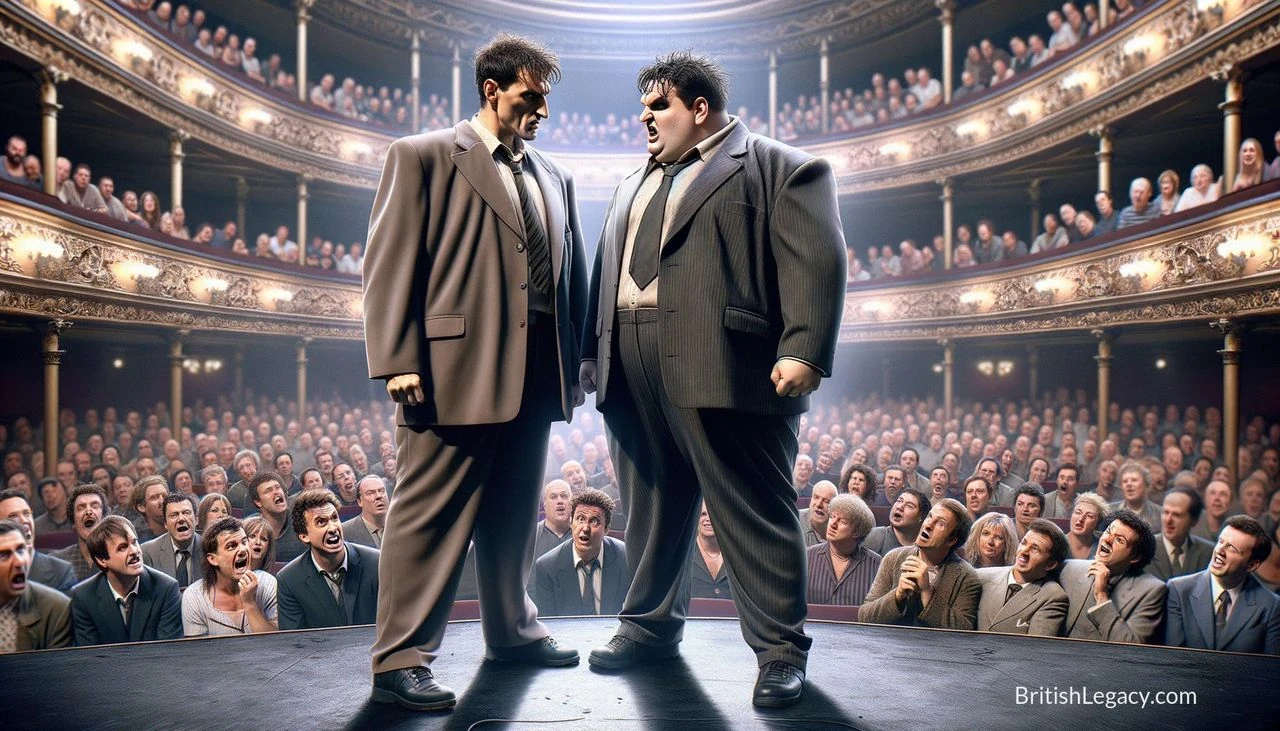
For Gareth Hale and Norman Pace, television was not the starting point. The pair spent years performing in south-east London before their club act developed into radio and television work. Their ITV sketch series, which ran from 1988 to 1998, brought recurring characters such as the stone-faced Two Rons and the brightly dressed children’s presenters Billy and Johnny to a national audience. Their work also reached beyond sketches: they made a charity single that topped the UK chart in 1991 and appeared in a public information campaign on firework safety.
From teacher training to the Tramshed
Hale and Pace met at Avery Hill teacher-training college in Eltham, south-east London. After five years in education, they moved into entertainment in the late 1970s. Their early partnership took shape on the London comedy circuit, especially at the Tramshed in Woolwich, where they performed for seven years. That sustained stage work became the basis for sketch-writing and a show titled Don’t Stop Now – It’s Fundation.
Before their television series, the pair made radio programmes for BBC Radio 4 based on their Tramshed show. Early television appearances followed in The Entertainers and Pushing Up Daisies in 1984, then the Channel 4 sketch show Coming Next in 1985 and Saturday Gang in 1986. They also appeared three times in The Young Ones, in the episodes “Flood”, “Nasty” and “Time”. These credits trace a gradual move across performance formats rather than a sudden leap to their own series.
A decade of sketches on ITV
A Christmas special for London Weekend Television in 1986 led to a full series in 1988. The ITV programme ran for ten series and 66 episodes, from 2 October 1988 to 20 December 1998. Its format mixed sketches and stand-up, and every episode included at least one original song performed by Hale, Pace or both. The first series won the Silver Rose of Montreux and the Press prize.
The Two Rons became one of the duo’s best-known creations: stone-faced bouncers whose deliberately stilted exchanges included the line “I do do wrong, Ron, I do do wrong”. The characters were also known as The Management, later appearing in their own six-episode spin-off. Another recurring pairing, Billy and Johnny, were ever-smiling, colourful children’s television presenters; Ainsley Harriott appeared in some sketches as their co-presenter, Willy. The rockers Jed and Dave also returned across the series.
The programme’s sketches ranged across characters and settings. The Two Rons moved from dimly lit stairs and studio scenes to filmed pieces, including gardening tips delivered in their own thuggish style. Other recurring parts included London taxi drivers Steve and Frank, the Swedish characters Sven and Benny, and the Yorkshiremen. The series also used musical numbers, stage performances and comic parodies. Not every sketch escaped controversy: one, in which the pair pretended to have microwaved a cat, was among those that drew criticism.
Work beyond their own series
Hale and Pace continued to take on other television work during and after the ITV run. In 1989 they appeared briefly as shopkeepers Harvey and Len in Doctor Who: Survival, the final story of the programme’s original 1963–89 run. In 1994 they dramatised the detectives from Dalziel and Pascoe for ITV. The duo moved to the BBC in 1997 for Jobs for the Boys, a three-part non-comedy series in which they tried different employment challenges, including writing a proposed UK entry for the Eurovision Song Contest.
Later television appearances included two episodes of Oddbods in 1998, the hybrid entertainment programme h&p@bbc in 1999, The Armando Iannucci Shows in 2001 and the Christmas special of Extras in 2007. In 2018 they appeared in several episodes of Benidorm as financial fraud investigators. Their work across these programmes took them beyond the format for which they were chiefly known, while leaving the established double act intact.
“The Stonk” and public campaigns
In 1991 Hale and Pace joined a charity supergroup, Hale & Pace and the Stonkers, for “The Stonk”, a song based on a fictitious dance craze and co-written by the duo with Joe Griffiths. Queen guitarist Brian May produced the record and played on it. Other musicians included Tony Iommi, David Gilmour and Nick Lowe on guitar; Neil Murray on bass; Roger Taylor and Cozy Powell on drums; Rowan Atkinson as Mr Bean, also on drums; and Joe Griffiths and Mike Moran on keyboards and piano. Comedians Steve Punt, Hugh Dennis, Rob Newman and David Baddiel appeared in the video.
The single, released in aid of Comic Relief, spent one week at number one in the UK in March 1991 and ranked 22nd among the year’s best-selling singles. It was issued jointly with Victoria Wood’s “The Smile Song”, which was listed as the second track on the seven-inch and CD releases. The chart did not credit Wood with a number-one hit. The duo’s characters also featured in firework-safety public information films shown around Guy Fawkes Night over several years from the late 1980s into the early 1990s.
Why Hale and Pace deserve a place in British Legacy
Hale and Pace’s place in British entertainment rests on a long-running partnership developed in the working spaces of comedy: a teacher-training college, a Woolwich club stage, radio and then television. Their decade-long ITV series gave audiences a substantial body of performance—ten series and 66 episodes—built from sketches, stand-up, musical numbers and returning characters. The Two Rons and Billy and Johnny were not isolated one-off turns; they became recurring parts of a programme whose format let the duo shift between character comedy, parody and song.
Their contribution also crossed into public life beyond the television set. “The Stonk” brought a large group of performers together for Comic Relief and reached number one in the UK, while the Two Rons appeared in firework-safety films shown to television audiences. Those examples connect comedy with charity and public information, rather than relying on broad claims about influence. The pair’s later appearances in programmes ranging from Doctor Who to Benidorm further document their continued work across British television. Their record is a specific one: a partnership rooted in live performance, sustained on ITV, and carried into music, other series and public campaigns.
Sources
Hale and Pace — revision 1379344663 · Hale and Pace
Adapted in part from Hale and Pace by Wikipedia contributors, under CC BY-SA 4.0. Text has been edited and combined with the existing article; this adapted text is shared under the same licence. Contributor history.