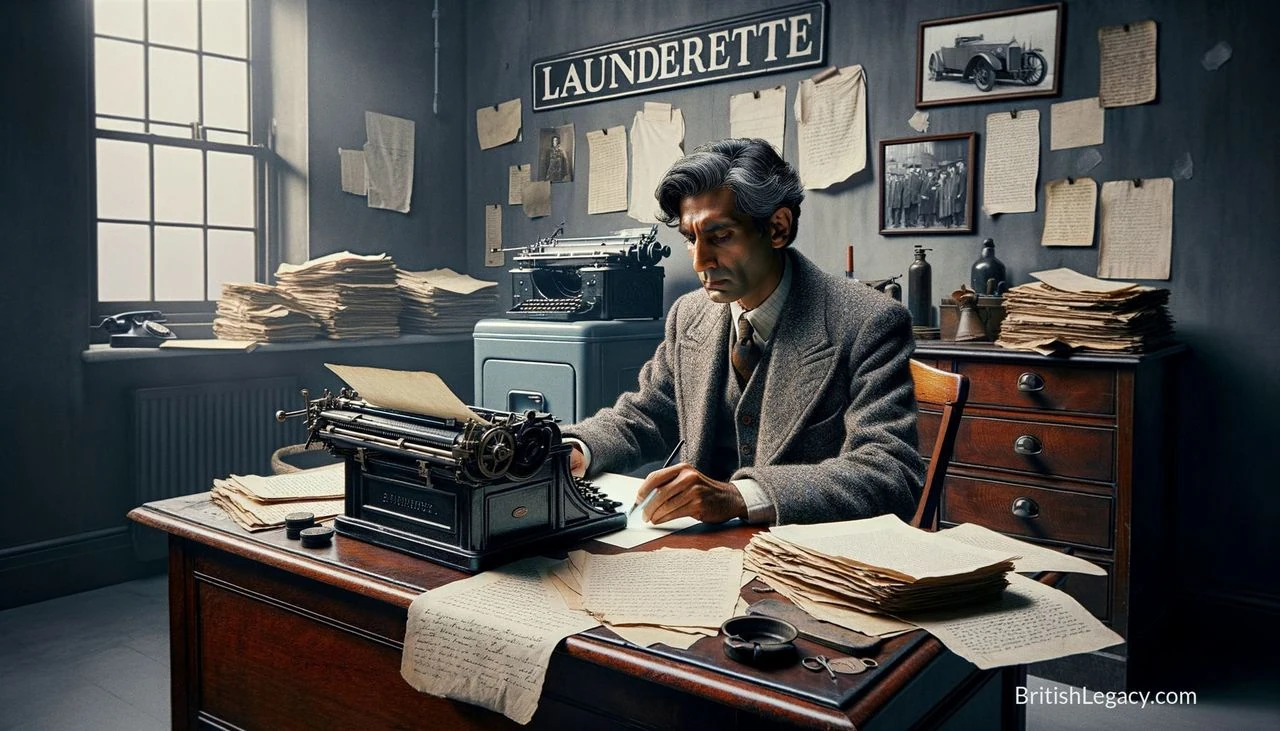
Hanif Kureishi came to national attention with stories that refused to keep race, class and sexuality at the margins of British life. His screenplay for My Beautiful Laundrette brought a gay Pakistani-British character to the centre of a film set in 1980s London; The Buddha of Suburbia followed a mixed-race teenager through the suburbs. Across drama, novels, essays and memoir, Kureishi has repeatedly returned to the pressures and possibilities of living between identities.
Bromley, family and education
Kureishi was born in Bromley, Kent, on 5 December 1954. His mother, Audrey Buss, was English; his father, Rafiushan, known as Shanoo, had left India for Britain in 1950. Kureishi has written about his father’s work at the Pakistani high commission in London and about a family history shaped by the 1947 Partition of India. Those details form part of the background to his writing, but they do not make his fiction a simple record of family life.
He attended Bromley Technical High School and studied for A-levels at Bromley College of Technology, where he was elected student union president in 1972. He spent a year studying philosophy at Lancaster University before leaving, then went to King’s College London, where he earned a degree in philosophy. The settings and experiences of his youth later informed the semi-autobiographical world of The Buddha of Suburbia.
Kureishi began writing for the stage in the 1970s. He wrote plays for venues including Hampstead Theatre and Soho Poly, and was associated with the Royal Court by the age of 18. Outskirts and Borderline were among his early plays. The theatre gave him a route into writing about social boundaries and conflict before film brought his work to a much larger audience.
My Beautiful Laundrette and a new kind of screen story
In 1985, Kureishi wrote the screenplay for Stephen Frears’s My Beautiful Laundrette. Its central figure is a gay Pakistani-British young man in 1980s London, whose plans to run a laundrette intersect with economic ambition, racism and his relationship with a white British former schoolmate. The film treats these subjects as part of its characters’ everyday lives rather than as a separate lesson about identity.
Kureishi drew on his own experiences of racism at school when writing the screenplay. He has recalled being the only brown pupil at his high school and facing racist abuse. The film received nominations for the Academy Award and BAFTA for Best Original Screenplay; it also won the New York Film Critics Circle Award for Best Screenplay. Its recognition established Kureishi as a screenwriter able to bring complicated, contemporary British lives into view.
He continued to work in film as well as theatre and fiction. He wrote the screenplay for Sammy and Rosie Get Laid (1987), and later wrote and directed London Kills Me (1991). His screenplay for Venus (2006), starring Peter O’Toole, was another substantial film project. These works show a career not confined to the success of a single early film.
Suburban life in fiction
The Buddha of Suburbia, published in 1990, follows Karim Amir, a mixed-race teenager growing up in South London. Its account of family, performance, sexual identity and the desire to escape a familiar environment is rooted in the suburbs, not in a distant or abstract idea of Britain. The novel’s mixture of comedy and social observation made it possible to examine class and race without reducing its characters to examples of either.
The book won the Whitbread Award for Best First Novel. The BBC later adapted it as a television series, with a soundtrack composed by David Bowie. Kureishi’s 1995 novel The Black Album also moved between fiction and other forms: it was adapted for the stage and performed at the National Theatre in 2009. His novels include Intimacy (1998), Something to Tell You (2008), The Last Word (2014) and The Nothing (2017).
His writing beyond novels and screenplays includes stories, essays and non-fiction. Collections such as Love in a Blue Time and Midnight All Day sit alongside essays gathered in Collected Essays and Love + Hate: Stories and Essays. In My Ear at His Heart (2004), he wrote about his relationship with his father. The range matters: Kureishi has approached questions of family and public life through more than one form, and has repeatedly revisited the work of writing itself.
Recognition and a later change in his work
Kureishi received the CBE in the 2008 New Year Honours for services to literature and drama. That year he was also elected a Fellow of the Royal Society of Literature. His other recognition includes the George Devine Award for Outskirts, the PEN/Pinter Prize in 2010 and the Asia House Literature Award in 2011.
In 2013, he became a professor in the creative writing department at Kingston University, where he was also writer in residence. The British Library announced in 2014 that it would acquire his archive, a collection spanning four decades of writing and including diaries, notebooks and drafts. Together, these details place his work not only in the public life of theatre, film and publishing, but also in the institutions that preserve and teach literature.
A spinal injury sustained in a fall in Rome on 26 December 2022 left Kureishi tetraplegic. He wrote about his recovery and changed physical circumstances in a series of online diary entries, later shaped into Shattered (2024). The memoir was a finalist for the National Book Critics Circle Award for Autobiography in 2025. Rather than treating the book as a departure from his earlier work, it can be read as a new setting for his continuing interest in the body, vulnerability, dependence and the act of making meaning through words.
Why Hanif Kureishi deserves a place in British Legacy
Kureishi’s place in British cultural history rests on the detail and range of the stories he has told. My Beautiful Laundrette put a gay Pakistani-British character at the centre of a film about work, desire and racism in London. The screenplay’s Academy Award and BAFTA nominations, and its New York Film Critics Circle award, mark the reach of that achievement. The Buddha of Suburbia then made the South London suburbs a setting for a mixed-race teenager’s account of family, ambition and identity. Its Whitbread award and BBC adaptation carried that story into other forms and audiences.
His contribution is not limited to those two works. Across plays, novels, short fiction, screenplays, essays and memoir, Kureishi has explored how people negotiate the identities imposed on them and the lives they choose to make. His writing gives British experience a particular texture: neighbourhoods and institutions, family histories and private desires, all shaped by wider social change. The British Library’s acquisition of his archive and his work in creative writing at Kingston University also point to the continuing value of his work as something to preserve and study. From the early plays to Shattered, Kureishi’s career has kept the act of telling difficult, recognisably contemporary stories in public view.
Sources
Hanif Kureishi — revision 1371697044 · Hanif Kureishi
Adapted in part from Hanif Kureishi by Wikipedia contributors, under CC BY-SA 4.0. Text has been edited and combined with the existing article; this adapted text is shared under the same licence. Contributor history.