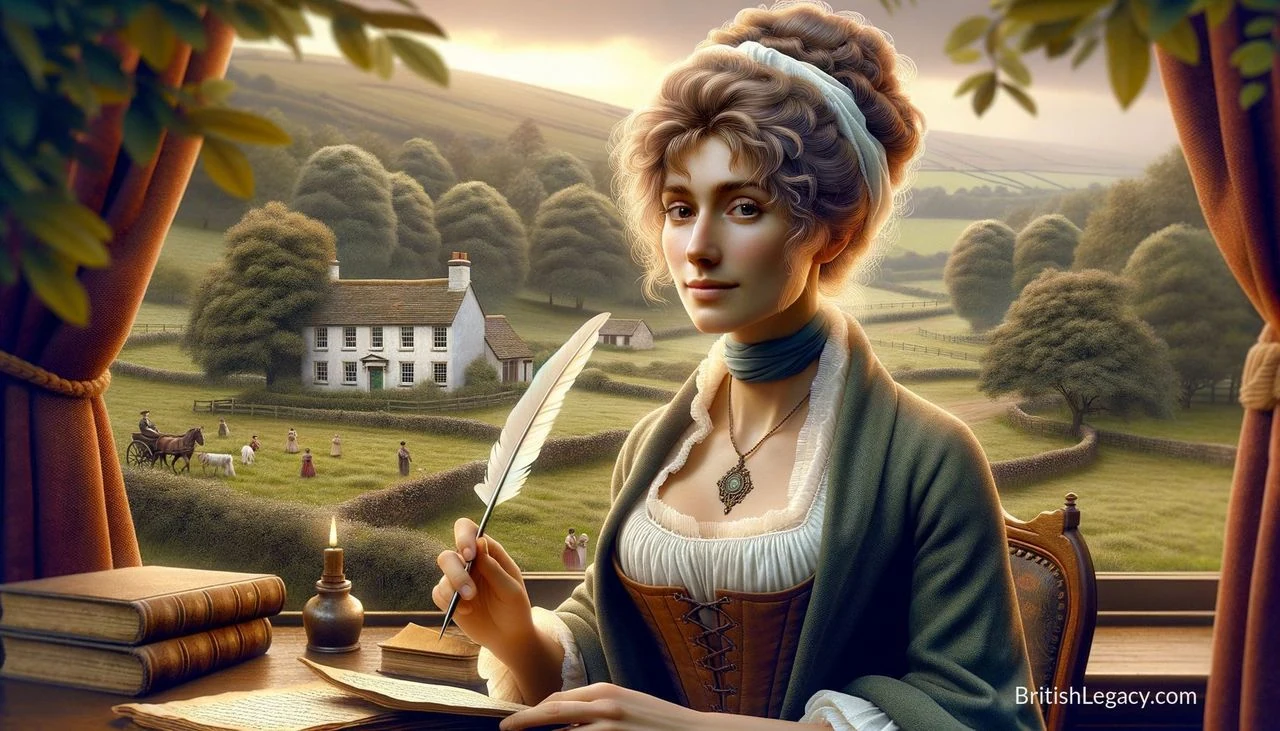
Hannah More built a literary career among the celebrated writers of her day, then put her writing to work in the service of religious and social causes. Her plays brought her into London’s literary circles; later, her Cheap Repository Tracts reached readers on a large scale, while schools she established with her sister Martha served poor children in Somerset. Her work combined education and philanthropy with a conservative moral outlook that sharply limited what she believed poor people and women should be taught.
Learning and literary beginnings
More was born on 2 February 1745 at Fishponds, in the parish of Stapleton near Bristol. She was the fourth of five daughters of Jacob More, a schoolmaster. Her father taught the sisters Latin and mathematics; Hannah also learnt French from her older sisters. In 1758, Jacob established a girls’ boarding school in Bristol, run by his elder daughters Mary and Elizabeth. Hannah became a pupil there at 12 and later taught at the school.
Her first literary work was The Search after Happiness, a verse drama written for young women to perform while she was still teaching. Her play The Inflexible Captive, published in 1774, drew on an opera by the Italian poet Pietro Metastasio. During visits to London, More made connections with figures including Samuel Johnson, Joshua Reynolds and Edmund Burke. David Garrick helped her into theatrical circles: his prologue and epilogue accompanied Percy, which succeeded at Covent Garden in 1777 and was revived in 1785.
More also joined the Bluestocking circle, whose members pursued literary and intellectual conversation. She wrote The Bas Bleu as a poetic celebration of her friends. Her literary life had its disappointments: after the death of Garrick and the poor reception of her final play, The Fatal Falsehood, she became disillusioned with the theatre. A difficult dispute also followed her efforts to help the poet Ann Yearsley, whom she supported when Yearsley was destitute.
Faith, abolition and public argument
From the 1780s, More’s writing increasingly reflected evangelical religious concerns. She became close to William Wilberforce and Zachary Macaulay, and joined a network of abolitionists that included the Bishop of London, Beilby Porteus. More wrote the poem Slavery in 1788. Her role in the cause was part of a wider circle of activity against the Atlantic slave trade, rather than a campaign conducted by her alone.
More was also a forceful participant in arguments about the French Revolution and political change. In Village Politics (1792), published under the name Will Chip, two village characters debate the ideas associated with Thomas Paine’s Rights of Man. The dialogue defends the British constitution and attacks the French Revolution. Its purpose was not politically neutral education: More wanted to counter arguments she considered dangerous and to uphold established religious and political values.
Her best-known publishing project grew out of a similar concern. From 1795 to 1798, the Cheap Repository issued three tracts a month on moral, religious and political subjects. The publications offered a more entertaining alternative to cheap popular literature that More and her allies feared would encourage irreligion. Their reach was substantial: the Wikipedia account reports sales of more than two million copies by March 1796. The Shepherd of Salisbury Plain, about a family presented as frugal and contented, became one of the best-known titles. The tracts were also reprinted in Ireland.
Schools and the limits of her educational vision
With encouragement from Wilberforce, More and her sister Martha founded schools for poor children in rural Somerset from the 1780s. They taught the Bible and catechism on Sundays and, during the week, practical work intended to prepare pupils for domestic service. More believed the poor should learn to read, but not to write. She explicitly opposed educating them as “scholars and philosophers”. This restriction is important to understanding her educational work: she created opportunities for instruction while seeking to keep education within the social roles she thought proper.
The schools faced local opposition. Some Church of England clergy suspected that More was promoting Methodism, while some landowners resisted even basic literacy for poor children. More defended her approach as a means of encouraging industry and piety. Her views on women’s education were also bounded by the conventions she upheld. In Strictures on the Modern System of Female Education (1799), she criticised the education given to fashionable women and called for a more serious curriculum, but she rejected arguments for women’s political equality and did not support unrestricted education.
More continued writing on religious and moral subjects after settling in Somerset. Among her works were Coelebs in Search of a Wife (1809), Practical Piety (1811) and Christian Morals (1813). She also helped others beyond her schools: in 1820 she gave money to Philander Chase, the first Episcopal Bishop of Ohio, towards the foundation of Kenyon College.
Final years and remembrance
More moved to Wrington in 1802, after spending time in Bath, and later lived in Clifton. She died there on 7 September 1833, aged 88. Her will left about £30,000, chiefly to charitable institutions and religious societies, with the residue intended for a new church in Bristol. She was buried beside her sisters at All Saints’ Church, Wrington.
Her memory has remained visible in places connected with her life. Schools have been named after her, and her image appeared on the Bristol Pound in 2012. These commemorations sit alongside a more contested literary reputation: More’s commitment to helping the poor existed alongside firm restrictions on their education, and her support for women’s learning did not extend to political equality.
Why Hannah More deserves a place in British Legacy
Hannah More’s place in British history rests on the unusual breadth of her activity. She began as a teacher and playwright, entered influential literary circles, and then used publication as a means of reaching readers beyond the theatre and elite salons. The Cheap Repository Tracts demonstrate the scale that a coordinated print campaign could achieve in the late eighteenth century: they carried moral and political arguments to a large audience and were reproduced beyond England. Her poem on slavery and her connections with abolitionists also place her within Britain’s organised opposition to the Atlantic slave trade.
Her schools made education a practical part of her philanthropy in rural Somerset, but the limits she imposed matter as much as the provision itself. More offered poor children reading, religious instruction and training for service while refusing to teach them writing; her advocacy of a more serious education for women coexisted with opposition to their political equality. That tension makes her legacy more revealing, not less. She shows how education and reform could expand within boundaries set by class, gender and religious conviction. For British Legacy, her story connects literature, schooling, philanthropy and abolitionist networks, while preserving the contradictions that shaped her influence.
Sources
Hannah More — Wikipedia revision 1372992813
Adapted in part from Hannah More by Wikipedia contributors, under CC BY-SA 4.0. Text has been edited and combined with the existing article; this adapted text is shared under the same licence. Contributor history.