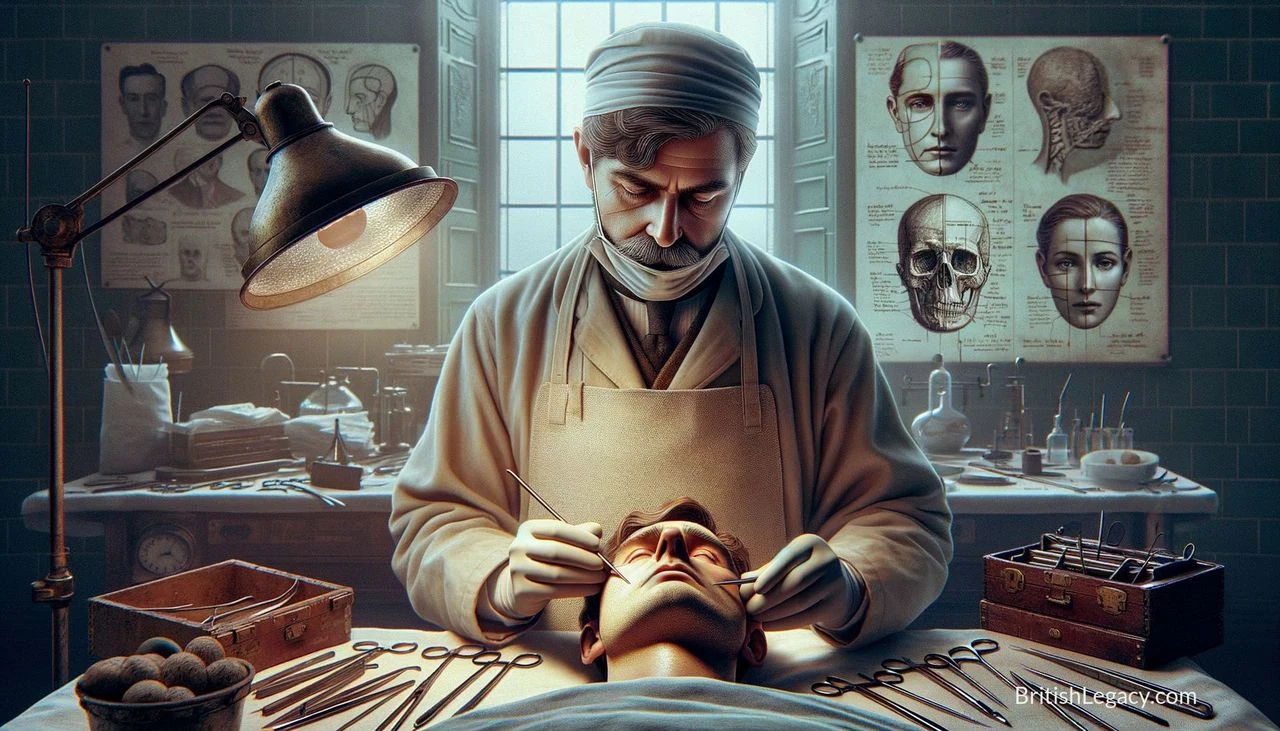
When wounded soldiers returned from the First World War with devastating facial injuries, the treatments available to them were not equal to the task. Harold Gillies helped build a new response: a hospital devoted to facial repair, teams combining surgical and other skills, and techniques for reconstructing damaged faces. At Queen’s Hospital in Sidcup, Gillies and his colleagues performed thousands of operations. His influence continued through private practice, wartime surgical services and the doctors he trained.
From Dunedin to medicine in Britain
Harold Delf Gillies was born in Dunedin, New Zealand, on 17 June 1882. He attended Whanganui Collegiate School before studying medicine at Gonville and Caius College, Cambridge. He went on to St Bartholomew’s Hospital in London, where he won the Luther Holden Research Scholarship in 1910 and lectured on plastic surgery. He had trained as an otolaryngologist, a specialist in conditions of the ear, nose and throat, before the First World War redirected his work.
Gillies was also an accomplished sportsman at Cambridge: he gained a golf blue in 1903, 1904 and 1905, and rowed in the 1904 Boat Race. These details belong to the life of a doctor whose professional reputation would come to rest not on sport but on the demanding work of repairing severe injuries.
War injuries and a new hospital
After the outbreak of war, Gillies joined the Royal Army Medical Corps. His early posting was to Wimereux, near Boulogne, where he worked alongside the French-American dentist Auguste Charles Valadier. Valadier was exploring ways to repair jaws, and Gillies saw the potential of emerging skin-grafting techniques. He later travelled to Paris to meet the oral surgeon Hippolyte Morestin. Watching Morestin remove a facial tumour and cover the wound with skin taken from the patient helped strengthen Gillies’s interest in reconstructive work.
Back in England, Gillies persuaded the army’s chief surgeon, William Arbuthnot-Lane, to establish a ward for facial injuries at the Cambridge Military Hospital in Aldershot. The ward could not meet the growing need. A hospital dedicated to facial repairs was therefore developed at Sidcup: the Queen’s Hospital opened in June 1917, with convalescent units providing more than 1,000 beds.
The scale of the work was substantial. Gillies and his colleagues developed techniques for plastic surgery there, carrying out more than 11,000 operations on over 5,000 men. Reconstructing a face involved more than a single procedure or practitioner. The work drew on surgical expertise and cooperation across disciplines, while the patients’ recovery extended beyond the operating theatre.
Reconstruction, teaching and further work
Gillies became particularly associated with the tubed pedicle flap, a method for transferring living tissue to repair extensive facial injuries. The technique formed part of a wider body of reconstructive work developed at Sidcup. The existing account also describes collaboration with dentists, sculptors and artists; the practical significance is clear in the nature of the task, which required careful attention to both the form and function of the face.
For his wartime service, Gillies was appointed an Officer of the Order of the British Empire in 1919 and promoted to Commander the following year. He was knighted in the 1930 Birthday Honours. Between the wars he built a substantial private practice with Rainsford Mowlem, treated well-known patients and travelled to lecture and teach. He also helped shape the career of his cousin Archibald McIndoe, inviting him to join the practice in 1930 and encouraging him to apply for a post at St Bartholomew’s Hospital.
During the Second World War, Gillies advised the Ministry of Health, the Royal Air Force and the Admiralty. He organised plastic-surgery units in different parts of Britain and encouraged colleagues to establish others. He continued operating at Rooksdown House, part of Park Prewett Hospital in Basingstoke, and trained doctors from Commonwealth countries during and after the war. His influence thus travelled through institutions and professional teaching as well as through the procedures associated with his name.
Work beyond wartime facial repair
Gillies’s career did not end with the First World War or with facial reconstruction. In 1946, he and a colleague performed one of the first male gender-affirming operations, on Michael Dillon. In 1951, Gillies and colleagues operated on Roberta Cowell in one of the first modern female gender-affirming surgical procedures. The work used a flap technique that became standard for 40 years.
Gillies continued to work into old age. On 3 August 1960, while undertaking a major operation on the damaged leg of an 18-year-old girl, he suffered a cerebral thrombosis. He died on 10 September at the London Clinic in Marylebone, aged 78. His working life had spanned the development of reconstructive surgery from an emerging response to wartime injuries into a field practised, taught and adapted in Britain and beyond.
Why Harold Gillies deserves a place in British Legacy
Gillies’s place in British Legacy rests on specific work carried out in British hospitals and medical institutions. At Aldershot, he argued for a dedicated ward for facial injuries; when that provision proved insufficient, the Queen’s Hospital at Sidcup opened in 1917. There, more than 5,000 men underwent over 11,000 operations by Gillies and his colleagues. The achievement was not a single celebrated technique in isolation. It was the development of a sustained clinical response to injuries that existing arrangements could not adequately address, supported by specialist teams and a hospital with extensive convalescent provision.
His wider contribution came through teaching, organisation and the continuity of surgical care. He established units during the Second World War, advised national services, trained doctors from Commonwealth countries and helped bring Archibald McIndoe into plastic surgery. His work also extended into gender-affirming operations, including procedures on Michael Dillon and Roberta Cowell. Gillies was born in New Zealand, so his British connection is not a matter of birthplace: it lies in his education, professional work and the services he helped develop in Britain. Together, those contributions show how British medical institutions became centres for new techniques and for training practitioners who carried them further.
Sources
Harold Gillies — revision 1372350635
Adapted in part from Harold Gillies by Wikipedia contributors, under CC BY-SA 4.0. Text has been edited and combined with the existing article; this adapted text is shared under the same licence. Contributor history.