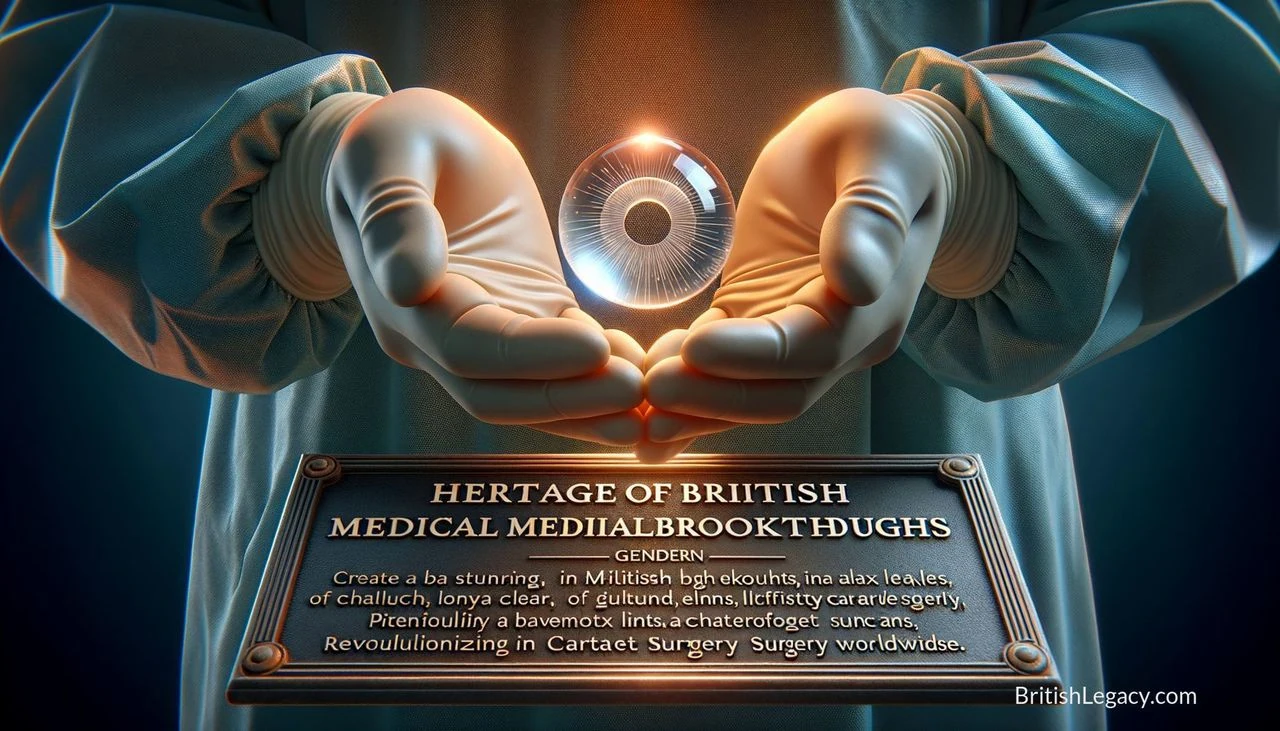
On 29 November 1949, at St Thomas’ Hospital in London, ophthalmologist Harold Ridley implanted an artificial lens in a patient’s eye. The idea had grown from an observation made during the Second World War: fragments of acrylic aircraft canopy could remain in injured pilots’ eyes without provoking the inflammatory reaction that glass caused. Ridley reasoned that a related material might be suitable for an implant. His first operation began a difficult chapter in eye surgery, and a new way to help people see after cataract removal.
Training in London and Cambridge
Nicholas Harold Lloyd Ridley was born on 10 July 1906 in Kibworth Harcourt, Leicestershire. Known from childhood by his middle name, he was the elder son of Nicholas Charles Ridley and Margaret Parker. He attended Charterhouse School, then studied at Pembroke College, Cambridge, from 1924 to 1927. He completed his medical training at St Thomas’ Hospital in 1930.
Ridley became an ophthalmic surgeon, working at St Thomas’ and Moorfields Eye Hospital in London. In 1938 he was appointed a full surgeon and consultant at Moorfields; he became a consultant surgeon there in 1946. The clinical work that shaped his later invention was part of a broader career in eye care and research.
Wartime observations and research
During the early years of the war, Ridley worked in civilian hospital services in south-east England, treating injured pilots. Later he served with the Royal Army Medical Corps, including postings to West Africa and south-east Asia. Accounts of his work during the war describe research as well as clinical practice.
In 1944, while stationed in the Gold Coast, now Ghana, Ridley travelled inland to investigate onchocerciasis, or river blindness. He examined patients in Funsi using a slit lamp powered by two car batteries. He recorded the effects of the disease through observation, photography and watercolour painting. His 1945 monograph, Ocular Onchocerciasis, drew attention to the condition and became an important contribution to ophthalmology.
Ridley also wrote about eye injuries caused by spitting snakes. After his transfer to India and Burma, he studied nutritional amblyopia among malnourished former prisoners of war. He treated patients whose sight had been affected by severe deprivation, observing that some improved after returning to a normal, vitamin-rich diet. These investigations show the range of his wartime medical work beyond the insight that led to the intraocular lens.
From acrylic fragments to an artificial lens
Ridley’s wartime experience included treating Royal Air Force casualties whose eyes had been injured by acrylic plastic from aircraft canopies. Unlike glass, the acrylic fragments did not provoke the same inflammatory rejection. The observation was not his alone: other ophthalmologists had reported on the body’s response to the material, and acrylic was already being used in other ophthalmic applications. Ridley’s distinctive step was to consider placing an artificial lens inside the eye after cataract surgery.
In the autumn of 1949, after a medical student asked whether he would insert a lens following a cataract operation, Ridley began working on the idea. He used an acrylic material called Transpex I, which had already been used for optical devices, spectacles and contact lenses. The first intraocular lens was manufactured by Rayner.
Ridley performed the first implant at St Thomas’ on 29 November 1949. That first lens was not left permanently in place; he did so for the first time on 8 February 1950. The distinction matters: the procedure began with a trial of the concept, while the later operation established that an artificial lens could remain in the eye. The first implant’s optical power was not correctly matched to that of the human lens, and the patient’s resulting vision was highly short-sighted. Early surgery also encountered problems, including inflammation associated with the antiseptic used to sterilise the lenses.
Resistance, collaboration and wider adoption
Putting a foreign object inside the eye was controversial. Many in the medical profession doubted the safety of intraocular lenses, and Ridley’s proposal met prolonged opposition. The idea did not pass straight from a successful first operation to routine practice. Materials, lens design and surgical methods needed further development, and surgeons had to learn from early complications.
In 1952, a Rayner–Ridley lens was implanted in the United States, at Wills Eye Hospital in Philadelphia. In 1966, Ridley and Peter Choyce founded the Intra-Ocular Implant Club to encourage research and open exchange about lens implantation and surgical techniques. Its membership was international from the outset; in 1975 it adopted the name International Intra-Ocular Implant Club. In the decades after Ridley’s first operation, improvements helped intraocular lenses gain wider acceptance. In the United States, the Food and Drug Administration approved them as safe and effective in 1981.
Ridley retired from NHS hospital service in 1971. In the 1990s, he underwent intraocular lens surgery himself at St Thomas’, the hospital where he had carried out the first implant. The operation allowed him to benefit from the procedure he had pioneered. He died on 25 May 2001, aged 94, and was buried at St Mary’s Church, Swinstead, Lincolnshire.
A lasting commitment to eye care
The intraocular lens was not Ridley’s only effort to improve eye health. In 1967 he established the Ridley Eye Foundation to raise funds for cataract operations in developing countries and to address avoidable blindness. The foundation continues this work, with a particular focus on the Middle East. His wartime study of river blindness, his research into nutritional amblyopia and his later work on lens implantation reflect a career spanning different causes of visual impairment and different ways to tackle them.
Ridley was elected a Fellow of the Royal Society in 1986. He received the Gullstrand Medal in 1992 and the Gonin Medal in 1994. In the New Year Honours announced in 1999, he was named a Knight Bachelor for pioneering services to cataract surgery; he was knighted at Buckingham Palace in February 2000. Commemorations include a plaque at St Thomas’ Hospital, a Royal Mail stamp issued in 2010 featuring artificial lens implant surgery, and a heritage blue plaque installed in Kibworth Harcourt in 2012.
Why Harold Ridley deserves a place in British Legacy
Ridley’s place in British Legacy rests on a specific medical achievement: he turned an observation from wartime eye injuries into a new surgical possibility. He recognised that acrylic fragments behaved differently from glass in the eye, then asked whether that property could serve a therapeutic purpose. His first intraocular lens implant at St Thomas’ in 1949 was not a finished solution; early optical shortcomings and complications underline the distance between an ingenious idea and a dependable treatment. Ridley’s importance lies in beginning that work and pursuing it through years of professional scepticism.
The impact of his career also reaches beyond the invention itself. The International Intra-Ocular Implant Club helped create a forum for the exchange of research and surgical techniques, while the Ridley Eye Foundation supported cataract surgery and efforts to prevent avoidable blindness. His investigations into river blindness and nutritional amblyopia show a wider concern with conditions that could take or damage sight. Those are concrete connections between British medical practice and benefits extending well beyond Britain: work carried out in London hospitals, wartime service overseas, and institutions created to advance eye care. Ridley’s story belongs in a British legacy not as a tale of instant triumph, but as an account of observation, experiment and persistence that helped reshape cataract surgery.
Sources
Harold Ridley (ophthalmologist), revision 1379003669
Adapted in part from Harold Ridley (ophthalmologist) by Wikipedia contributors, under CC BY-SA 4.0. Text has been edited and combined with the existing article; this adapted text is shared under the same licence. Contributor history.