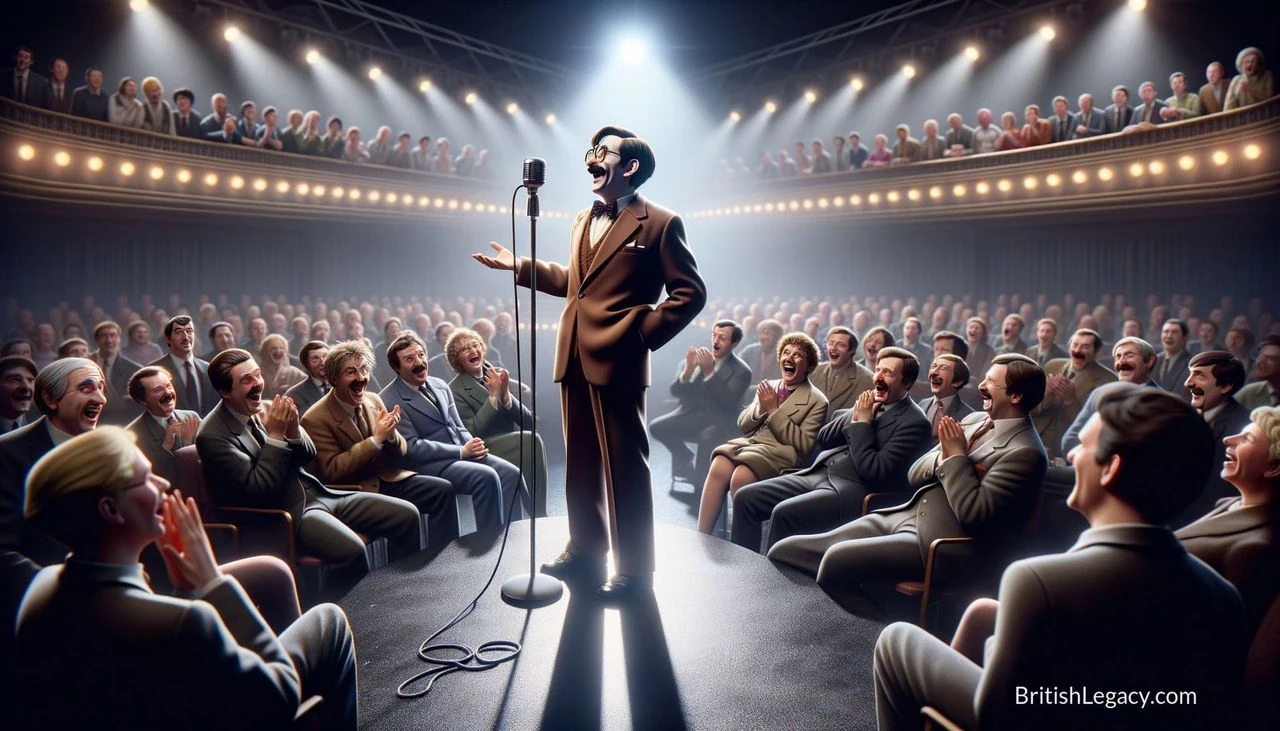
Harry Enfield’s comedy often begins with a recognisable type and pushes it until its assumptions become impossible to miss. A plasterer boasting about his earnings, a teenager furious with the world, a complacent young gentleman: his characters turn social attitudes into voices, gestures and catchphrases. Enfield is an English comedy actor and writer whose television work includes Harry Enfield’s Television Programme, Harry Enfield & Chums and, with Paul Whitehouse, Harry & Paul.
Finding a route into comedy
Born Henry Richard Enfield in Horsham, Sussex, on 30 May 1961, he grew up in Billingshurst. His father, Edward Enfield, was a journalist and presenter. Enfield attended several schools, including Dorset House and Worth School, before studying politics at the University of York. After university he spent time squatting in Hackney and working as a milkman.
His comedy career began with writing: after being recruited at the Edinburgh Fringe Festival, he wrote three episodes of the BBC Radio 4 programme Week Ending in 1982–83. In 1985 he took a voice-acting role in the satirical television puppet show Spitting Image. He reached a wider audience on Channel 4’s Saturday Live from 1986 to 1988, appearing in characters developed with Paul Whitehouse. Stavros, a Greek kebab-shop owner speaking fractured English, and Loadsamoney, an obnoxious plasterer boasting about his income, helped establish the partnership’s comic approach.
Loadsamoney was more than a catchphrase. The character was created in reaction to the policies of Margaret Thatcher’s government, and his conspicuous celebration of cash made him a pointed comic figure of the period. The character also escaped the sketches: a single, “Loadsamoney (Doin’ Up the House)”, reached number four in the UK chart in 1988, and Enfield took the act on a sell-out live tour. Enfield and Whitehouse later created Bugger-All-Money as a foil. They became concerned that audiences were reading Loadsamoney as a positive figure, rather than a satire; in a Comic Relief appearance, he was run over after presenting Lenny Henry with an enormous cheque for ten pence.
Building a television ensemble
In 1990, Enfield developed the BBC sketch show Harry Enfield’s Television Programme with Whitehouse and Kathy Burke. It was later retitled Harry Enfield & Chums. The shows brought together an expanding group of recurring characters, among them the Old Gits, Tim Nice-But-Dim, the Scousers, Smashie and Nicey, Wayne and Waynetta Slob, Mr You-Don’t-Wanna-Do-It-Like-That, and Mr Cholmondley-Warner and Grayson. Kevin the Teenager began as the Annoying Kid Brother and grew into one of Enfield’s best-known creations.
The sketches drew on familiar television and comedy traditions rather than the alternative style then prevalent. Their recognisable figures could be broad, but the humour depended on detail: speech patterns, social mannerisms and the confidence with which each character misunderstood the world around them. The format also gave Enfield and his collaborators room to return to a character and develop its comic premise across sketches, rather than relying on a single impression.
Enfield continued to work in several formats. He played Dirk Gently in BBC radio adaptations of Douglas Adams’s Dirk Gently’s Holistic Detective Agency in 1986–87, and in 1989 starred in Norbert Smith – A Life, a spoof of theatrical knights taking smaller roles in film. His acting work included the series Gone to the Dogs in 1991 and Celeb in 2002. He also fronted a Channel 4 documentary series about opera, a subject he has described himself as a fan of.
Partnerships, acting and directing
Enfield’s collaboration with Whitehouse continued in Harry & Paul, first broadcast in 2007 as Ruddy Hell! It’s Harry & Paul. They performed in and directed the series. Their work received the 2009 BAFTA Television Award for Best Comedy Programme, and the show also won a British Comedy Award for Best Sketch Show that year. The partnership’s longevity was celebrated in 2015 with An Evening With Harry Enfield and Paul Whitehouse, marking 25 years of working together.
In 2000 Enfield took the lead in Kevin & Perry Go Large, reprising Kevin opposite Kathy Burke as Perry. The film followed the pair’s attempts to become professional DJs in Ibiza. Other film roles included King George VI in the satire Churchill: The Hollywood Years (2004), Martin in The Bad Education Movie (2015), and Mr Jackson in the BBC adaptation of Swallows and Amazons (2016). He also played John Shakespeare in the sitcom Upstart Crow.
From 2016 Enfield portrayed Prince Charles, later King Charles III, in Channel 4’s The Windsors. The role brought a 2017 BAFTA Television Award nomination for Best Male Comedy Performance. His other television appearances have included Martin, the father of Jack Whitehall’s character, in Bad Education, and Jim Stonem in Skins; Enfield also directed two episodes of the latter. In 2021 he played Prince Charles in the stage production The Windsors: Endgame at London’s Prince of Wales Theatre.
Recognition and a continuing career
Enfield’s awards include a Writers’ Guild of Great Britain award for television light entertainment in 1995, shared for Harry Enfield and Chums, and the 2009 BAFTA and British Comedy Award wins for Harry & Paul. He has also received nominations for his performances and writing across television. These recognitions span both his work as a performer and the collaborative nature of sketch comedy, in which characters and programmes are made with writers and fellow performers.
His career has continued across television, film, music and live performance. He appeared as Tony Blair in the television musical comedy Prince Andrew: The Musical in 2022. In 2025 he featured in Ego Death, a film of interconnected music videos accompanying an album by Jazz Emu, and launched the theatrical tour Harry Enfield and No Chums. Enfield married Lucy Lyster in 1997; they have three children, and the couple separated in 2020.
Why Harry Enfield deserves a place in British Legacy
Harry Enfield’s place in British cultural history rests on the precision and reach of his character comedy. Loadsamoney gave a comic form to conspicuous wealth and the politics of the 1980s; Kevin the Teenager made adolescent self-absorption a recurring television performance; and characters such as Tim Nice-But-Dim and the Slobs drew humour from recognisable social types. These creations were not simply catchphrases. Their repeated appearances let audiences recognise the attitudes being satirised and see how a comic stereotype could carry a social observation.
His work also records the value of sustained creative partnership. From the characters made with Paul Whitehouse on Saturday Live to their later BBC sketch programmes, Enfield’s career shows how performers can build a shared comic language over decades. He has moved between writing, acting, directing, radio, film and the stage, while continuing to return to the forms and characters that first brought him to public attention. The significance of that work is specific to British television comedy: it turned familiar accents, class signals and everyday behaviours into material for popular satire, without abandoning the broad entertainment of a sketch show. Enfield’s characters remain a way of recalling how comedy can reflect the moment in which it was made and make its assumptions visible.
Sources
Adapted in part from Harry Enfield by Wikipedia contributors, under CC BY-SA 4.0. Text has been edited and combined with the existing article; this adapted text is shared under the same licence. Contributor history.