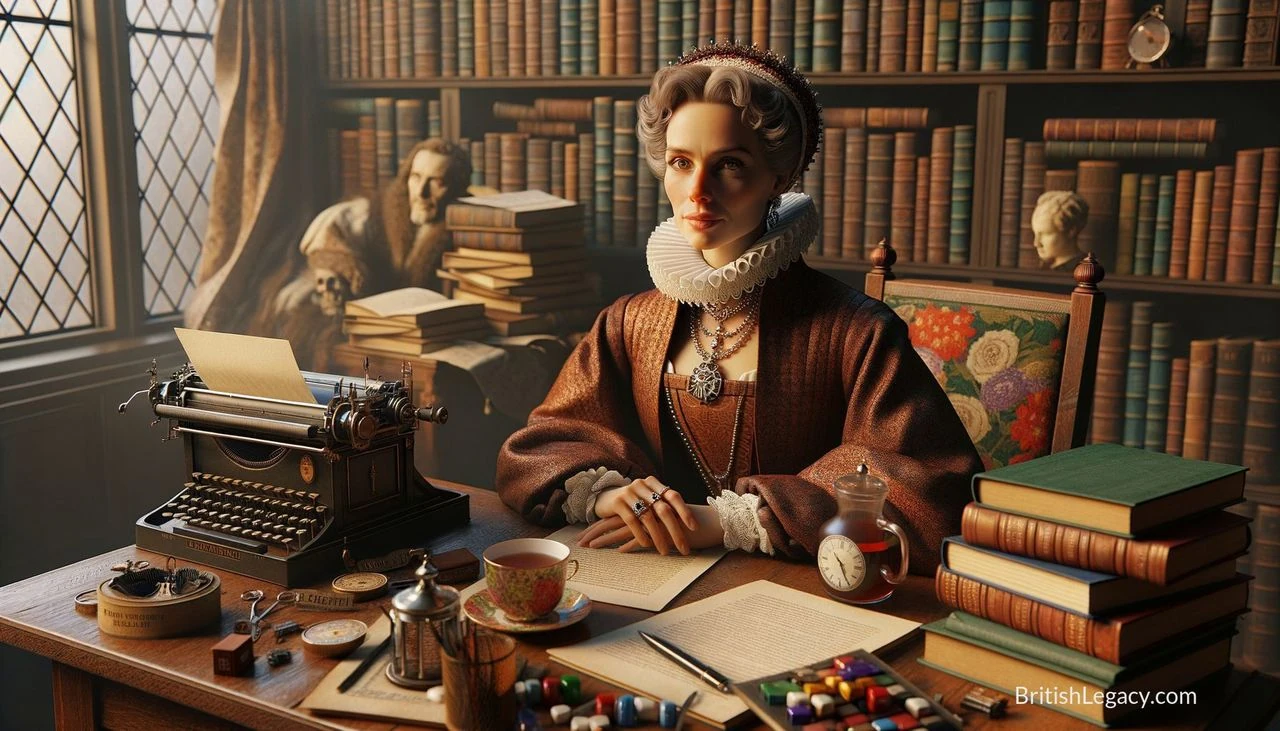
Hilary Mantel changed the scale and perspective of historical fiction. In Wolf Hall, she brought Thomas Cromwell—Henry VIII’s minister, often cast as a hard-edged political operator—close to the reader, rendering the past through the shifting calculations and private understanding of one of its most powerful figures. The novel won the Booker Prize in 2009. Its sequel, Bring Up the Bodies, won the prize again in 2012, making Mantel the first woman and the first British writer to win it twice. The books formed the centre of a career that ranged from novels and short stories to memoir, criticism and public lectures.
From Glossop to a life in writing
Mantel was born Hilary Mary Thompson in Glossop, Derbyshire, on 6 July 1952. She grew up in the mill village of Hadfield and attended St Charles Roman Catholic Primary School before moving with her family to Romiley, Cheshire, where she went to Harrytown Convent. She began studying law at the London School of Economics in 1970, then transferred to the University of Sheffield and graduated in 1973 with a Bachelor of Jurisprudence.
After university, she worked in the social work department of a geriatric hospital and as a sales assistant at Kendals in Manchester. She married geologist Gerald McEwen in 1973. A novel about the French Revolution that she began the following year could not find a publisher; it eventually appeared in 1992 as A Place of Greater Safety. In 1977, she moved with McEwen to Botswana. They later spent four years in Jeddah, Saudi Arabia, experiences she drew on in writing about life abroad.
Mantel’s first published novel, Every Day Is Mother’s Day, appeared in 1985, followed a year later by Vacant Possession. After returning to England, she worked as film critic for The Spectator from 1987 to 1991 and reviewed books and other subjects for publications in Britain and the United States. Her work during this period already showed the range she would sustain: domestic fiction, historical subjects and writing informed by her own experience.
Fiction beyond the Tudor court
Before the Cromwell novels, Mantel had established a body of work that resisted a single label. Eight Months on Ghazzah Street (1988), drawing on her time in Saudi Arabia, explores tensions between neighbours and the values they bring to life in a city apartment block. Fludd (1989), set in a fictional northern village in 1956, centres on a Roman Catholic church and convent. It won the Winifred Holtby Memorial Prize.
A Place of Greater Safety takes a large historical canvas, following the French revolutionaries Danton, Robespierre and Camille Desmoulins from childhood to their deaths during the Reign of Terror. Later novels turned to other settings and preoccupations. An Experiment in Love (1995) follows three young women at university in London; it won the Hawthornden Prize. The Giant, O’Brien (1998) reworks the story of Charles Byrne and the surgeon John Hunter, while Beyond Black (2005) follows a professional medium whose outward composure contrasts with the damage beneath it.
Mantel also published the memoir Giving Up the Ghost and the short-story collection Learning to Talk in 2003. Her writing about illness belongs to that broader account of her life and work, but it does not reduce the fiction to autobiography. She later said that pain had narrowed her options in life towards writing, and became patron of the Endometriosis SHE Trust.
The Cromwell trilogy
Wolf Hall appeared in 2009, presenting the rise of Thomas Cromwell at Henry VIII’s court. Mantel’s historical fiction did not simply retell events: it placed political manoeuvring alongside the mental work of interpreting motives, loyalties and danger. Cromwell is neither a remote emblem of power nor a simple villain. The novel invites readers to follow the world through his attention, without making that viewpoint an uncomplicated verdict on the man or his age.
The Booker judges chose Wolf Hall in 2009. Mantel followed it with Bring Up the Bodies in 2012, which won both the Booker Prize and the Costa Book of the Year. The second award made her the first author to win the Booker for a sequel; she was also the first woman and first British writer to win the Booker twice. The trilogy was completed with The Mirror & the Light in 2020, which was longlisted for that year’s Booker Prize. The three books went on to sell more than five million copies.
The novels travelled beyond the page. The Royal Shakespeare Company adapted the first two for the stage, and the books were made into a BBC television series. The adaptations extended the audience for Mantel’s Tudor world while keeping the novels’ central achievement in view: a historical figure could be made legible as a person shaped by, and acting upon, the pressures of his time.
Essays, public debate and later work
Mantel’s work as a critic and essayist continued alongside her fiction. She wrote reviews and essays for publications including The Guardian, the London Review of Books and the New York Review of Books. Her 2014 collection The Assassination of Margaret Thatcher brought together ten short stories, including its controversial title story. In 2017, she delivered the BBC Radio 4 Reith Lectures on historical fiction, including a lecture on adapting historical novels for stage and screen.
Her writing also entered public argument. An essay on royal women, “Royal Bodies”, prompted debate about the treatment of Catherine Middleton in public life. Mantel discussed her upbringing and changing religious beliefs in Giving Up the Ghost. These interventions sit alongside, rather than replace, the fiction: they show a writer prepared to examine the language and assumptions through which private lives become public subjects.
Mantel received the CBE in 2006 and was made a Dame Commander of the Order of the British Empire in 2014 for services to literature. Her awards included the David Cohen Prize in 2013 and the British Academy President’s Medal in 2016. She died in Exeter on 22 September 2022, aged 70, after complications from a stroke. At her death she had been working on a new novel and on a short non-fiction book about the Polish playwright Stanisława Przybyszewska; the latter was edited and published posthumously.
Why Hilary Mantel deserves a place in British Legacy
Mantel’s place in British literary history rests on more than the distinction of winning the Booker Prize twice. The Cromwell trilogy made a sustained historical narrative a major contemporary literary event: three novels, published across eleven years, followed one central figure through Henry VIII’s court and were read by millions. The first two books received stage adaptations by the Royal Shakespeare Company and a BBC television adaptation, carrying Mantel’s reimagining of Tudor politics into theatre and broadcasting. Her achievement was not simply to make the past vivid, but to make readers attend to how people interpret power, remember experience and act under pressure.
That accomplishment sits within a much wider contribution. Mantel wrote novels about modern life, revolution, religion, illness and social expectation; she published short stories and memoir, reviewed other writers’ work, and used the Reith Lectures to examine how historical fiction is made and adapted. Her career connected British universities, publishing, literary prizes, the stage and public-service broadcasting without being confined to any one of them. The success of the Cromwell books has helped keep Tudor history in public discussion, while the breadth of her other writing shows why her legacy cannot be reduced to a single historical character. Mantel left British readers a demanding, imaginative way to encounter the past—and a body of work that continues to reward attention.
Sources
Adapted in part from Hilary Mantel by Wikipedia contributors, under CC BY-SA 4.0. Text has been edited and combined with the existing article; this adapted text is shared under the same licence. Contributor history.