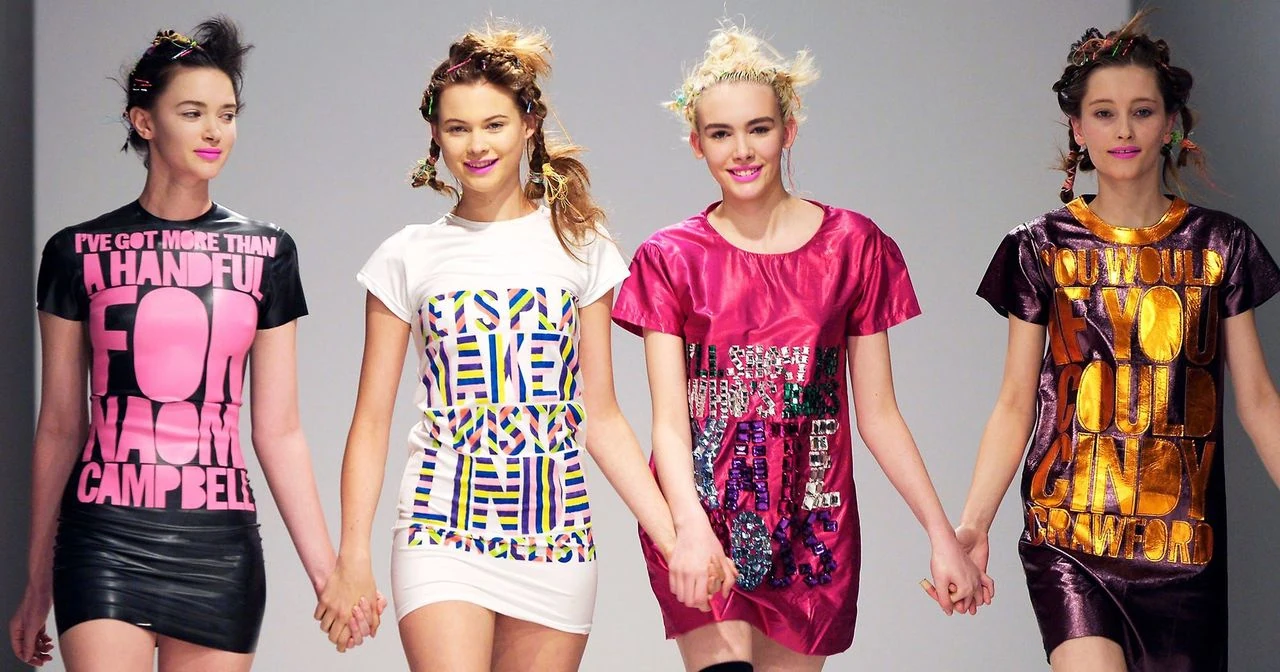
Henry Holland first attracted attention in fashion with T-shirts that made the clothes themselves the punchline. Their cheeky slogans drew on pop culture and the personalities around the London fashion scene. That early visibility led to a fuller career spanning his own fashion house, collaborations with retailers and eyewear brands, and appearances on television. Holland’s route into design was not a conventional one: he trained in journalism and worked on magazines before establishing himself as a fashion designer.
From Ramsbottom to fashion journalism
Holland was born on 26 May 1983 in Ramsbottom, Greater Manchester. He studied for a BA in Journalism at the London College of Communication and went on to work for the teenage magazine Sneak, in its fashion section, as well as Smash Hits and Bliss. That work placed him in the world of youth magazines and popular culture before his own name became familiar in fashion.
In 2006, his Fashion Groupies T-shirt designs brought him wider attention. They included the slogan “I’ll tell you who’s boss, Kate Moss”, a pointed, playful line that connected celebrity culture to fashion. In September that year, designs by Holland also appeared at the ends of two London Fashion Week runway shows. Gareth Pugh wore a shirt reading “Get Yer Freak on Giles Deacon” as he took his bow; later in the week, Giles Deacon wore one printed with “Uhu Gareth Pugh”. Holland had made his mark through clothes that turned fashion-world rivalries and personalities into wearable jokes.
Building House of Holland
The T-shirts preceded the establishment of Holland’s fashion house. He founded House of Holland in 2008, after gaining attention with the slogan designs, and went on to develop a full collection. The label became the setting for a broader approach to dressing: bold prints, vivid colour and unexpected combinations rather than an emphasis on restraint. The earlier account describes a visual vocabulary including tartan, polka dots, florals and slogans. Its clothes brought a playful, pop-cultural sensibility into collections shown under Holland’s own name.
His work also reached beyond the runway. In 2009, Levi Strauss & Co launched a denim collaboration with him. That September he agreed a deal with British retailer Debenhams to create H! by Henry Holland, a fashion line that went on sale in Debenhams stores from spring 2010. The arrangement brought his designs to a high-street audience, extending the label’s reach beyond fashion-week collections.
Other projects took different forms. For spring/summer 2010, Holland designed a pink wedding dress for the Los Angeles-based boutique REVOLVE Clothing, under the House of Holland label. In May 2012, a sunglasses collaboration with Le Specs was released as Henry Holland for Le Specs. Its styles included names such as “Muffin Top” and “Blinders”; the campaign featured Australian hip-hop artist and model Iggy Azalea. Later eyewear campaigns featured Ioanna Gika and model and actress Adwoa Aboah, with the latter collection including a design called “Cagefighters”.
Fashion, television and public profile
Holland’s work with models and performers formed part of his public profile. He was known for working with Agyness Deyn, whose name appeared in one of the early slogan designs. In February 2009, singer MIA wore a black-and-white polka-dot tulle mini-dress from House of Holland’s spring/summer 2009 collection to the 51st Grammy Awards while heavily pregnant. The garment brought one of the label’s designs into a prominent red-carpet setting.
Holland also worked in television. He co-presented the fashion and music series Frock Me on T4 in autumn 2008 and spring 2010, alongside Alexa Chung and Gemma Cairney. In 2012, he appeared as a judge on Sky Living’s fashion design programme Styled to Rock. The show gave unknown British designers the opportunity to create clothes for performers including Cheryl Cole, The Saturdays and Katy B. These appearances added a broadcast dimension to a career otherwise centred on fashion design, collaborations and the House of Holland label.
His projects could also take on a more elaborate, one-off form. To mark Magnum’s 25th birthday, Holland made a bespoke dress inspired by the 1960s, with a chocolate-crack effect created from layers of fabric and sequins. The work took more than three months to complete. Alongside commercial ranges and seasonal collections, it showed how his interest in humour and pop references could be expressed through a specially made garment.
A label in administration
On 5 March 2020, House of Holland was reported to have gone into administration. The announcement said that the company’s seven employees would be retained during the administration to assist with the process. That is a more precise account than saying that the label simply closed its doors: administration describes the company’s financial and legal position, not by itself the immediate end of every activity associated with the brand.
The distinction matters to the shape of Holland’s story. House of Holland had grown from a striking T-shirt idea into a fashion house with collections, retail partnerships and collaborations. The company’s difficulties are part of that commercial history, alongside the designs and public appearances that made its founder recognisable. They also place the label’s end in context without treating a bold visual identity as proof of unbroken commercial success.
Why Henry Holland deserves a place in British Legacy
Henry Holland deserves a place in British Legacy for turning a specific strand of British fashion culture—its magazines, runway personalities and appetite for irreverence—into a recognisable design language. The Fashion Groupies T-shirts were not simply slogans on garments: their jokes depended on knowing the people and rivalries of the fashion scene. Holland’s appearances at the ends of Gareth Pugh’s and Giles Deacon’s shows in 2006 made that exchange visible on the runway. He then built on the attention, founding House of Holland in 2008 and developing collections beyond the original T-shirt format.
His career also illustrates how a British designer can take ideas across different parts of the industry. The Debenhams line put H! by Henry Holland into a high-street retail setting; the Levi’s and Le Specs collaborations extended his work into denim and eyewear; and television introduced fashion design to audiences beyond the catwalk. These projects offer concrete examples of fashion’s reach as both creative work and public communication. The story is not one of uncomplicated triumph: House of Holland entered administration in 2020. Remembering both the label’s commercial ambition and its distinctive, playful designs gives a fuller account of Holland’s contribution to contemporary British fashion.
Sources
Henry Holland (fashion designer), revision 1341788502
Adapted in part from Henry Holland (fashion designer) by Wikipedia contributors, under CC BY-SA 4.0. Text has been edited and combined with the existing article; this adapted text is shared under the same licence. Contributor history.